

Here is the worry. You drive four hours, the telescope comes out, and your six-year-old looks for ninety seconds.
Then they want to know what is for dinner.
That does happen. Still, the honest answer is yes, with conditions. So this guide is about the conditions.
It covers the ages that work, what children actually respond to, and how to shape the night. Whether a stargazing trip worth it with kids depends almost entirely on planning, not on luck.
The Short Answer First
Yes, for most children over about five. Also yes for younger ones, if you change what you expect.

The trip works when the sky is one part of it. Then it fails when the sky is the only part.
So the real question is not whether children like stars. It is whether the rest of the trip holds up when the night does not cooperate.
Children respond strongly to three things. Scale, novelty, and being allowed to stay up late.
A dark sky delivers all three at once. That is why it lands even when they cannot name a single constellation.
Q: My child has a short attention span. Is it pointless?
A: No. Plan for ten good minutes rather than an hour. Most children give you more than that, but ten is the number you should build around.
What Works at Each Age
Ages are rough, and children vary. Still, the pattern is consistent enough to plan with.
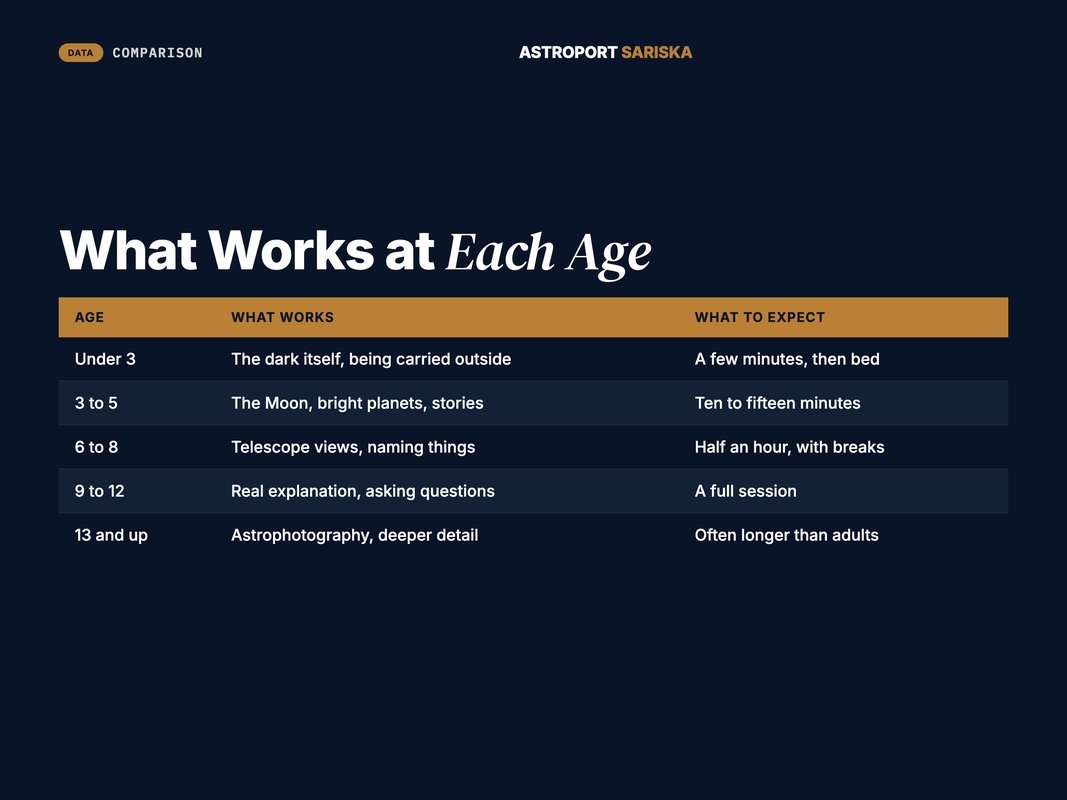
| Age | What works | What to expect |
|---|---|---|
| Under 3 | The dark itself, being carried outside | A few minutes, then bed. |
| Age 3 to 5 | The Moon, bright planets, stories | Ten to fifteen minutes. |
| Age 6 to 8 | Telescope views, naming things | Half an hour, with breaks. |
| Age 9 to 12 | Real explanation, asking questions | A full session. |
| Age 13 and up | Astrophotography, deeper detail | Often longer than adults. |
Look at the six-to-eight row. That is the age most parents underestimate.
Children that age are old enough to understand a simple explanation. Then they are young enough to find it genuinely amazing.
The Under-Fives
Do not build the evening around them. Instead, take them out, show them the Moon, and let that be enough.
Ten minutes of a small child pointing at the sky is a real memory. Also, it costs you nothing if it ends early.
Bring them out again briefly if they wake. Sometimes the second attempt works better than the first.
Also, carry them rather than asking them to walk. A sleepy toddler on a hip will look up happily for a few minutes.
Then take them straight back in. The aim is one good moment, not a full evening.
Timing helps with this age. A toddler brought out just after their normal bedtime is usually calm and curious.
Much later and they are simply tired. So the window is narrow, but it is real.
What Children Actually Respond To
Adults like faint things. Children like obvious ones.
So lead with the Moon. It is bright, detailed and instantly readable through any telescope.
Craters do the work here. A child who sees a crater edge for the first time usually reacts out loud.
Then move to planets. Saturn’s rings and Jupiter’s moons are the two reliable crowd-pleasers, because they look nothing like a dot of light (Source: NASA, 2026 — Jupiter Moons).
Jupiter’s four largest moons were first seen by Galileo in 1610 with an early telescope (Source: NASA, 2026 — Jupiter Moons). That story works well with children, because they can see the same thing he did.
Meteors are the other winner. They need no equipment, and the waiting becomes a game.
Lying down helps here. So bring a blanket, because a child on their back sees far more sky than one standing up.
Then count them out loud. Counting turns waiting into an activity, which is the whole trick.
What Does Not Land
Faint galaxies and nebulae mostly do not work. They look like smudges, and children say so honestly.
Also, long explanations lose them fast. Keep it to one fact per object.
So the rule is simple. Bright, obvious, and short.
There is one more reliable object. The International Space Station crosses the sky as a steady bright point. Children love that it has people on board.
It moves fast enough to be obviously artificial. So it needs no telescope and no patience at all.
Star colours work too. Point out that some stars look orange and others blue, then let them find more.
That turns looking up into a search rather than a lecture.
Quick Facts
- Jupiter has 115 moons recognised by the International Astronomical Union (Source: NASA, 2026 — Jupiter Moons). Its four largest show in a small telescope.
- Jupiter is the largest planet in the solar system, more than twice as massive as all the others combined (Source: NASA, 2026 — Jupiter).
- NASA runs a dedicated science-for-children resource, which is useful preparation before a trip (Source: NASA, 2026 — NASA Space Place).
- Natural darkness is managed as a protected resource because artificial light changes wildlife behaviour (Source: US National Park Service, 2026 — Night Skies).
Preparing Children Before You Go
A little preparation changes the night completely. So spend twenty minutes on it during the week.
Show them one picture of Saturn. Then tell them they will see the real thing, not a photo.
That framing matters. Children are used to screens, so the idea that the light is arriving directly is the part that impresses them.
Give them one job each. One holds the red torch. Another spots the first star. A third counts meteors.
Jobs prevent boredom better than facts do. Also, they stop siblings competing for the eyepiece.
Rotate the jobs each night. Then nobody feels stuck with the dull one.
Keep a small notebook too. Children like recording what they saw, and it gives the trip an ending they can keep.
Let them draw rather than write. A drawing of Saturn made at the eyepiece is the souvenir that survives.
Date the page. Then it becomes a record of a real night, not a craft project.
NASA keeps a science site written for children, which is useful preparation (Source: NASA, 2026 — NASA Space Place).
Set One Rule Before You Arrive
Agree the torch rule in the car. White light ruins night vision for everyone nearby.
So torches point down, and red light only once it is dark. Children follow this well when it is framed as being part of the team.
How to Shape the Night
Timing is where most family stargazing goes wrong. So work backwards from darkness, not from dinner.
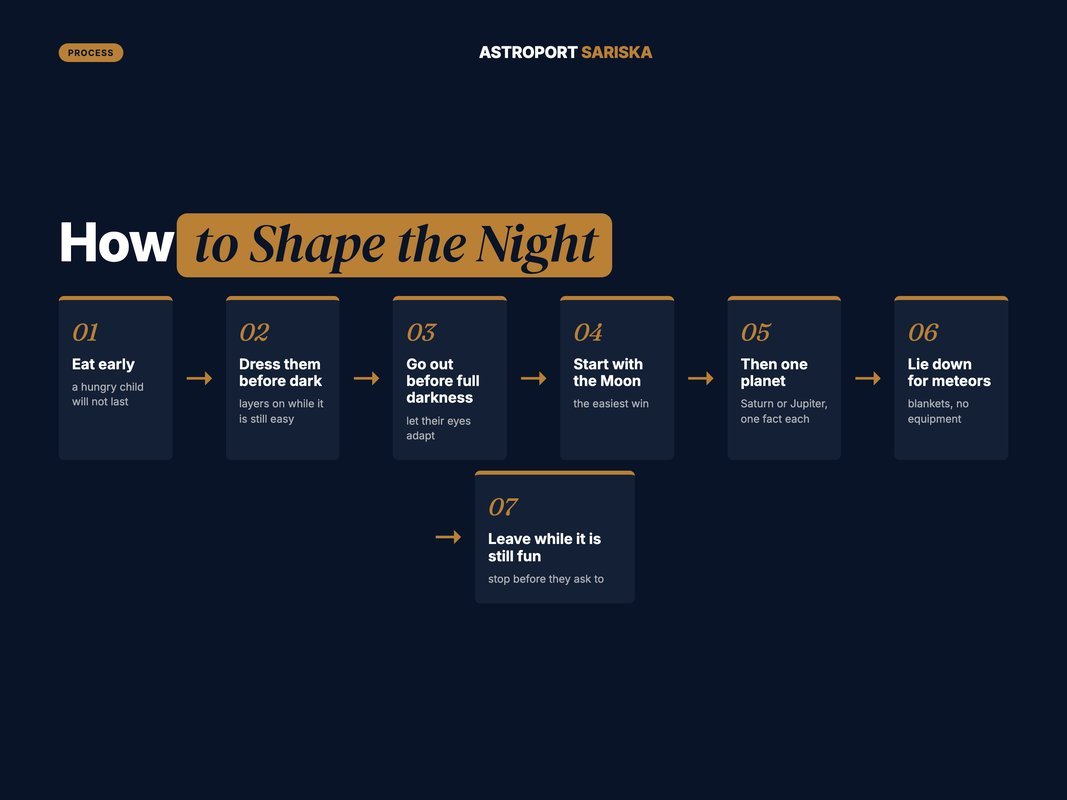
- Eat early. A hungry child will not last, and food after dark is a distraction.
- Dress them before dark. Layers on, while it is still warm and easy.
- Go out before full darkness. Let their eyes adapt as the sky changes.
- Start with the Moon. The easiest win, and it builds interest.
- Then one planet. Saturn or Jupiter, with one fact each.
- Lie down for meteors. Blankets on the ground, no equipment.
- Leave while it is still fun. Stop before they ask to stop.
Step seven matters more than the rest. Ending early leaves them wanting to come back.
Then the trip becomes something they ask to repeat.
The Cold Problem
Desert nights drop fast after sunset. So a warm afternoon tells you nothing about nine o’clock.
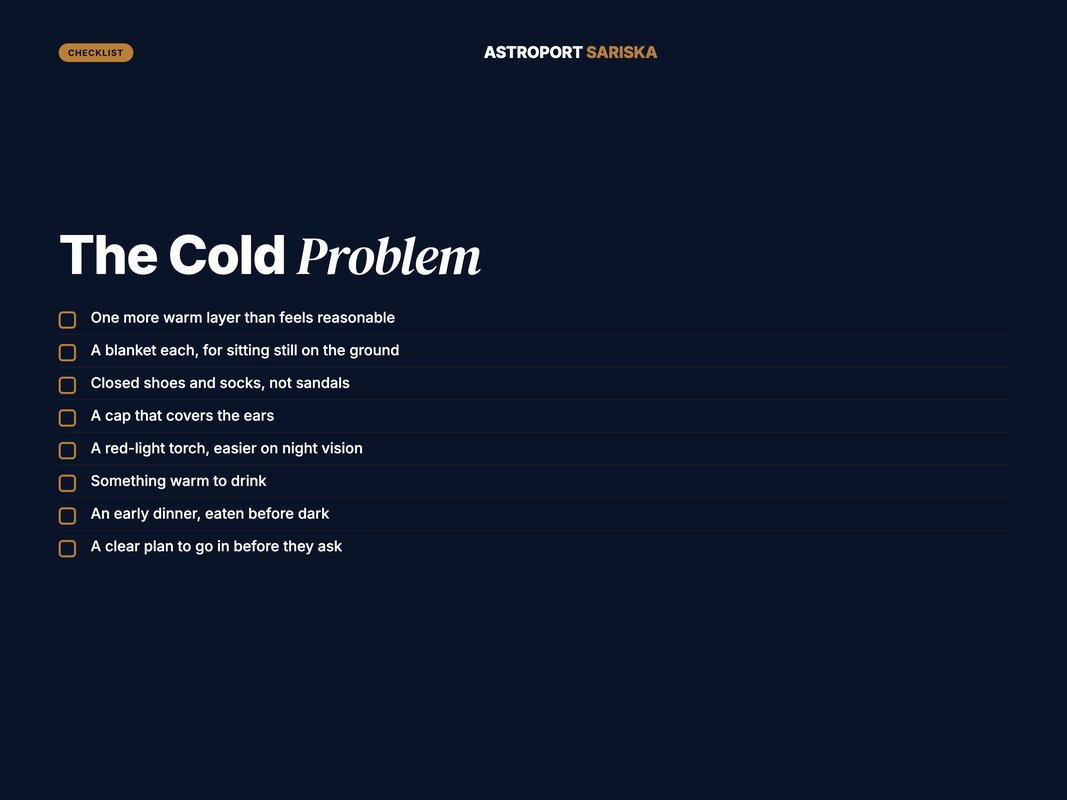
Cold is the most common reason a child goes inside. Therefore it is the easiest thing to fix.
Pack more layers than feels reasonable. Also bring a blanket each, because sitting still makes cold worse.
Make the Daytime Carry the Trip
This is the single most useful piece of advice here. Do not let the sky be the whole reason you came.
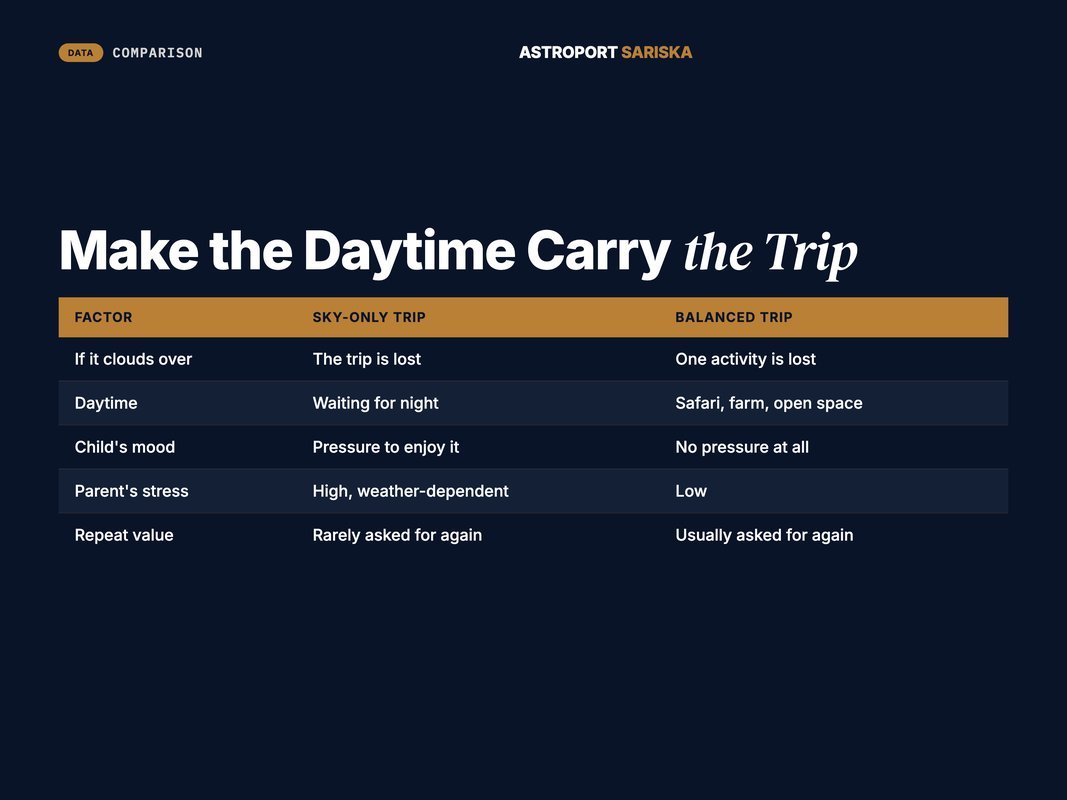
Clouds happen. Children get tired. Then the night simply does not deliver.
So pick a place where the day works on its own. A safari, open space to run, animals, a farm, a pool.
If the day stands up by itself, a cloudy night costs you one activity. Meanwhile, if the trip was only about stars, it costs you everything.
That balance is also why winter suits families. Full darkness arrives early enough that children can see a proper sky and still get to bed.
Q: Which season is best for a family trip?
A: October to March. Skies are clearer, nights start earlier, and the daytime heat is manageable for small children.
What to Do If It Clouds Over
Some nights simply do not work. So have a fallback ready rather than inventing one at nine o’clock.
Ask whether there is an indoor session. Many astronomy resorts run talks, meteorite handling or telescope demonstrations when the sky closes.
Then use the dark anyway. A cloudy night in open country is still far darker and quieter than home, and children notice that.
A night walk works well. Listening for animals is a genuine activity, not a consolation prize.
Failing all that, go to bed early and try the pre-dawn sky. Clouds often clear overnight, and the hour before sunrise is often the clearest of the trip.
Children wake more easily than parents expect. So a five-minute look before a safari can rescue the whole weekend.
Also, tell them the plan the night before. Then the early start feels like an adventure rather than a punishment.
Q: Should we rebook if the forecast looks bad?
A: Only if the whole trip depends on the sky. Where the daytime holds up on its own, a cloudy forecast is not worth moving a family booking for.
Why Astroport Sariska Works for Families
Astroport Sariska was built for this specific problem. It is India’s first purpose-built astronomy resort, in Village Roopwaas near Sariska Tiger Reserve, Alwar, Rajasthan.
The drive from Delhi NCR is roughly 200 km, about four to five hours. So it is reachable without an overnight journey, which matters with small children.
The evenings are run by resident astronomers with professional telescopes. Because they do this nightly, they are good at pitching an explanation to a seven-year-old rather than to an adult.
There are also daytime reasons to be there. Sariska is next door for a morning safari, and the organic farm gives children something concrete to do and eat.
The property runs on solar power and keeps outdoor lighting low. That is partly why the sky beats a city so badly. Most children have only ever seen a handful of stars.
For a fuller picture of what families do between sessions, our guide to daytime activities at Sariska covers the options.
The Short Version
It is worth it, with planning. Aim for ten good minutes and you will usually get more.
Lead with the Moon, then one bright planet. Keep explanations to one fact each, and stop before they want to.
Above all, pick a trip where the daytime stands on its own. Because that is what turns a cloudy night from a ruined weekend into a minor disappointment.
Planning a first family sky trip? Plan your stay at Astroport Sariska and pick a winter weekend near new moon.
FAQ
Ages and Expectations
Q: What is the best age for a child’s first stargazing trip?
A: Around six to ten is the sweet spot. Children that age can stay up, follow an explanation and remember it afterwards. Younger children still enjoy it, but you plan the night differently.
Q: Can you take a toddler on a stargazing trip?
A: Yes, with lower expectations. A toddler will not last a full session. Treat the sky as ten good minutes rather than the evening’s main event, and plan the rest of the trip around daylight.
Q: Will young children actually see anything through a telescope?
A: Yes, if you pick the right targets. The Moon works for every age. Saturn and Jupiter also land well, because they look obviously different from a star even to a small child.
Timing and Comfort
Q: How late do children need to stay up to see stars?
A: Later than most parents expect. Full darkness arrives well over an hour after sunset. In winter that can mean a usable sky by about seven, which suits families far better than summer does.
Q: What should children wear for a night of stargazing?
A: More than you think. Desert nights get cold quickly after sunset, even when the day was warm. Cold is the single most common reason a child asks to go back inside.
If It Goes Wrong
Q: Is a stargazing trip worth it if the sky turns cloudy?
A: It can still work, which is why the daytime half matters. Pick a place where a safari, a farm or open space fills the day. Then a cloudy night is a disappointment rather than a wasted trip.