
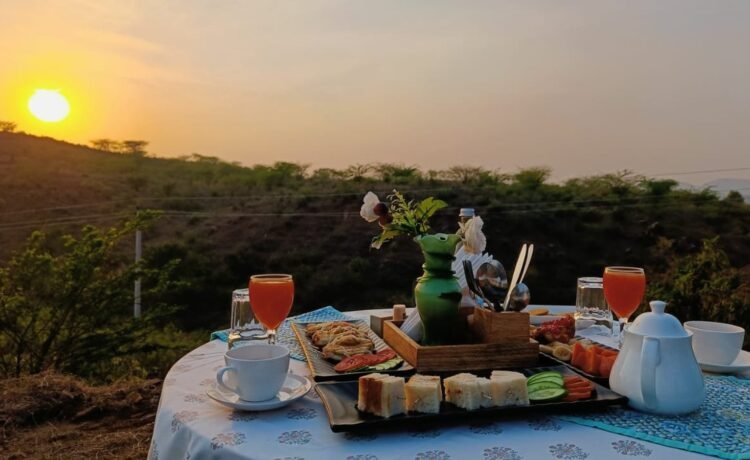
Someone always says it out loud at dinner. Usually about a tomato.
They will say it tastes like tomatoes used to. Then everyone else nods, because they were thinking it too.
It is not nostalgia. So something real is going on, and most of it comes down to distance.
Also, it is not the chef showing off. Instead, it is the supply chain being short.
This piece explains farm to table dining Rajasthan style, without the marketing gloss. First, what the phrase actually means.
Then why the distance matters. Also, what grows here. Finally, why the same vegetable tastes better away from the city.
What Farm-to-Table Actually Means
The phrase gets stuck on a lot of menus that have not earned it.
At its strictest, it means the food came from the land you are standing on. Not a nearby district. Not a partner farm three states away.
At Astroport Sariska, that is the arrangement. Vegetables and fruit are grown on the premises, and the property keeps its own poultry and dairy (Source: Astroport Sariska, 2026 — Astroport Sariska).
So the gap between harvest and kitchen is measured in hours.
That is the whole idea. Everything else follows from it.
So the claim is easy to test. Ask where the tomatoes came from.
Then ask when they were picked. Because both answers are simple, a real kitchen gives them straight away.
There is a related word worth separating out. Organic describes how something was grown, without synthetic inputs.
Farm-to-table describes how far it travelled. So a dish can be one without being the other.
The two often overlap here, because a kitchen garden has little reason to spray. Still, they are different claims.
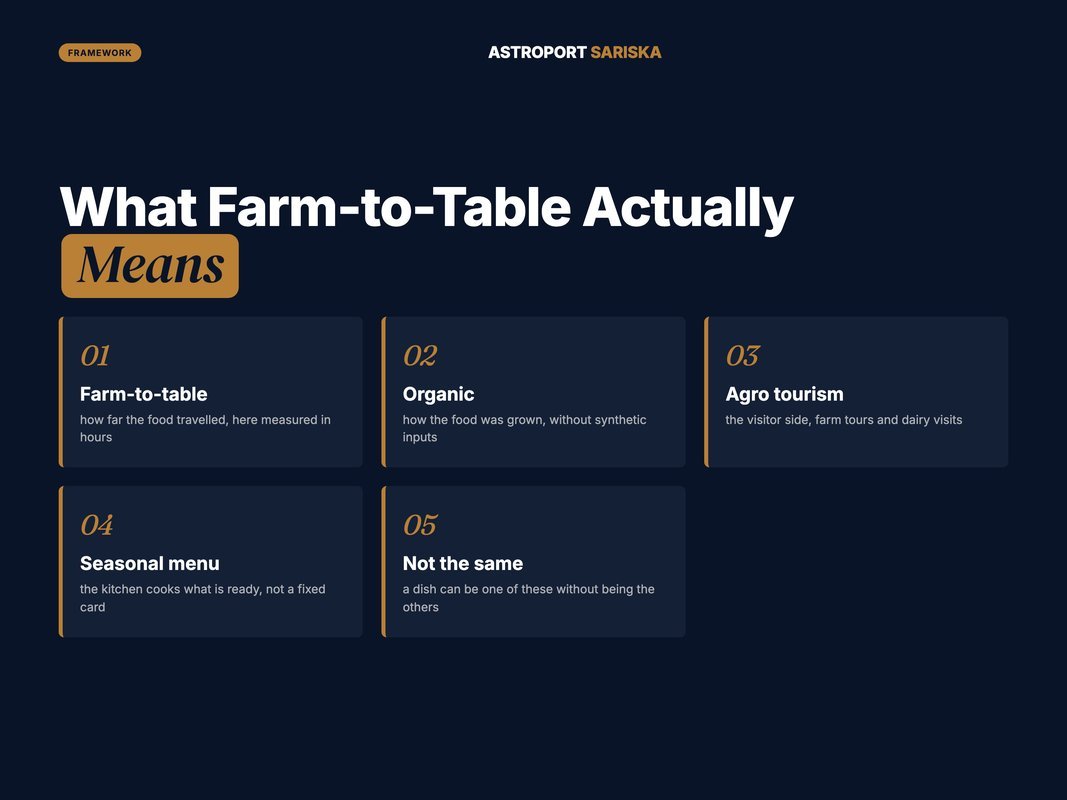
There is also agro tourism, which is the visitor side of the same thing. That covers farm tours, organic farming activities and dairy visits (Source: Astroport Sariska, 2026 — Tourism and Activities).
Q: How do I tell a real farm-to-table kitchen from a marketing line?
A: Ask to see the farm. So if there is one, they will happily walk you round it. Because a genuine kitchen garden is the whole selling point, nobody hides it.
Why Distance Is the Whole Point
Here is the part people rarely explain properly.
Produce that has to travel is not picked ripe. It is picked firm, so it survives the journey without bruising.
Then it finishes ripening in transit or in storage. Because that ripening happens off the plant, it is never quite the same.
Sugars, texture and aroma all develop differently. So the fruit looks right and tastes flat.
A kitchen beside the field has no such constraint. Nothing needs to survive a truck, a warehouse or a shelf.
So it gets picked at the point it is actually best. Then it is cooked a few hours later.
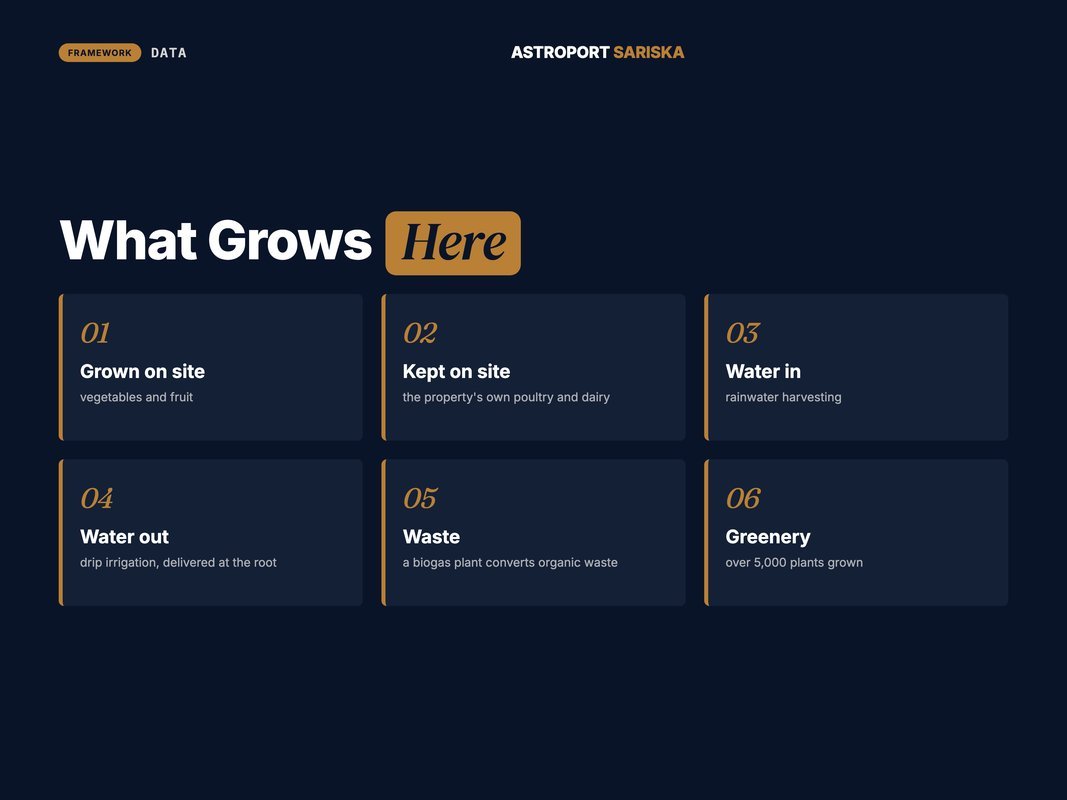
Herbs show this most obviously. Because their aroma comes from volatile oils that fade quickly, a cut herb loses power by the hour.
Leaves are the same. A salad picked that morning behaves nothing like one bought three days earlier.
Root vegetables are more forgiving. Still, even they sweeten differently when they are not stored cold for weeks.
Eggs are the other quiet giveaway. Because the yolk colour tracks what the birds eat, a farm egg looks different in the pan.
Milk behaves the same way. So the first breakfast usually makes the point without anyone saying anything.
Q: Does the food have to be exotic to be good?
A: Quite the opposite. So the clearest examples are ordinary things, like tomatoes, spinach and coriander. Because you already know how those should taste, the difference is obvious.
What Grows Here
The farm is not decorative. It is a working operation that feeds the kitchen.
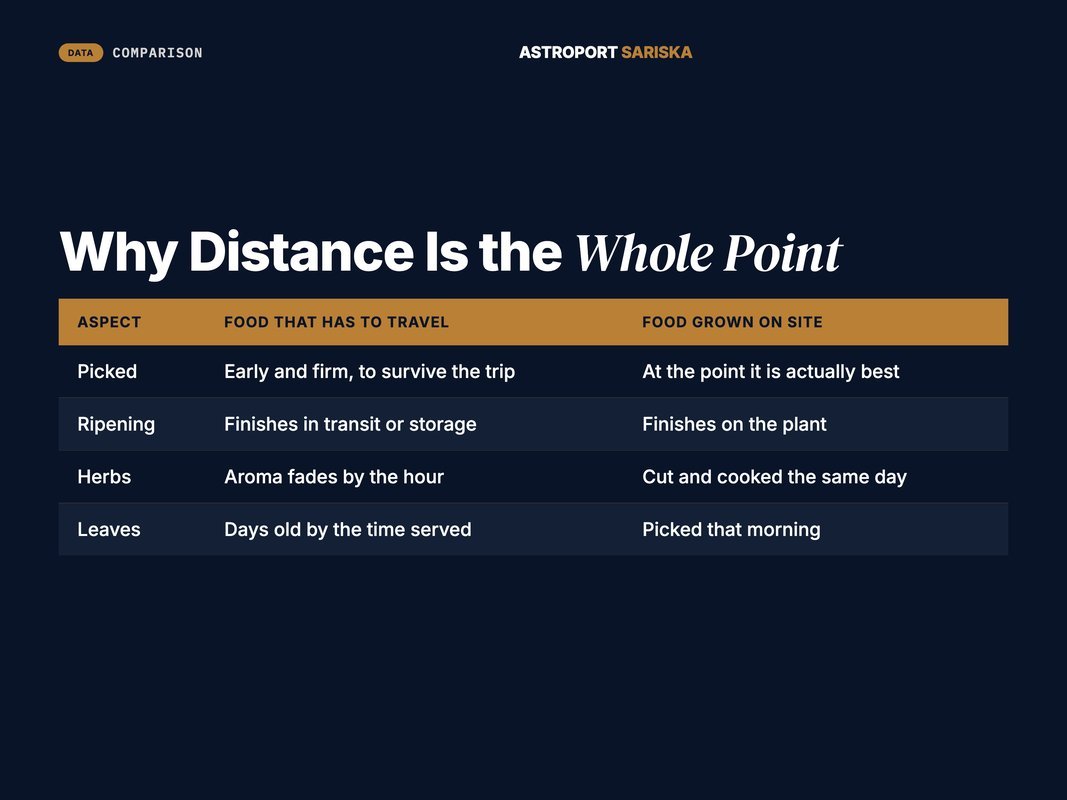
Vegetables and fruit are cultivated on site. Meanwhile, poultry and dairy are also kept on the property (Source: Astroport Sariska, 2026 — Astroport Sariska).
Water is the hard part in Rajasthan, so the systems around the farm matter. There is rainwater harvesting, and irrigation runs by drip rather than flooding (Source: Astroport Sariska, 2026 — Astroport Sariska).
Drip delivers water at the root. Because almost none is lost to evaporation, it stretches a scarce supply a long way.
Waste runs in a loop too. A biogas plant converts organic waste rather than sending it away (Source: Astroport Sariska, 2026 — Astroport Sariska).
Over 5,000 plants have been grown on the property (Source: Astroport Sariska, 2026 — Astroport Sariska).
That greenery is not only decoration either. Because shade lowers ground temperature and holds soil, it makes growing viable in a dry landscape.
So the farm is one part of a set. Power, water, waste and food all connect.
Then each part props up the next. Because waste becomes gas, and rain becomes irrigation, less has to come in by road.
Also, less goes out. So the whole site stays quiet.
Q: Can guests actually go onto the farm?
A: Yes, that is the point of it. So farm tours, organic farming activities and dairy visits all run as guest activities. Because it is hands-on, children usually take to it fastest.
Why It Tastes Better on a Trip
Freshness explains part of it. But not all of it, if you are honest.
The rest is context, and context does real work on flavour.
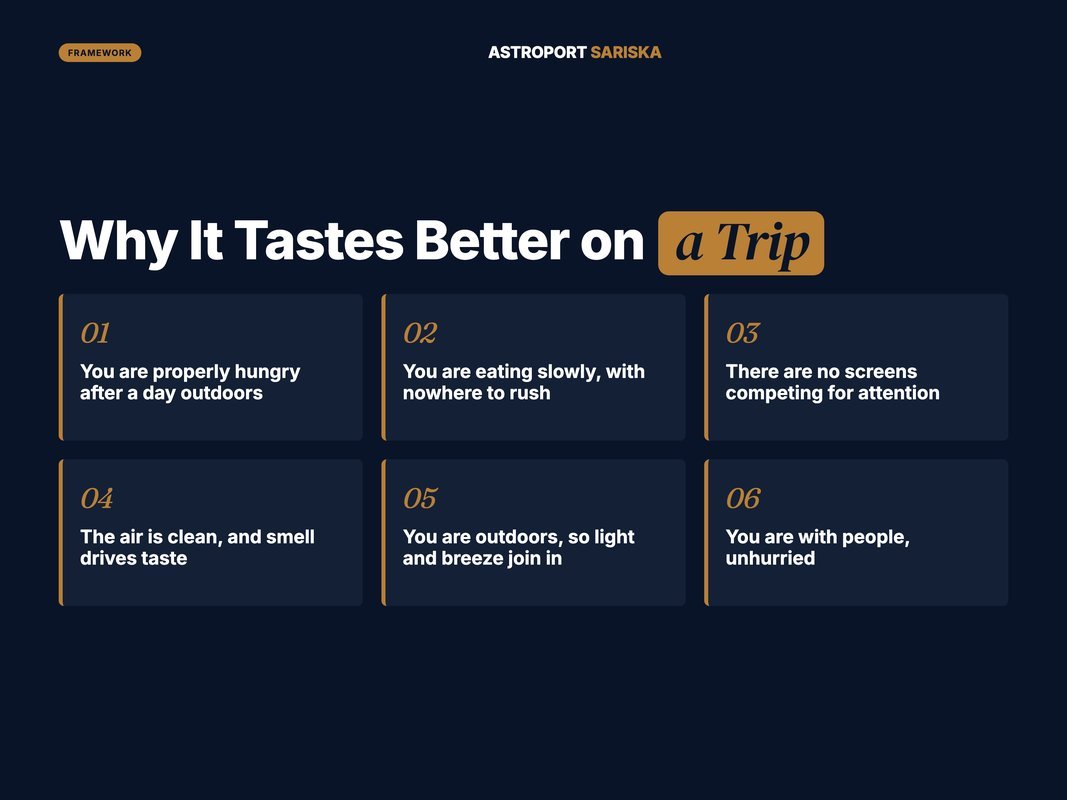
You are properly hungry. After a dawn safari and a walk, you arrive at dinner genuinely ready to eat.
You are eating slowly. Because there is nowhere to rush off to, the meal takes as long as it takes.
There are no screens. So nothing is competing for your attention while you chew.
The air is clean. Because smell drives most of what we call taste, cleaner air genuinely helps.
You are outdoors, or nearly. Then temperature, breeze and light all become part of the meal.
You are with people, unhurried. So conversation stretches, and courses arrive at a human pace.
None of that is mystical. It is attention, hunger and clean air doing what they always do.
Still, the effect is strong. So people go home and try to repeat it.
Usually it does not work at a kitchen counter. Because half the recipe was the setting, the dish alone falls short.
So the freshness gives you a better raw ingredient. Then the setting makes you notice it.
Q: Is this just the holiday effect?
A: Partly, and that is fine. Because a good meal is an experience rather than a chemistry test, the setting counts. Still, a ripe tomato is measurably different from a shipped one.
The Menu Follows the Season
A farm-to-table kitchen cannot run a fixed card. So the menu moves through the year.
At Astroport Sariska, the Orbit Restaurant serves a seasonal menu built on home-grown ingredients (Source: Astroport Sariska, 2026 — Our Facilities).
The style mixes local Rajasthani cooking with wider influences (Source: Astroport Sariska, 2026 — Our Facilities).
That seasonality is a feature, not a limitation. Because the kitchen cooks what is ready, the dishes are at their best by definition.
It does mean a shorter list. Still, most guests find a smaller menu easier rather than harder.
There is a small habit worth adopting. Ask what came off the farm this morning.
So you will usually get a straight answer, and often a better dish than the one you were going to order.
Q: What if I have dietary requirements?
A: Flag them when you book, as you would anywhere. Because a kitchen working from its own produce is used to adapting, it is generally flexible. So give them notice rather than springing it at dinner.
Where You Eat Changes What You Taste
The same plate lands differently depending on where it is put down.
There is the Orbit Restaurant for the main service. Also, the Dharohar Bar sits poolside (Source: Astroport Sariska, 2026 — Our Facilities).
Beyond that, there is private dining and jungle dining, plus hi-tea (Source: Astroport Sariska, 2026 — Astroport Sariska).
Jungle dining is the one people remember. Because you are eating out in the landscape rather than looking at it, the meal changes character.
There is a timing note that matters here. Eat before full darkness rather than after.
That sounds like a small thing. So it is worth explaining.
The stargazing session starts once the sky is properly dark. If dinner runs late, you either rush the meal or miss the best hour.
Also, bright dining lights undo your night vision. Because your eyes need twenty to thirty minutes to adapt, a late-lit dinner costs you the first part of the session (Source: NASA, 2026 — How to Find Good Places to Stargaze).
So an early dinner is the single best scheduling decision of the day.
Q: Can we eat outside every night?
A: Options vary with weather and season, so ask on arrival. Because winter nights get cold here, layers make outdoor dinners far more pleasant. So plan for it rather than hoping.
Getting the Most From a Farm-to-Table Stay
Small choices change the experience considerably.
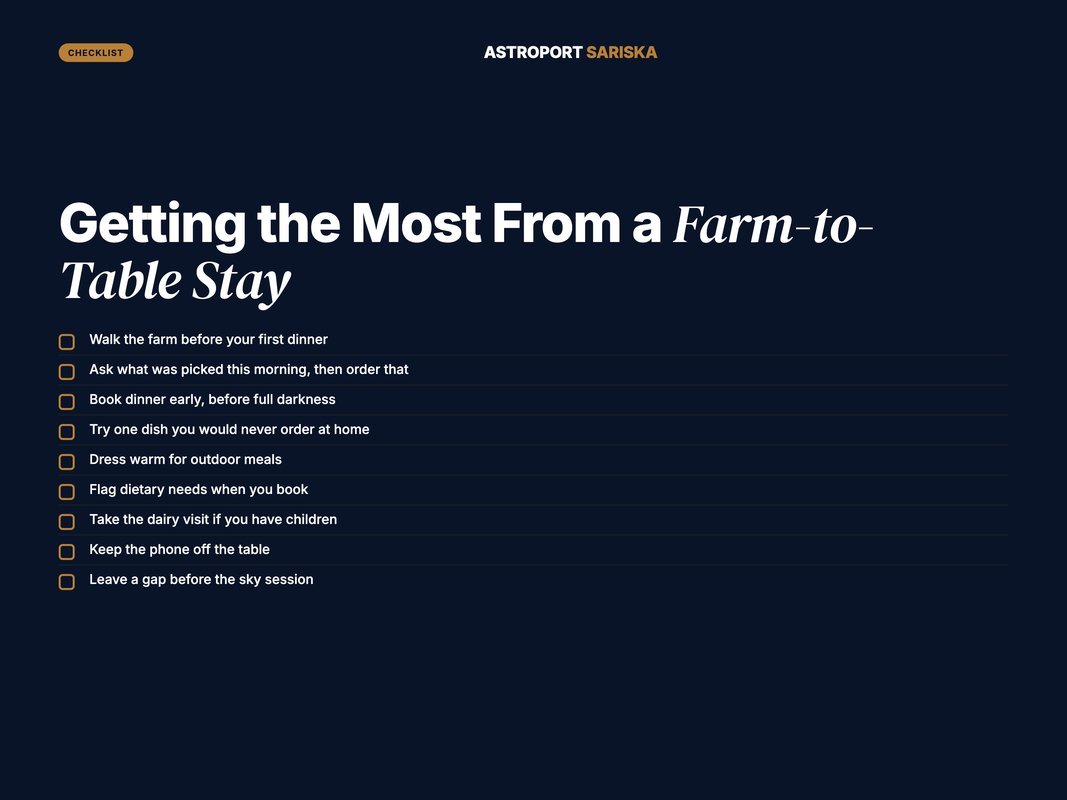
- Walk the farm before your first dinner, not after your last
- Ask what was picked this morning, then order that
- Book dinner early, before full darkness
- Try one dish you would never order at home
- Dress warm for outdoor meals, since desert evenings drop fast
- Flag dietary needs at the time of booking
- Take the dairy visit if you have children with you
- Skip the phone at the table, so the food gets your attention
- Leave a gap before the sky session, rather than eating late
Also, do not over-plan the evening. Because the meal and the sky are the evening, nothing else needs to happen.
Q: What is the one thing most guests wish they had done?
A: Walked the farm on the first day. So people tend to leave it to the end, then realise every dinner since would have read differently.
Why Astroport Sariska
Plenty of places print the phrase on a menu. Fewer have the farm behind it.
Astroport Sariska is India’s first astronomy resort. It sits at Tehla in the Aravalli hills, beside the Sariska Tiger Reserve in Alwar, Rajasthan.
The drive is about four to five hours from Delhi NCR. So the food arrives from the field rather than from a city market.
The farm supplies the kitchen directly, and the poultry and dairy are kept here too. Meanwhile, farm tours and dairy visits run as guest activities.
The Orbit Restaurant works to a seasonal menu built on those ingredients, with Rajasthani cooking at its centre. There is also the poolside Dharohar Bar, private dining, jungle dining and hi-tea.
The rest of the property follows the same logic. It runs fully on solar power, operates as a no-plastic zone, harvests rainwater and runs a biogas plant.
Then the day gives you a reason to be hungry. There are jeep safaris into Sariska, nature walks, birdwatching and the Sparsh Spa.
And the evening gives you somewhere to sit afterwards. Resident astronomers run stargazing sessions under skies dark enough for thousands of stars.
One timing note. Astronomy activities pause each year from 1 June to 15 August during the monsoon. So plan around that. Plan your stay and eat before dark.
Conclusion
So farm-to-table is a claim about distance, not a style of cooking.
When the field is beside the kitchen, produce gets picked ripe. Because nothing has to survive a journey, flavour stops being a trade-off.
Herbs and leaves show it fastest. Meanwhile, even ordinary vegetables taste noticeably different.
Then the setting does the rest. You are hungrier, slower and paying attention, with clean air and no screens.
The practical advice is simple. Walk the farm early, ask what was picked today, and book dinner before dark.
Do that and the meal becomes part of the trip. Plan your farm-to-table stay and taste the difference yourself.
FAQ
Q: What does farm-to-table actually mean?
A: It means the food on your plate came from the land around you rather than a supply chain. At Astroport Sariska that includes vegetables and fruit grown on the premises, plus the property’s own poultry and dairy. The gap between harvest and kitchen is measured in hours.
Q: Why does farm-to-table food taste better?
A: Mostly because it is picked ripe rather than early. Produce built for long transport is harvested firm so it survives the journey, which costs flavour. When the kitchen is beside the field, nothing has to travel.
Q: Is farm-to-table the same as organic?
A: No, though they often overlap. Farm-to-table describes how short the journey is, while organic describes how the food was grown. A dish can be one without being the other.
Q: Can you visit the farm at a farm-to-table resort?
A: At Astroport Sariska, yes. Farm tours, organic farming activities and dairy visits all run as guest activities, alongside nature trails. Seeing the beds before dinner changes how the meal reads.
Q: Does a farm-to-table menu limit what you can order?
A: It narrows the list and improves it. The menu follows what is ready rather than a fixed card, so it shifts through the year. Most guests find the smaller choice easier, not harder.
Q: What kind of food is served at a farm-to-table resort in Rajasthan?
A: At Astroport Sariska the Orbit Restaurant serves a seasonal menu built on home-grown ingredients. The cooking is Rajasthani at its centre, with wider influences. There is also private dining, jungle dining and hi-tea.
Q: Why does the same food taste better on a trip?
A: Because context does real work. You are hungrier after a day outdoors, you are eating slowly, and there are no screens competing for attention. Add clean air and an open sky and the meal simply registers more.