
The sky charges nothing. So it is a little strange that seeing it properly costs anything at all.
But it does. Because you have to leave the city to find a dark one, there is a trip attached.
The good news is that most of the cost is timing. So this guide shows how to plan a budget stargazing trip India travellers actually enjoy.
First, you will learn what off-season really means here. Then you will get the calendar in plain terms.
Also, you will learn the free upgrade almost nobody uses. Finally, you will see what you must never cut.
What Off-Season Actually Means Here
Most resorts have one quiet season. An astronomy resort has two calendars laid on top of each other.
There is the travel calendar. So winter is peak, and the hot months are quiet.
Then there is the sky calendar. Because clear, dry air makes better observing, autumn and winter are also the best skies.
Those two line up badly for a bargain hunter. The cheapest months are cheap partly because the sky is worse.
There is a harder trap underneath that. Astronomy activities pause through the rainy season, from June until August (Source: Astroport Sariska, 2026 — Resort Terms and Conditions).
So the quietest window is not a window at all. You would be booking the resort without the observatory.
Q: So is there no off-season bargain?
A: There is, but it sits in the shoulder weeks rather than the dead ones. Because September and late winter have both a running sky programme and softer demand, that is where the value is. The trick is timing, not season alone.
The Calendar, in Plain Terms
Here is the year sorted by what you actually get.
| Window | Sky programme | Demand | Verdict |
|---|---|---|---|
| June to August | Paused | Lowest | Avoid for astronomy |
| September | Running, air washed clean | Softening | The value sweet spot |
| October to December | Running, best conditions | Highest | Book early, pay peak |
| January to February | Running, cold and clear | Moderate | Excellent, slightly softer |
| March to May | Running, hot and hazy | Lower | Cheap, but plan for heat |
(Source: Astroport Sariska, 2026 — Resort Terms and Conditions)
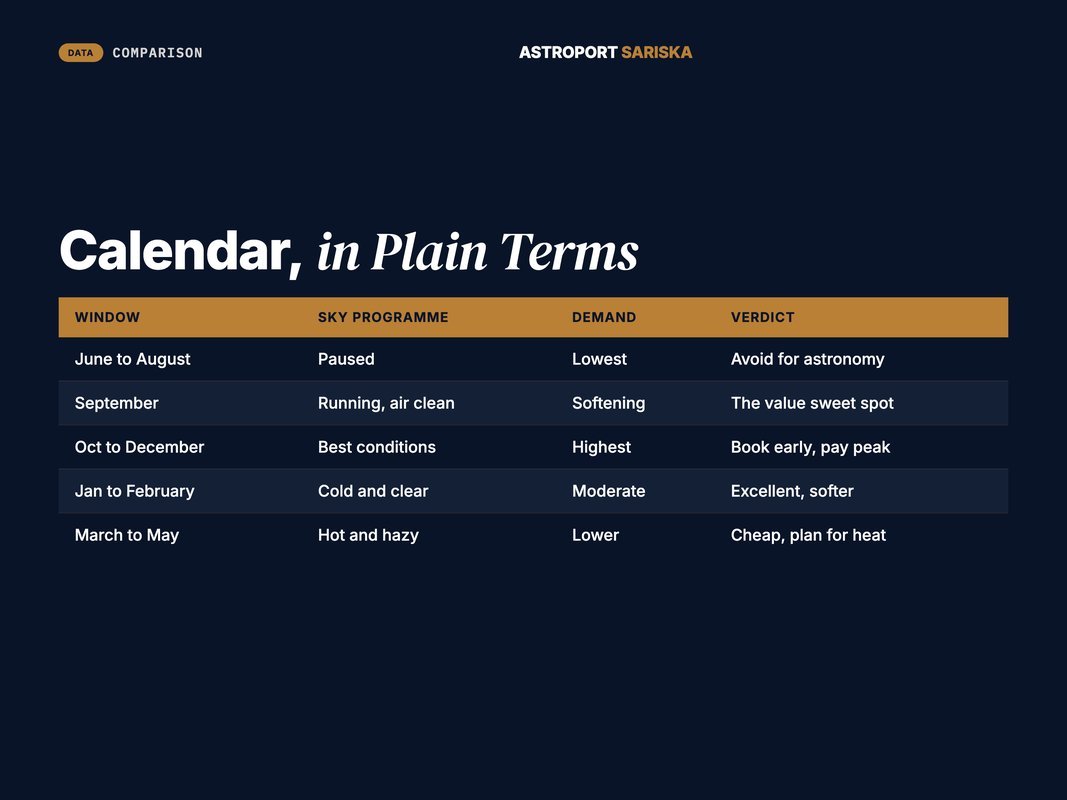
September is the row to notice. Because the rains have just washed the dust out, the air is unusually clear.
Demand has not caught up yet. So you get near-peak skies in a shoulder week.
Late winter is the other quiet win. Meanwhile, January and February are cold but very steady.
Spring is genuinely cheap. But be honest about the heat, because Sariska runs hot from March onward.
Q: Is a hot-weather trip still worth it?
A: For the sky, often yes. Because clear nights are common in spring, the observing can be good. Still, the daytime is hard work, so plan an indoor afternoon.
The Free Upgrade Almost Nobody Uses
This one costs nothing and changes everything. Book around the new moon.
Moonlight in a dark-sky area is as bright as a streetlight (Source: NASA, 2026 — Stargazing for Beginners).
So a full moon on a clear night still ruins the faint sky. You paid for a dark site and then lit it up.
The new moon is the invisible phase, with the lit side facing away from us (Source: NASA, 2026 — Moon Phases).
That cycle repeats about every 29.5 days (Source: NASA, 2026 — Moon Phases).
So roughly one dark week comes round each month. The next new moon falls on 11 September 2026 (Source: In-The-Sky.org, 2026 — The Moon).
How to Use the Cycle
Aim for the few days either side of new moon. Because the moon is absent or a thin crescent then, the faint sky is fully available.
Those dates are often not the popular ones. So you frequently get the best sky in a softer week.
That is the whole hack. Instead of hunting for a lower rate, hunt for a darker night at the same rate.
Check the phase before you check availability. Then you never book a bright week by accident.
Q: What if my dates are fixed by work?
A: Then favour the second half of the night. Because the moon sets earlier as it wanes, a late session can still find dark hours. So ask when the moon sets on your night.
Eight Hacks That Actually Save Money
These are the levers worth pulling, in rough order of impact.
- Move off holiday weekends, since Gandhi Jayanti, Diwali and Christmas all price high
- Travel midweek, because most demand here is weekend demand
- Take one family cottage for a group rather than several small ones
- Split the drive, since one full car beats two half-empty ones
- Take the train to Rajgarh and one taxi for the last stretch
- Book two nights instead of two separate one-night trips
- Choose two add-ons, not all of them
- Book the sky session for everyone, and skip a spa hour instead
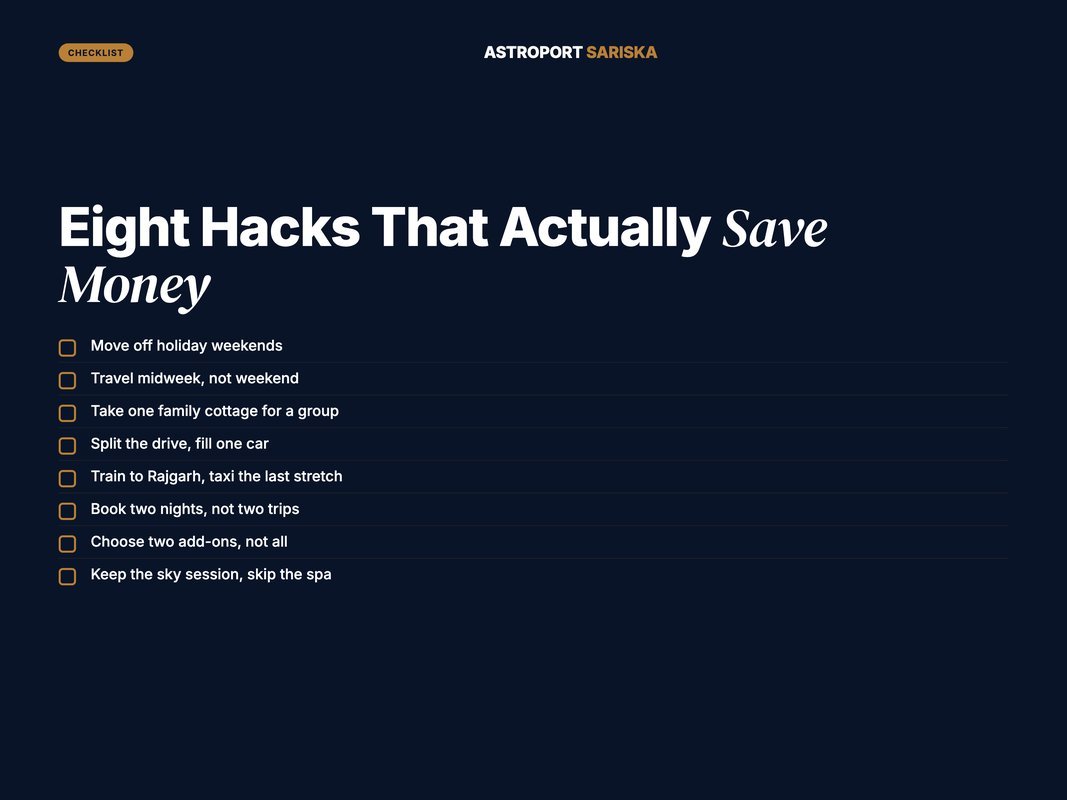
The holiday point does the most work. Gandhi Jayanti falls on Friday 2 October 2026, Diwali on Sunday 8 November, and Christmas on Friday 25 December (Source: Drik Panchang, 2026 — Indian Calendar 2026).
Those three windows price like holidays. So shifting one week either side changes the whole total.
The group hack is the second biggest. Because the family cottage runs to 750 square feet and sleeps six to eight, the per-head figure drops sharply (Source: Astroport Sariska, 2026 — Rooms).
Rail is worth a look too. Rajgarh station sits about 25 km from the resort (Source: Astroport Sariska, 2026 — Contact Us).
Q: Is driving or training cheaper?
A: It depends on how many of you there are. Because a full car splits four ways, driving wins for a group. For one or two people, the train plus a short taxi usually wins.
What Not to Cut
Budget travel goes wrong when you cut the reason for the trip. So here is the line.
Never cut the astronomy session. Because it is charged per person and booked on arrival, it is tempting to trim (Source: Astroport Sariska, 2026 — Resort Terms and Conditions).
But that is the whole trip. So cutting it turns a dark-sky weekend into an ordinary one.
Never cut the second night either. Sky activities depend on the weather, so one night is a single roll of the dice (Source: Astroport Sariska, 2026 — Resort Terms and Conditions).
Two nights roughly doubles your odds of a clear one. That is cheap insurance for the thing you came for.
Also do not cut warm clothes. Because you stand still for hours, a desert night bites harder than the forecast suggests.
Cut the add-ons instead. So the spa, the private dinner and the second safari are the flexible lines.
Q: One great night or two average ones?
A: Two, almost every time. Because you cannot book weather, more nights is the only real hedge. So spread the budget across nights before you spend it on extras.
Building the Cheap Weekend, Step by Step
Here is the whole method in order.
-
Pick the month first. First, choose September, or a late-winter week outside the holidays.
-
Find the new moon. Then set your dates within a few days of it.
-
Shift to midweek. Also check whether a Tuesday works, since weekends carry the demand.
-
Size the room to the group. Next, compare one family cottage against several small ones.
-
Sort the travel together. Meanwhile, fill one car or take the train to Rajgarh.
-
Book two nights. Finally, protect against cloud before you spend on anything else.
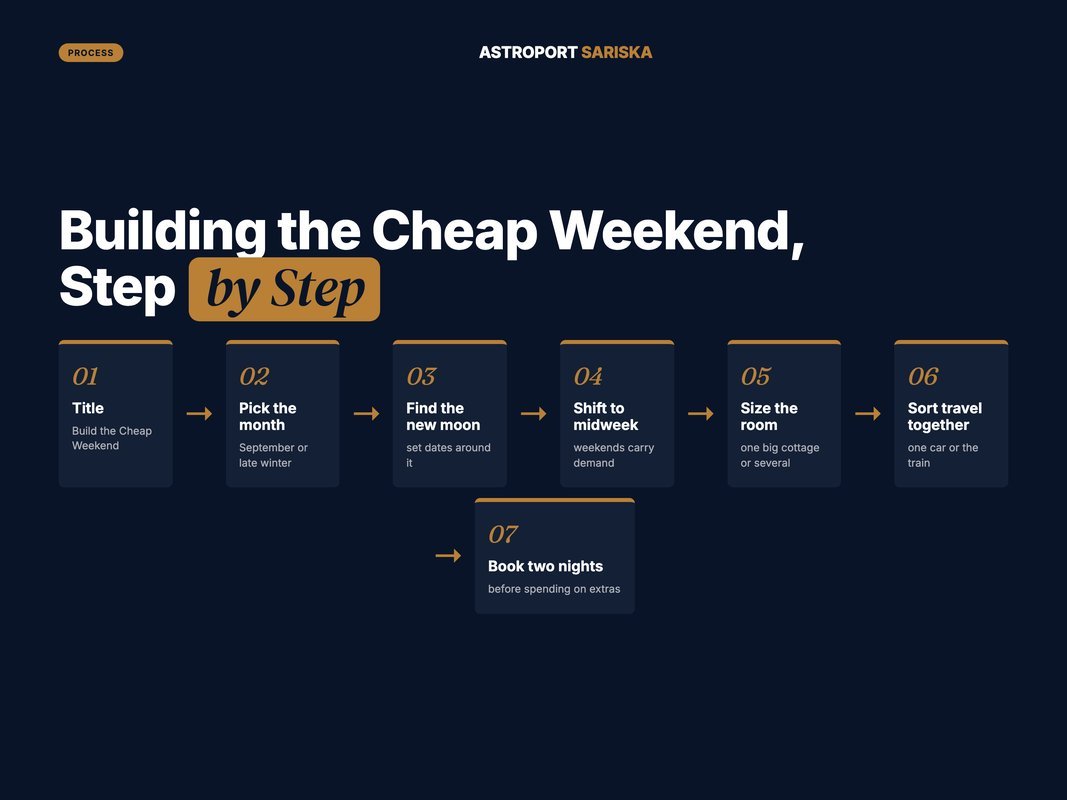
Run those in that order. Because each step narrows the next, going out of order costs you options.
Do it twice for two candidate months. Then compare, and take the better sky.
Q: How far ahead should I book a shoulder week?
A: Three to four weeks is usually enough. Because you are deliberately avoiding peak dates, availability is easier. Still, new-moon weekends do move faster than the rest.
The Two-Night Shoestring Itinerary
Here is what the cheap version actually looks like. Nothing is missing from it.
| When | What you do | What it costs you |
|---|---|---|
| Friday afternoon | Drive out, arrive before dark | Fuel, split four ways |
| Friday evening | Full astronomy session | The one line you protect |
| Saturday morning | Farm walk and the pool | Already in the stay |
| Saturday afternoon | Games room, then rest | Already in the stay |
| Saturday night | Second sky session, or a campfire | Your cloud insurance |
| Sunday morning | Slow breakfast, drive back | Fuel again |
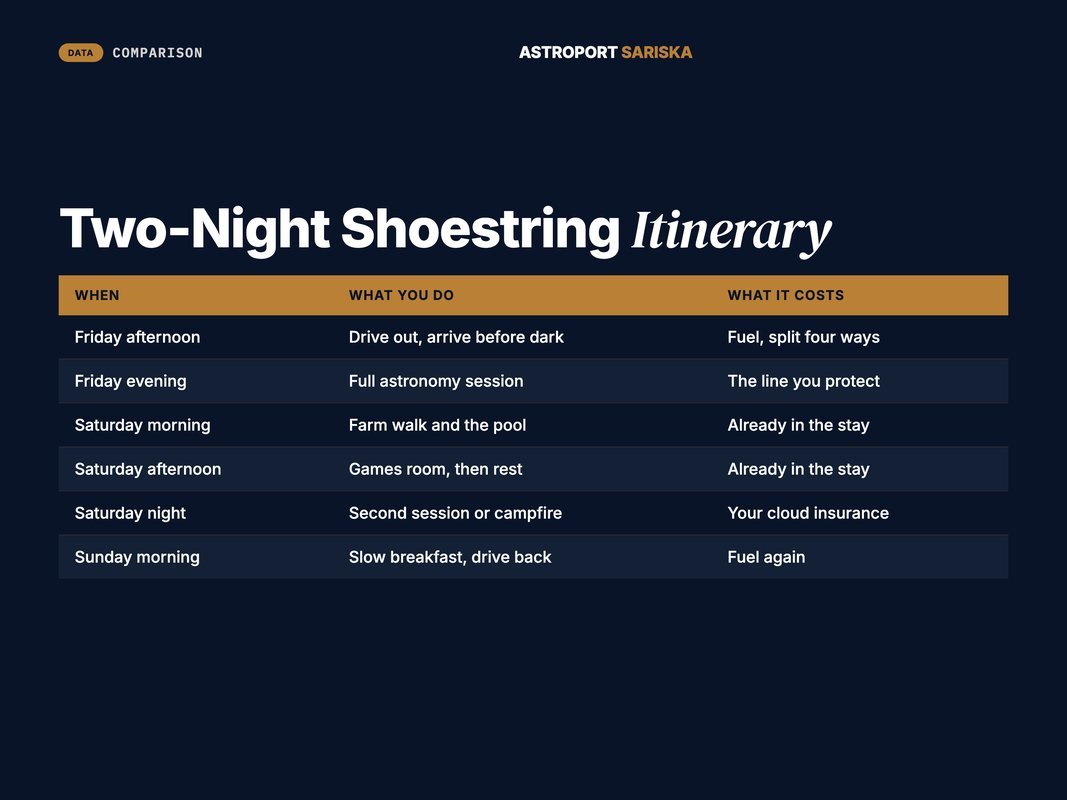
Notice what is not on that list. There is no safari, no spa hour and no private dinner.
Those are the flexible lines. So the trip still works fully without them.
Notice what is on it twice. Because the sky session appears on both nights, cloud on one evening does not sink the weekend.
The daytime costs almost nothing here. Meanwhile, the pool, the games room and the farm walks are part of the stay (Source: Astroport Sariska, 2026 — Our Facilities).
Where to Spend If You Have a Little More
Add the safari first, if the budget stretches. Because Sariska is right there, it is the add-on with the most to show.
Add the second sky session next. So you convert a good weekend into a proper one.
Leave the spa for a different trip. Meanwhile, it is lovely, but it is not why you drove 220 km.
That order holds for most people. So work down it until the money runs out.
Q: Can I do this in one night?
A: You can, and plenty of people do. But you lose the cloud hedge entirely. So if the budget only covers one night, pick a new-moon date and accept the risk knowingly.
Why Astroport Sariska
A budget trip only works if the destination still delivers. So the site has to be genuinely dark.
Astroport Sariska is India’s first astronomy resort. It sits at Village Roopwaas near Tehla, beside Sariska Tiger Reserve in Alwar, Rajasthan.
It is about 220 km from Delhi, and roughly three hours from Gurugram on the expressway (Source: Astroport Sariska, 2026 — Contact Us).
That distance matters for a budget trip. Because it is a single tank and no flight, the travel line stays small.
Plenty is already in the stay. There is a pool, a games room with billiards, carom and chess, and the Orbit Restaurant serving farm-grown food (Source: Astroport Sariska, 2026 — Our Facilities).
That helps on a tight trip. So a rained-off evening still has somewhere to go.
Resident astronomers run the sessions with professional telescopes. Plan a new-moon weekend in a shoulder month.
Conclusion
So a budget astronomy weekend is a timing problem, not a spending one.
Skip June to August, because the sky programme is paused. September is the value month.
Then let the moon pick your dates. Because a new-moon night costs the same as a full-moon one, that upgrade is free.
Move midweek and off the holiday bridges. Group up into one bigger cottage, and fill one car.
Protect two things above all. Keep the astronomy session and keep the second night. Find a new-moon week and book that instead of a bargain.
FAQ
Q: When is the cheapest time for a stargazing trip in India?
A: Shoulder weeks are the sweet spot, especially September and late winter. Midweek nights outside holiday bridges are softer again. The monsoon looks cheapest but the sky programme pauses then.
Q: Is the monsoon a good budget window?
A: No, and this is the main trap. Astronomy activities pause from June until August, so you would be buying the resort without the observing. Wait for September instead.
Q: Does the moon phase really matter that much?
A: Yes, and it costs nothing to plan around. Moonlight in a dark-sky area is as bright as a streetlight. Booking near a new moon is the single biggest free upgrade available.
Q: What is the cheapest way for a group to stay?
A: Take one family cottage rather than several smaller ones. It runs to 750 square feet and sleeps six to eight, so the per-head figure drops sharply.
Q: Can I reach Sariska without a car?
A: Yes. Rajgarh is the nearest railway station, about 25 km from the resort. Taking the train and one taxi at the end is usually cheaper than driving alone from Delhi.
Q: What should I never cut to save money?
A: The astronomy session and the second night. The session is the reason you travelled, and the second night is your insurance against cloud. Cut add-ons instead.