
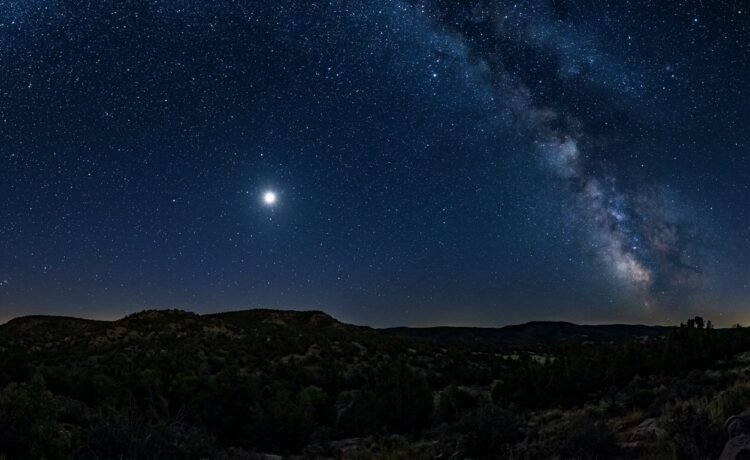
Most people expect a photograph. Then they look through the eyepiece and see something small.
That first reaction is normal. Still, about ten seconds later, something else happens.
You notice it is a disc, not a dot. Then you notice the stripes. Then you notice the little points of light sitting beside it.
Those points are moons. So this guide covers what Jupiter through telescope India skies really shows, and how to find it yourself.
What You Actually See
Set expectations first, because that is what makes the view land.

Jupiter appears as a small bright disc. It looks slightly squashed, wider than it is tall.
Across the disc you will see one or two darker bands. These are cloud belts, and they are the first detail most people notice.
Beside the planet sit up to four tiny points in a rough straight line. Those are the four largest moons.
The line is the giveaway. Stars scatter randomly, so four points in a neat row beside a bright disc is unmistakable.
What you will not see is colour like a spacecraft image. The view is subtle, pale and slightly creamy.
Still, almost everyone finds the real thing more affecting. Because the light entering your eye left Jupiter less than an hour ago.
Q: Is it disappointing compared to photos?
A: For about ten seconds. Then most people ask to look again, which tells you what actually happens.
Why Jupiter Is Worth Finding
Jupiter is the fifth planet from the Sun and the largest in the solar system. It is more than twice as massive as every other planet combined (Source: NASA, 2026 — Jupiter).
Scale is hard to convey, so here is the useful version. If Jupiter were a hollow shell, about 1,000 Earths would fit inside (Source: NASA, 2026 — Jupiter).
It also spins fast. A Jupiter day lasts about 9.9 hours, the shortest in the solar system (Source: NASA, 2026 — Jupiter).
That speed is observable. Watch for an hour and the moons visibly shift position.
Come back an hour later and the line has changed. Then come back the next night and it has changed again.
That is the hook for most people. You are not looking at a picture, you are watching a system move.
So Jupiter is the rare object that changes while you look at it. Meanwhile most of the night sky appears fixed.
The Four Moons, and Why They Matter
Jupiter has 115 moons officially recognised by the International Astronomical Union (Source: NASA, 2026 — Jupiter Moons). Only four are easy to see.
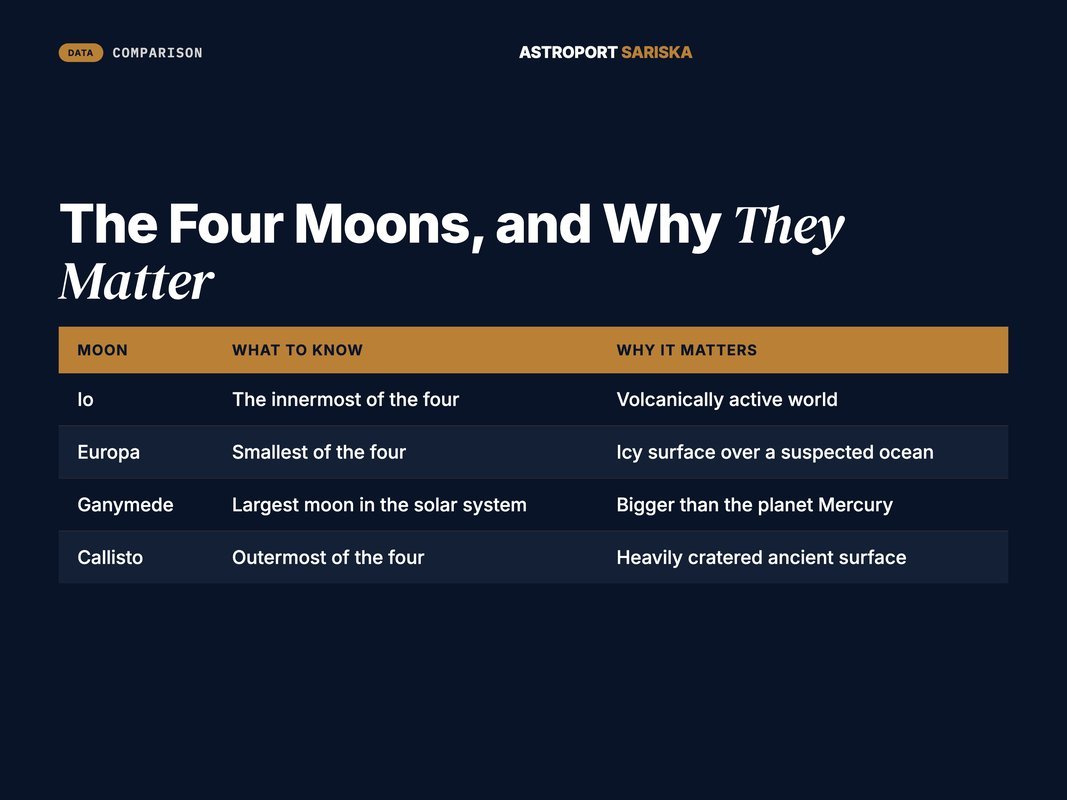
Those four are Io, Europa, Ganymede and Callisto. Galileo Galilei first observed them in 1610 using an early telescope (Source: NASA, 2026 — Jupiter Moons).
They are known today as the Galilean satellites. So when you see them, you are seeing what he saw.
That detail lands hard with most guests. It is a rare case where a beginner’s view matches a historic one.
| Moon | What to know | Why it matters |
|---|---|---|
| Io | The innermost of the four | Volcanically active world |
| Europa | Smallest of the four | Icy surface over a suspected ocean |
| Ganymede | Largest moon in the solar system | Bigger than the planet Mercury |
| Callisto | Outermost of the four | Heavily cratered ancient surface |
The four swap positions nightly. Sometimes you see only three, because one is passing in front of or behind the planet. Occasionally you catch a moon’s shadow crossing the face of the planet, which is a genuine treat.
So the pattern is never the same twice. That is why regular observers keep coming back to it.
Quick Facts
- Jupiter has 115 moons officially recognised by the International Astronomical Union (Source: NASA, 2026 — Jupiter Moons).
- Jupiter is more than twice as massive as all the other planets combined (Source: NASA, 2026 — Jupiter).
- A Jupiter day lasts about 9.9 hours, the shortest in the solar system (Source: NASA, 2026 — Jupiter).
- NASA’s Juno mission has been studying Jupiter from orbit (Source: NASA, 2026 — Juno).
How to Find It From India
Jupiter is bright enough to see from almost anywhere, including cities. So finding it is easier than people assume.

- Look for the brightest steady point. Planets shine steadily while stars twinkle.
- Check it is not flickering. Twinkling means a star, not a planet.
- Use a sky app to confirm. One check settles it in seconds.
- Try binoculars first. The moons often show before you touch a telescope.
- Then use low magnification. Find the planet at low power before zooming.
- Increase power slowly. Push too far and the image turns to mush.
- Let the air settle. Wait a few minutes and detail often appears.
Step seven is the one beginners skip. Air movement blurs the view constantly, so patience reveals more than magnification does.
So look for the steady moments. The image sharpens briefly, and that is when you see the belts.
Binoculars Are Enough to Start
You do not need a telescope for the moons. Steady binoculars show them as tiny points beside the glare.
Bracing matters more than power here. Rest your elbows on something, or prop the binoculars on a wall.
Then look slightly to one side of the planet. Faint points are easier to catch just off-centre.
This trick has a name. Averted vision works because the edge of your eye is better in low light.
So use it on anything faint. It helps with star clusters too, not just moons.
When to Look
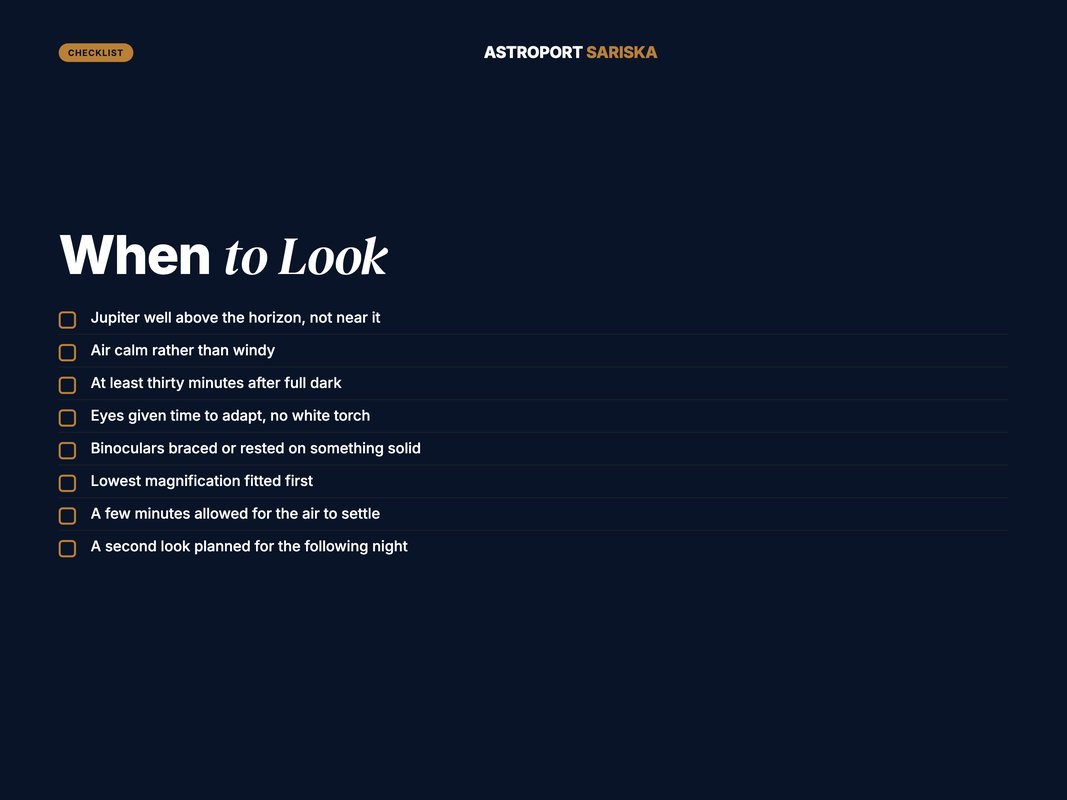
Any clear night with Jupiter above the horizon will work. Still, some nights are much better than others.
The best period is around opposition. That is when Earth passes between the Sun and Jupiter.
At opposition the planet rises around sunset and stays up all night. It also appears at its largest and brightest, because it is closest to us.
Opposition dates shift each year, so check a current almanac before planning a trip around it. NASA publishes monthly skywatching guidance (Source: NASA, 2026 — Skywatching).
Beyond that, three conditions matter.
- Height above the horizon. Higher is better, because you look through less air.
- Steady air. Calm nights beat clear-but-turbulent ones for planets.
- Timing after dark. Let the air and your eyes settle first.
Notice that dark sky is not on that list. Jupiter is bright, so light pollution barely affects finding it.
Darkness still helps for the moons. It reduces surrounding glare, which makes faint points easier to separate.
What Makes a Good Viewing Night
Clarity and steadiness are not the same thing. So it is worth knowing which you need.
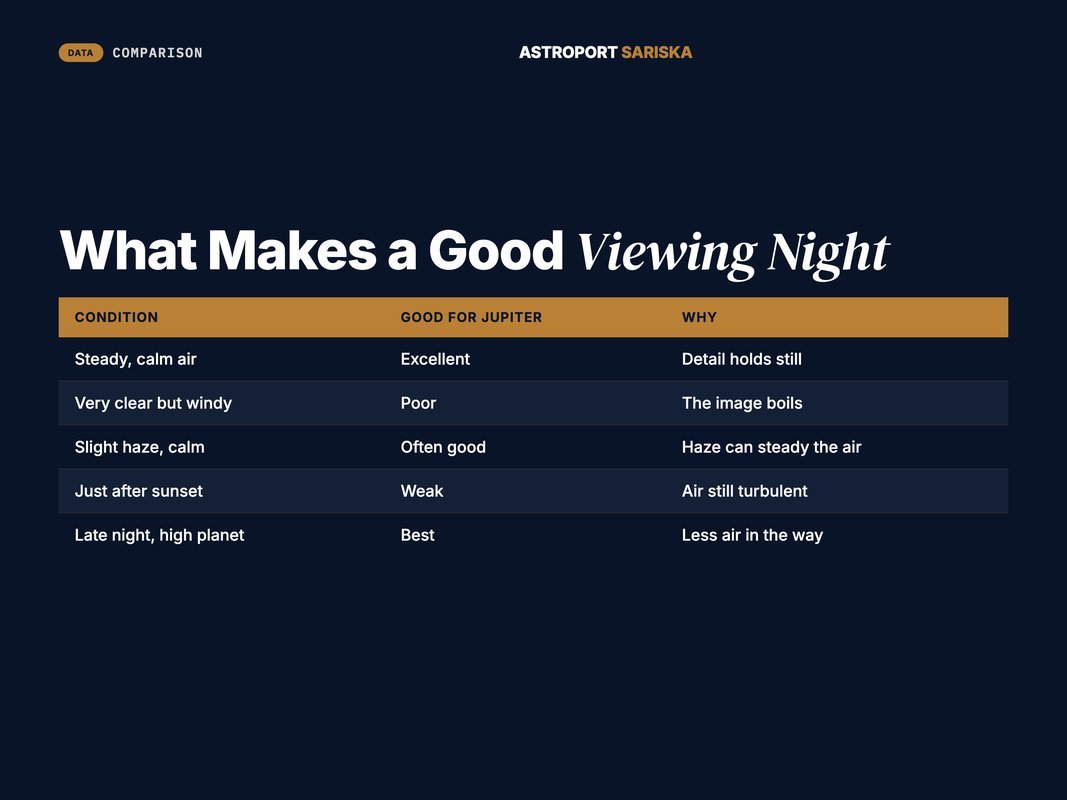
| Condition | Good for Jupiter | Why |
|---|---|---|
| Steady, calm air | Excellent | Detail holds still |
| Very clear but windy | Poor | The image boils |
| Slight haze, calm | Often good | Haze can steady the air |
| Just after sunset | Weak | Air still turbulent |
| Late night, high planet | Best | Less air in the way |
The third row surprises people. A slightly hazy night can give better planet views than a crisp one.
That is because haze often comes with calm air. Meanwhile a sharp, clear night frequently means wind.
So do not write off a soft-looking sky. For planets, steadiness wins.
There is a simple field test. Look at a bright star low down and watch how hard it twinkles.
Heavy twinkling means unsettled air. So the planet will boil too, and detail will be hard to hold.
Gentle, slow twinkling is a good sign. Then it is worth setting up properly.
Common Mistakes at the Eyepiece
Most first-time problems are easy to fix. So here are the ones that come up every night.
Using too much power. Beginners reach for the strongest eyepiece first. Then the image turns to soup.
Low power gives a sharp, steady view. Also, it makes the moons easier to hold in frame.
Looking for too short a time. Ten seconds is not enough. The air moves, and detail comes and goes.
So stay at the eyepiece for a full minute. The view will sharpen at least once.
Using a white torch nearby. One phone screen ruins night vision for the whole group.
Touching the telescope. A small nudge sends the planet out of view. Keep your hands off the tube.
Expecting colour. The belts are grey-brown, not orange. Photos are stacked and processed.
Giving up on a windy night. Wind is the enemy of planet detail, so try again rather than concluding you cannot see it.
Not going back. One look tells you very little. Two nights tell you the moons move.
Forgetting to note what you saw. Sketch the moon positions roughly. Then compare them the next night.
That one habit turns a single view into an observation you can actually keep.
Q: Why does the image keep wobbling?
A: That is air movement, not the telescope. It is called seeing, and it changes hour to hour. Waiting a few minutes usually helps.
Why Astroport Sariska Is a Good Place to Try
Astroport Sariska is India’s first purpose-built astronomy resort, in Village Roopwaas near Sariska Tiger Reserve, Alwar, Rajasthan. The drive from Delhi NCR is about 200 km, roughly four to five hours.
The advantage here is not only darkness. It is that resident astronomers already have telescopes set up and pointed.
Finding Jupiter yourself takes practice. So a first view through a properly aligned instrument removes the frustrating part.
The astronomers also know what is up that night. So you are not guessing which bright point is a planet.
Then you can learn to find it yourself the next evening. Most guests do exactly that.
The site sits under genuinely dark rural sky, and outdoor lighting is kept low and downward. That helps the moons stand out beside the planet’s glare.
The resort runs on solar power, with an organic farm supplying the kitchen. Sariska itself is next door for a morning safari, which gives the trip a daytime half.
If you want the wider picture of what else is up there this year, see our guide to planets visible in 2026. For photographing what you see, try Milky Way photography with a phone.
The Short Version
Expect something small, then look for ten more seconds. A disc, one or two dark belts, and up to four points of light in a line.
Those points are Io, Europa, Ganymede and Callisto. Galileo saw the same four in 1610, with far worse equipment than yours.
Start with binoculars and low magnification. Then wait for the air to steady, because patience shows more than power does.
Above all, go back the next night. The moons will have moved, and that is the part people remember.
Want to see it properly? Plan your stay at Astroport Sariska and ask the astronomers to point a telescope at Jupiter.
FAQ
What You Will See
Q: What does Jupiter actually look like through a small telescope?
A: A small, bright, slightly flattened disc with one or two darker bands across it. Beside it sit up to four tiny points of light in a rough line. It looks small but unmistakably like a world rather than a star.
Q: Can you see the Great Red Spot from India?
A: Sometimes. Jupiter spins in about ten hours, so the spot faces Earth only part of the time. You also need steady air and a reasonable telescope, which makes it a bonus rather than a promise.
Finding It
Q: How do you tell Jupiter apart from a bright star?
A: Jupiter shines with a steady light while stars twinkle. It is also among the brightest objects in the night sky. If it is very bright and it is not flickering, it is almost certainly a planet.
Q: Can you see Jupiter’s moons with binoculars?
A: Yes. Steady binoculars show the four Galilean moons as tiny points beside the planet. Bracing your elbows or resting the binoculars on something solid makes the difference between seeing them and not.
Timing and Conditions
Q: What is opposition, and why does it matter for viewing Jupiter?
A: Opposition is when Earth passes between the Sun and Jupiter. The planet then rises around sunset, stays up all night and appears at its biggest and brightest. It is the easiest time of year to observe it.
Q: Do you need a dark sky to see Jupiter?
A: Not to find it, because Jupiter is bright enough to see from a city. A dark, steady sky helps you see detail, and it makes the moons far easier to pick out beside the glare.