
Saturn is the planet everyone wants to see through a telescope. So the rings are the reason.
Yes, you can see Saturn through a telescope from India in 2026, but with one honest catch. Still, the rings are real and they are there. They are just thinner than usual right now. So this guide tells you why, when, and how.
In fact, we crossed Saturn’s ring plane in March 2025. Then the rings went edge-on. They nearly vanished. (Source: NASA Science, 2025 — Hubble Views Saturn Ring-Plane Crossing) But now they are tipping back into view, slowly.
So this is a straight, no-hype guide. First, we cover the 2026 date. Then comes what you really see. Also, we cover the gear that helps. Finally, we set honest expectations. So let us look up.
The Honest Bit First: The Rings Are Thin in 2026
First, start with the truth. So the rings will not look wide and dramatic this year.
Earth passed through Saturn’s ring plane on 23 March 2025. (Source: NASA Science, 2025 — Hubble Views Saturn Ring-Plane Crossing) So for a short while the rings turned edge-on. In fact, they are so thin they almost disappeared.
How thin? Well, the rings are huge across, but in places only about 10 metres thick. (Source: Sky & Telescope, 2025 — See Saturn’s Rings at Their Thinnest) So that is thinner than a sheet of paper, to scale.
Also, this happens every 13 to 15 years. (Source: NASA Science, 2025 — Hubble Views Saturn Ring-Plane Crossing) It is just where Saturn sits in its long orbit.
Since the 2025 crossing, the rings have started to open. But only by a little. At the 2026 opposition the tilt is about 7.5 degrees. (Source: EarthSky, 2026 — Saturn at opposition)
What the Thin Rings Mean for You
So what does that mean for you? Well, the rings show as a thin, bright line. Not the fat open hoop of a few years back. Still, they keep opening for years, up to about 27 degrees by 2033. (Source: Sky & Telescope, 2025 — See Saturn’s Rings at Their Thinnest)
But do not let that put you off. A thin-ringed Saturn is still a jaw-drop. Yet it still looks unreal the first time.
Q: Will Saturn’s rings look dramatic in 2026?
A: Not wide and dramatic, no. They went edge-on in March 2025. In 2026 they tilt only about 7.5 degrees. So they look thin and subtle, like a bright line. Still gorgeous, just not the classic fat rings.
When To Look: The 2026 Opposition Date
Now the timing. So there is one best night, and a long good window.
First, mark 4 October 2026. That is Saturn at opposition. (Source: EarthSky, 2026 — Saturn at opposition)
Opposition means Earth sits between Saturn and the Sun. So Saturn is closest and brightest for the year. In fact, it glows at about magnitude 0.3. (Source: in-the-sky.org, 2026 — Saturn at opposition)
On that night Saturn is up almost all night. Then it rises near sunset. Later it sets near sunrise. (Source: in-the-sky.org, 2026 — Saturn at opposition)
But you are not locked to one date. In fact, the good window is wide.
Saturn looks great for weeks on either side of opposition. So think September through November 2026. The planet barely changes over that stretch. Thus any clear, calm night in that window is a fine night to look.

Also, a quick tip on the Moon. A bright full Moon does not hurt Saturn much. Saturn is bright too. But a moonless night still gives the calmest, blackest backdrop.
So aim for late evening. Then let Saturn climb higher in the sky first. Higher means you look through less thick air. As a result, you get a steadier, sharper view.
Q: What is the single best night to see Saturn in 2026?
A: The night of 4 October 2026, when Saturn is at opposition. It is closest, brightest, and up all night. But the weeks around it, roughly September to November, are nearly as good.
What You See: Saturn Through a Telescope
Let us set the scene. So here is what Saturn through a telescope really puts in the eyepiece.
First, the disc. Saturn shows as a small, pale-gold ball. So it is soft and creamy, not sharp white.
Then the rings. Even a small scope shows them. They look like a thin bright line across the planet this year. In fact, the 1610 first glimpse made Galileo think Saturn had “ears.”
Next, on a steady night with enough scope, you may catch the Cassini Division. (Source: Sky & Telescope, 2025 — Viewing Saturn Guide) It is a fine dark gap inside the rings. So it splits the bright A and B rings.
The Moons You Can Spot
Then the moons. Also, look for tiny “stars” near the planet. The brightest is Titan.
Titan shines near magnitude 8.4. (Source: BBC Sky at Night, 2024 — How to observe Saturn’s moons) Still, it shows up even in a 60 mm scope. It has an orange tint from its thick smoggy air.
Here is a fun part. Titan moves. So it circles Saturn in about 16 days. (Source: BBC Sky at Night, 2024 — How to observe Saturn’s moons) Thus its spot shifts from night to night. Watch over a week and you see it travel.
Also, seven of Saturn’s moons are bright enough to see from Earth. (Source: BBC Sky at Night, 2024 — How to observe Saturn’s moons) Namely Titan, Rhea, Tethys, Dione, Enceladus, Iapetus and Mimas. Plus a bigger scope and dark skies bring out more of them.
Q: What can I actually see on Saturn through a small telescope?
A: The pale-gold disc and the thin rings. Titan, its biggest moon, as a small orange dot. On a steady night with a bigger scope, the Cassini Division too. It is small in the eyepiece, but unmistakable.
Naked Eye Or Binoculars Or Telescope?
Three ways to view. So each shows a very different Saturn. Here is the honest split.
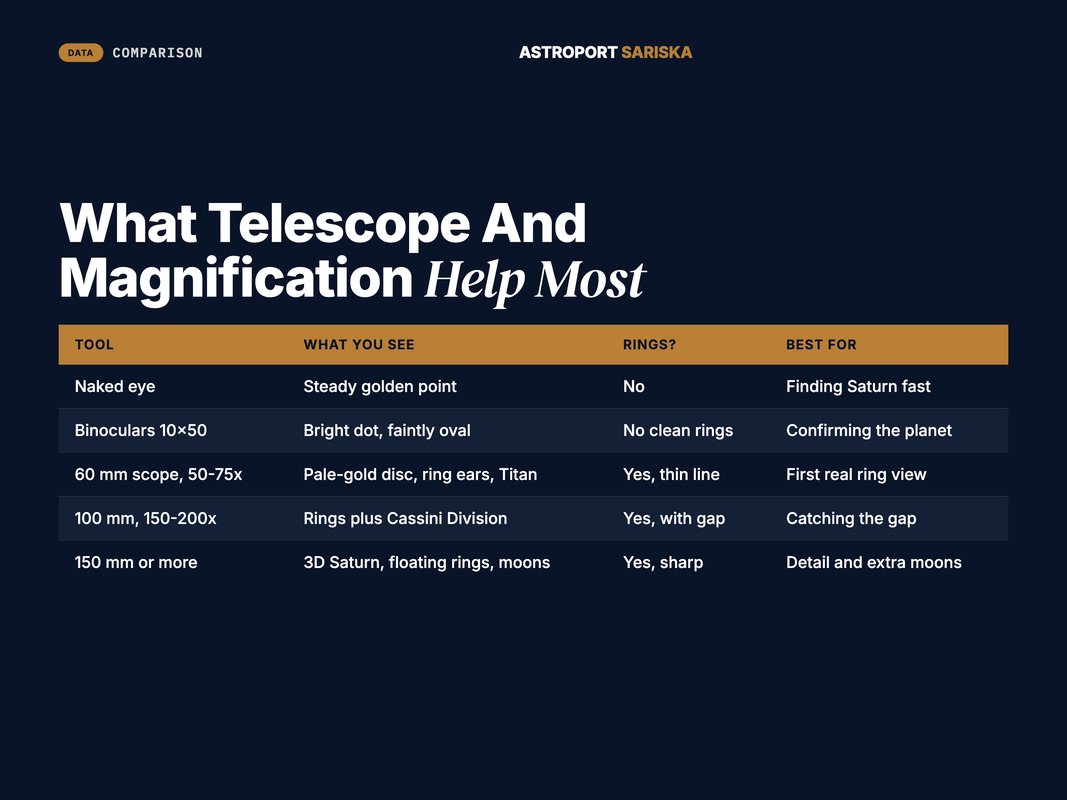
First, your naked eye finds Saturn easily. It is a steady, golden point of light. Also, it does not twinkle like a true star. But you will not see the rings this way. So you need about 25 to 30 times magnification for that.
Next, binoculars help you find it. A 10×50 pair makes Saturn a bright “star.” Held very steady, Saturn may look a touch oval. But binoculars still cannot split the rings cleanly.
So the telescope is where the magic is. Viewing Saturn through a telescope shows the rings even in a small one. Thus this is the tool that changes everything.
So the rule is simple. First, find Saturn with your eyes. Then confirm it with binoculars if you like. Finally, point a telescope to see the rings and Titan.
Q: Can binoculars show Saturn’s rings?
A: Not really. Binoculars show Saturn as a bright dot, maybe slightly oval if held very steady. To truly see the rings as rings, you need a telescope at about 25x or more. Binoculars are great for finding it, though.
What Telescope And Magnification Help Most
Let us talk gear, plainly. So you do not need a huge scope. Instead, you need the right approach.
First, a 60 mm telescope is the entry point. At 50 to 75 times, the rings show as clear “ears” on the planet. (Source: Sky & Telescope, 2025 — Viewing Saturn Guide) So the view is small but real.
Then step up to a 100 mm scope. At 150 to 200 times, it can reveal the Cassini Division on good nights. (Source: Sky & Telescope, 2025 — Viewing Saturn Guide) So that thin dark gap is the prize.
Next, go to 150 mm or more and Saturn turns three-dimensional. Then the rings seem to float in front of the disc. Also, more moons appear.
Now the secret most beginners miss. Basically, aperture and steady air beat raw zoom. A bigger lens or mirror gathers more light. (Source: Sky & Telescope, 2025 — Viewing Saturn Guide)
But calm air matters even more. Astronomers call it “seeing.” So bad seeing is wobbly air that blurs the planet. In fact, it is the same thing that makes stars twinkle.
So do not chase the highest magnification. Past a point, it just blurs. Instead, a steady medium power often beats a shaky high one.
Q: Do I need an expensive telescope to see the rings?
A: No. A simple 60 mm scope at about 50 to 75 times already shows the rings. For the Cassini Division, a 100 mm scope helps. Steady, dark skies matter just as much as the scope itself.
Why A Dark, Steady Site Like Sariska Helps
Saturn is bright. So you can spot it from a city. But the fine details are shy.
For example, the Cassini Division is delicate. Also, the faint moons are faint. So to catch them, you want black skies and calm air.
Meanwhile, city light scatters and hazes the view. It dulls contrast. As a result, the thin gap in the rings gets lost.
Sariska sits deep in the Aravalli hills. So the skies here run genuinely dark on the Bortle scale. They stay dark and clean.
But why does the air matter so much? Basically, steady, dry hill air gives better seeing. A sharper, calmer image holds together at high power. So that is when the Cassini Division snaps into view.
Plus there is the comfort factor. A telescope on a tripod. A guide who knows the sky. No traffic, no glare, no rush. Just Saturn, hanging gold in the dark.
Q: Is it worth driving out of the city just to see Saturn?
A: For Saturn itself, a city scope can show the rings. But for the Cassini Division and the moons, dark, steady skies make a real difference. A calm Aravalli night gives a much sharper, more memorable view.
Quick Facts: Saturn In 2026
Quick Facts
– Opposition date: Saturn is brightest for 2026 on 4 October. (Source: EarthSky, 2026 — Saturn at opposition)
– Brightness: About magnitude 0.3 at opposition. (Source: in-the-sky.org, 2026 — Saturn at opposition)
– Ring tilt: About 7.5 degrees in October 2026, so the rings look thin. (Source: EarthSky, 2026 — Saturn at opposition)
– Last ring-plane crossing: 23 March 2025, when the rings went edge-on. (Source: NASA Science, 2025 — Hubble Views Saturn Ring-Plane Crossing)
– Brightest moon: Titan, near magnitude 8.4, orbits in about 16 days. (Source: BBC Sky at Night, 2024 — How to observe Saturn’s moons)
How To Observe Saturn: A Simple Checklist
Pack and plan with this. Each item makes the night easier.
- Check the date. Aim for the weeks around 4 October 2026, or any clear night September to November.
- Pick a dark, open spot with a clear southern sky and calm air.
- Find Saturn first with your naked eye, as a steady golden “star.”
- Set up your telescope and let it cool to the night air for 20 to 30 minutes.
- Start at low power to centre Saturn, then raise the magnification slowly.
- Look for the thin rings, then hunt the Cassini Division on steady moments.
- Spot Titan as a small orange dot, and note its place to track it later.
- Dress warm, bring a red torch, and give your eyes 20 minutes to adjust.
Why Astroport Sariska
Some sights deserve the right setting. So Saturn is one of them.
Astroport Sariska is India’s first astronomy resort. It sits in the Aravalli hills, near Sariska Tiger Reserve. Also, it is about 4 to 5 hours from Delhi NCR, around 200 km.
So the sky here is the draw. On a clear night, guests can see 4,000-plus stars. But from inside Delhi, you might see 20. In fact, that gap is the whole point.
Resident astronomers run the sessions. So they set up professional telescopes for you. Then they point you to Saturn, frame the rings, and find Titan. No fiddling, no guesswork.
But there is more than the planet. For example, you can join a constellation tour and see what else fills the night sky. Or try a telescope-making workshop. Then sit for an astrophotography class under a real dark sky.
Also, by day the place keeps giving. There are tiger-reserve safaris, with leopards, sambar deer and 200-plus bird species. Plus an organic farm and farm-to-table food. Then the Sparsh Spa and yoga under the stars await.
Meanwhile, the resort runs fully on solar power. So the stay is premium but grounded. Thus it suits couples and families alike.
So if seeing Saturn through a telescope is on your list, do it the right way. A steady telescope, a black sky, and a guide who knows where to point. Then plan your trip to Astroport Sariska and look up.
Conclusion
Saturn through a telescope is a moment you remember. So the thin rings of 2026 do not change that.
Yes, the rings are subtle this year. In fact, they went edge-on in 2025 and are only just reopening. But a pale-gold Saturn with a bright ring line still stops you cold. Also, add Titan and maybe the Cassini Division, and it is pure wonder.
So the plan is simple. First, aim for the weeks around 4 October 2026. Then use a telescope, not just your eyes. Next, find a dark, calm sky. Finally, take your time at the eyepiece.
So Astroport Sariska makes that easy. Dark Aravalli skies. Pro telescopes. Astronomers who know the sky. So come see Saturn the way it should be seen. Then plan your stay and let us point the way.
FAQ
Q: When can I see Saturn’s rings from India in 2026? A: Saturn is at opposition on 4 October 2026. That is its brightest and best night of the year. You can see it through a telescope for weeks on either side, roughly September through November. A small scope shows the rings; the naked eye does not.
Q: Will Saturn’s rings look thin in 2026? A: Yes. Earth crossed Saturn’s ring plane in March 2025, so the rings went edge-on. They are opening again, but only a little. At the 2026 opposition the tilt is about 7.5 degrees. The rings look like a thin bright line, not a wide open hoop. They are still beautiful, just subtle.
Q: Can you see Saturn’s rings with the naked eye? A: No. To the naked eye Saturn is a steady, golden-yellow point of light. It does not twinkle like a star. You need about 25 to 30 times magnification to resolve the rings, which means a telescope or a strong spotting scope.
Q: What size telescope do I need to see Saturn’s rings? A: A 60 mm telescope at 50 to 75 times will show the rings as “ears” on the planet. A 100 mm scope at 150 to 200 times can show the Cassini Division on a steady night. With 150 mm or more, Saturn looks three-dimensional. Aperture and steady air matter more than raw power.
More Saturn Viewing Questions
Q: Can you see Saturn’s moons through a small telescope? A: Yes. Titan is the easy one. It shines near magnitude 8.4 and shows up even in a 60 mm scope. It orbits Saturn in about 16 days, so it shifts position from night to night. A larger scope under dark skies can add Rhea, Dione and a few more.
Q: Why is a dark site like Sariska better for seeing Saturn? A: Saturn is bright, so a city can show it. But the fine detail, the Cassini Division and the faint moons need steady, dark, clear air. Sariska sits deep in the Aravallis, far from city glow. Calm air and a black sky let the small details come through.
Q: What does the Cassini Division look like? A: It is a thin dark gap inside the rings. It separates the bright A and B rings. In a 100 mm or larger scope, on a steady night, it shows as a fine dark line running through the ring. It is a real thrill to catch it for the first time.