
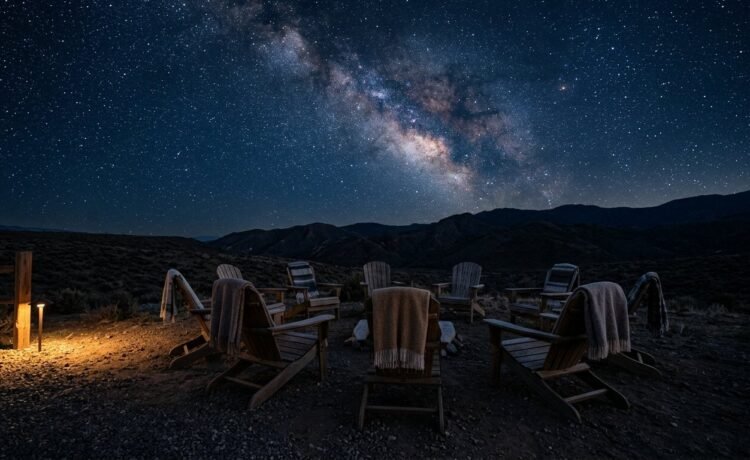
Eight people, three generations, one booking. Somebody is two, somebody is seventy-four.
That is the trip most families find hardest to plan. Because what suits one end of the range usually fails the other.
So the honest answer is yes, a stargazing resort does work for both. Still, it works for a specific reason, and it fails for predictable ones.
This guide covers why the sky suits both ends, what to check before booking, and how to run the days. A multi-generational family trip stargazing is mostly a logistics problem, not a taste problem.
Why the Sky Suits Both Ends
Most holiday activities have a fitness floor. Trekking, forts, markets and sightseeing all need walking.

Still, stargazing does not. It is seated, slow, and happens in one place.
So a grandparent can take part completely rather than watching from a bench. That single fact is why these trips work.
Also, it suits toddlers for a different reason. There is nothing to break, nowhere to fall from, and no queue.
Then there is the shared-novelty effect. Nobody in the group is an expert, so a four-year-old and a seventy-year-old start level.
In fact, that levelling is rarer than it sounds. On most family holidays, somebody is bored and somebody is struggling.
Q: Will the older adults actually enjoy it, or just tolerate it?
A: Most genuinely enjoy it. The common feedback is surprise. They expected to be cold and bored, and instead found it calm.
What Each Generation Actually Needs
Meanwhile, the needs differ more than people plan for. So it helps to name them.
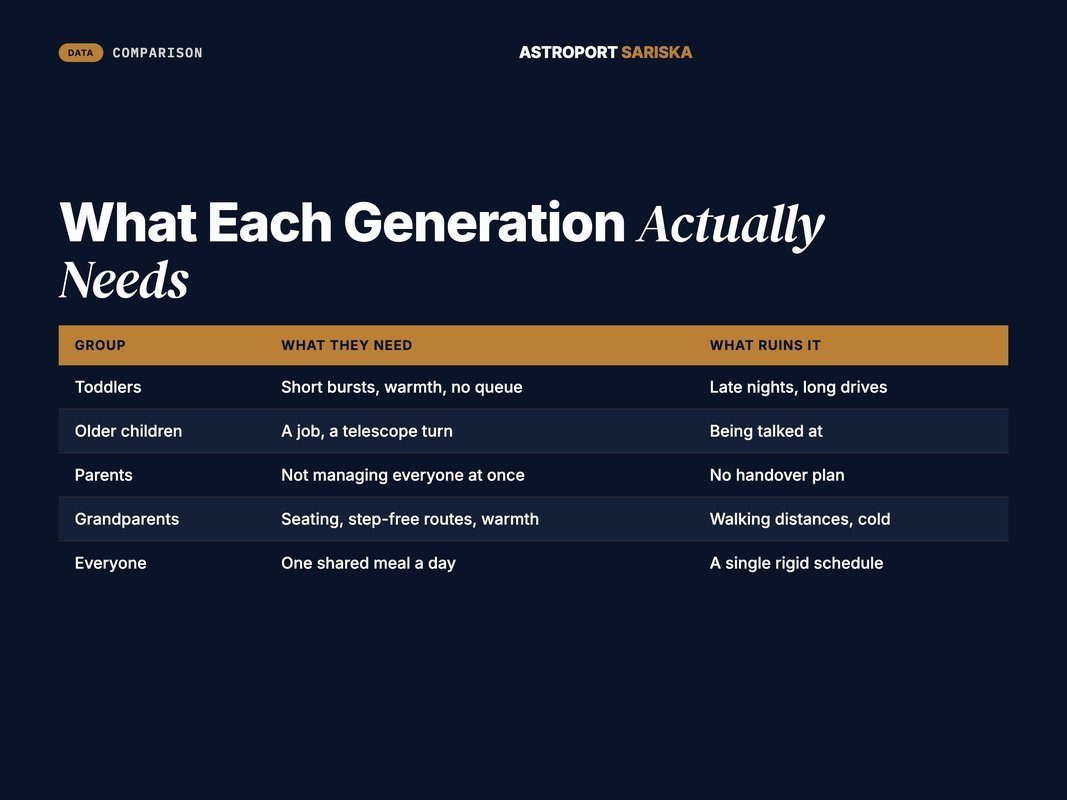
| Group | What they need | What ruins it |
|---|---|---|
| Toddlers | Short bursts, warmth, no queue | Late nights, long drives |
| Older children | A job, a telescope turn | Being talked at |
| Parents | Not managing everyone at once | No handover plan |
| Grandparents | Seating, step-free routes, warmth | Walking distances, cold |
| Everyone | One shared meal a day | A single rigid schedule |
So look at the bottom row. One shared meal is usually enough togetherness.
The rest of the day can split. In fact, it should.
The Warmth Point Applies to Both Ends
Cold affects toddlers and older adults first. So it is the one thing that will end an evening early for both.
Desert nights drop quickly after sunset, even after a warm day. Therefore layers matter more than any other piece of planning.
Bring a blanket per person. Also, sitting still makes cold worse. That is exactly what stargazing involves.
What to Check Before You Book
First, these are the questions that decide whether the trip works. Ask them before paying, not on arrival.
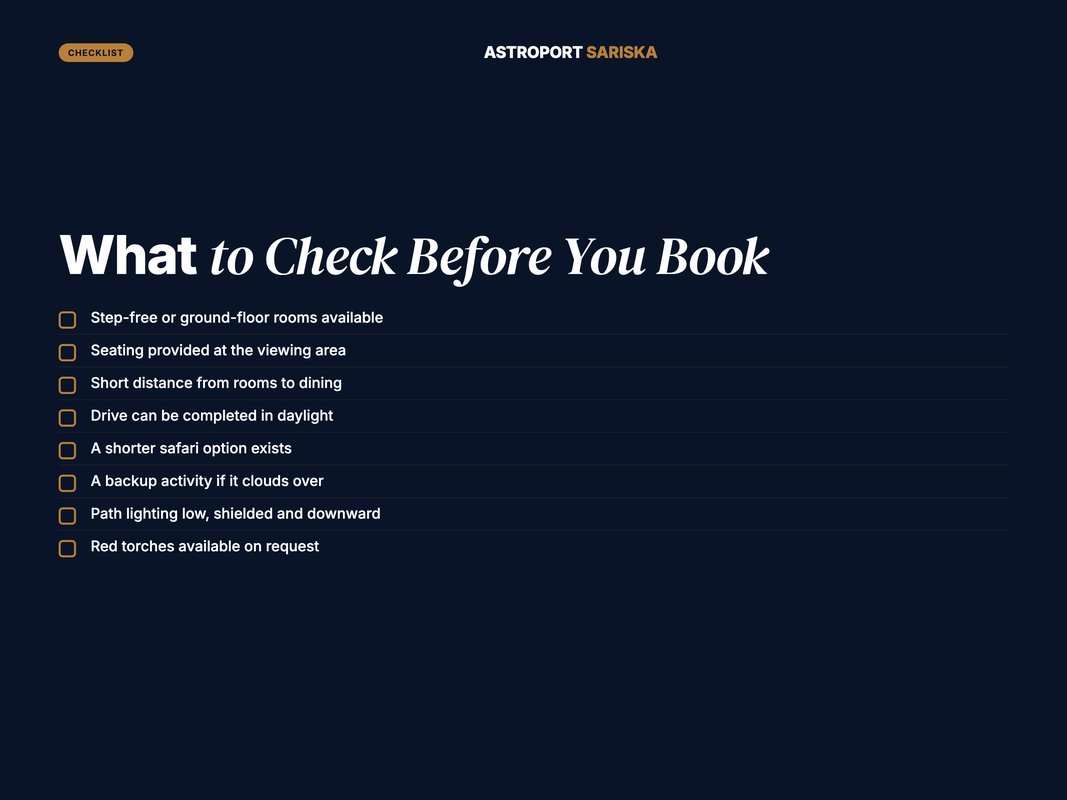
- Are there step-free or ground-floor rooms? Stairs decide everything for some travellers.
- Is there seating at the viewing area? Standing for an hour is not realistic.
- How far are rooms from dining? Long, dark walks between buildings are the usual complaint.
- Can the drive be done in daylight? Night arrivals are hard with both toddlers and elders.
- Is there a shorter safari option? Useful when a full route is too long for somebody.
- What happens if it clouds over? A backup activity saves the evening.
- Is the lighting low and downward? Good for the sky, but check paths are still safe.
Question seven is worth a follow-up. Dark-sky places keep light low on purpose. That is right for stars. Still, paths then need handrails and low lighting to stay safe.
So ask how they handle it. A good answer mentions low, shielded path lights and red torches.
Packing for Both Ends of the Range
One bag list covers most of it. So write it once and reuse it.
Warmth comes first. Then light. Then the small things that stop an evening ending early.
- Two warm layers each, not one
- A blanket per person
- Closed shoes for everyone, including the toddler
- A red torch, or red film over a normal one
- Any regular medicines, kept in the room, not the car
- A folding stool, if seating is limited
- Wet wipes and a spare set of toddler clothes
- Something warm to drink after the session
Then add one thing per person. A book, a toy, a pair of binoculars.
Those fill the gaps while somebody else is at the telescope.
Keep one bag for shared kit. Then nobody hunts through five suitcases for a torch.
Label the medicines bag clearly. Also, keep it in the room rather than the car, because the car may be parked some distance away.
Binoculars Are the Quiet Winner
Most people bring none. Still, a cheap pair does more for a mixed group than another telescope would.
They are easy to share. Also, an older adult can sit and scan comfortably, and a child can hold them without help.
There is no queue either. A telescope has one eyepiece, so somebody is always waiting.
Binoculars remove that problem entirely. Then the whole group can look at the same moment.
Jupiter’s moons show in steady binoculars, which surprises almost everyone (Source: NASA, 2026 — Jupiter Moons).
Quick Facts
- Stargazing needs no equipment to be rewarding, because bright planets are visible to the naked eye from dark skies (Source: NASA, 2026 — Skywatching).
- Jupiter’s four largest moons can be seen through a small telescope, which makes an easy shared first target (Source: NASA, 2026 — Jupiter Moons).
- Natural darkness is managed as a protected resource, which is why good sites keep outdoor lighting low (Source: US National Park Service, 2026 — Night Skies).
- Astroport Sariska is about 200 km from Delhi NCR, roughly four to five hours by road.
Getting There Without Wearing Everyone Out
The drive decides the mood of day one. So treat it as part of the trip, not a gap before it.
Leave after breakfast, not at dawn. Then everyone has slept, and you still arrive in daylight.
Break the drive once. A proper stop of twenty minutes beats three rushed ones. Pick the stop in advance, so nobody argues about it on the road.
Seat people deliberately. A toddler’s car seat next to a grandparent often works badly for both, so split them if you have two vehicles.
Also, carry water and snacks in the cabin rather than the boot. Because stopping to open the boot is what turns one break into three.
Plan to arrive with light to spare. Unfamiliar paths in the dark are the single hardest thing for both ends of the age range.
Then do nothing for the first hour. Everyone rests, nobody schedules anything, and the trip starts properly after that.
Check in as one group, not eight individuals. So send one person to the desk while everyone else sits down.
Ask for the rooms nearest the dining area for the oldest guests. Most places will do this if you ask on arrival rather than later.
Then walk the route to dinner once in daylight. That way nobody is learning the path for the first time in the dark.
Q: Should we split into two cars?
A: If you have the option, yes. It lets the toddler’s car leave earlier or later, and it removes most of the seating arguments.
Run the Trip in Shifts
This is the single most useful change you can make. Stop planning one schedule for eight people.
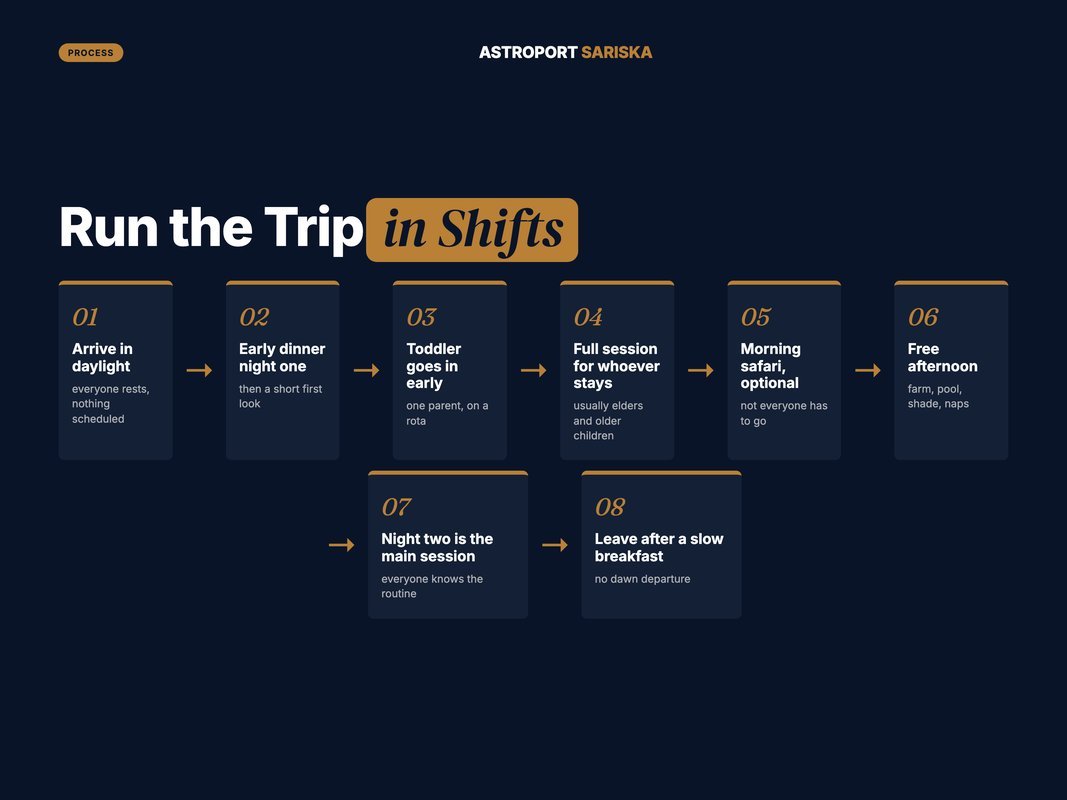
Instead, plan a spine and let people join it. Then nobody is dragged along and nobody is left out.
Here is a two-night shape that works.
- Arrive in daylight. Everyone rests. Nothing is scheduled.
- Early dinner on night one. Then a short first look at the sky.
- Toddler goes in early. One parent handles bedtime, on a rota.
- Full session for whoever stays. Usually grandparents and older children.
- Morning safari, optional. Not everyone has to go.
- Free afternoon. Farm, pool, shade, naps.
- Night two is the main session. Everyone knows the routine by now.
- Leave after a slow breakfast. No dawn departure.
Step three is the one families forget to agree in advance. So decide the bedtime rota in the car, before anyone is tired.
Write it down if the group is large. Then it is a plan rather than a nightly negotiation.
Also, give the non-parents a turn. Grandparents often want an evening with the toddler, and asking costs nothing.
Then nobody ends up doing it every night by default.
Where These Trips Go Wrong
Still, a few failure patterns repeat. All of them are avoidable.
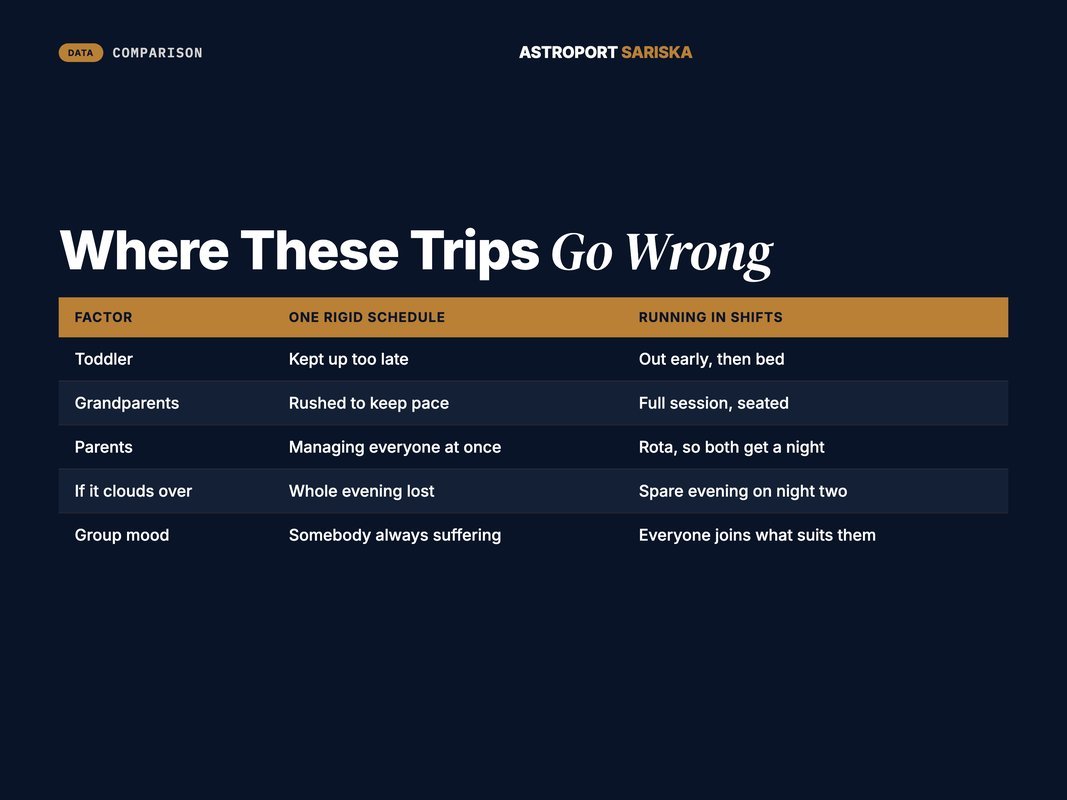
One rigid schedule. Everyone does everything, so somebody is always suffering.
A night arrival. Unfamiliar paths in the dark are hard for both ends of the range.
One night only. Everybody travels tired, and a single cloudy evening wastes the trip.
No handover plan. One parent quietly misses every session.
Underestimating cold. The evening ends early, and people blame the activity.
Booking rooms far apart. A scattered group spends the trip walking between buildings.
No quiet space in the afternoon. Both ends of the range need a nap window, and neither gets one.
Too much walking between points. Distance between room and dining is the detail people notice most.
Treating the sky as the only reason. Then clouds ruin everything. Our guide on one night versus two explains why.
Q: Is two nights really necessary?
A: For three generations, yes. One night means arriving tired, one chance at weather, and leaving before anyone has settled.
Why Astroport Sariska Suits Three Generations
Astroport Sariska is India’s first purpose-built astronomy resort, in Village Roopwaas near Sariska Tiger Reserve, Alwar, Rajasthan. The drive from Delhi NCR runs about 200 km, roughly four to five hours.
So that distance matters here. You can leave after breakfast and arrive in daylight, which removes the hardest part of a multi-generation trip.
The evening sessions are seated and run by resident astronomers. Because they run them nightly, they are used to mixed groups and pitch the explanation accordingly.
Meanwhile, the daytime carries its own weight. Sariska is next door for a morning safari, and the organic farm gives slower guests something to do close to the rooms.
The property runs on solar power and keeps outdoor lighting low and downward. That is what makes the sky work, and it is worth asking about torches on arrival.
Does your group lean older? Our guide to a senior-friendly stargazing stay goes deeper on comfort and pacing. For the youngest end, see stargazing with young children.
The Short Version
So yes, it works. The sky is one of the few activities that genuinely suits a toddler and a grandparent at the same time.
Still, the trip succeeds on logistics. Book two nights, arrive in daylight, and check rooms, seating and distances before you pay.
Then run the days in shifts. Share one meal, split everything else, and agree the bedtime rota before anyone is tired.
Do that and the evening looks after itself. Because once everyone is sitting down and looking up, the age range stops mattering.
Planning a trip for three generations? Plan your stay at Astroport Sariska and give yourselves two nights.
FAQ
Suitability
Q: Does stargazing actually suit older travellers?
A: Unusually well. It is seated, unhurried and needs no walking or fitness. For many grandparents it is the rare holiday activity they can join fully rather than watch from a distance.
Q: Is a safari suitable for both toddlers and grandparents?
A: Often yes, with care. The drive is seated and the vehicle does the work. Consider the early start and the cold, and check whether a shorter route is available for those who want one.
Planning
Q: What should we check before booking for three generations?
A: Check four things. Are rooms ground-floor or step-free? Is there seating at the viewing area? How far are rooms from dining? Can the drive be done in daylight?
Q: How many nights work best for a three-generation trip?
A: Two. One night means everyone travels tired and sees very little. Two nights give you a spare evening for weather and a full day that does not revolve around driving.
Running the Days
Q: How do you handle very different bedtimes?
A: Split the evening. Take the toddler out early for a short look, then hand over so the older adults can stay for the full session. Trying to keep everyone out together is what usually fails.
Q: What is the most common mistake on multi-generational trips?
A: Planning one schedule for everybody. The trip works when the group splits and rejoins at meals, rather than when all eight people do every activity together.