
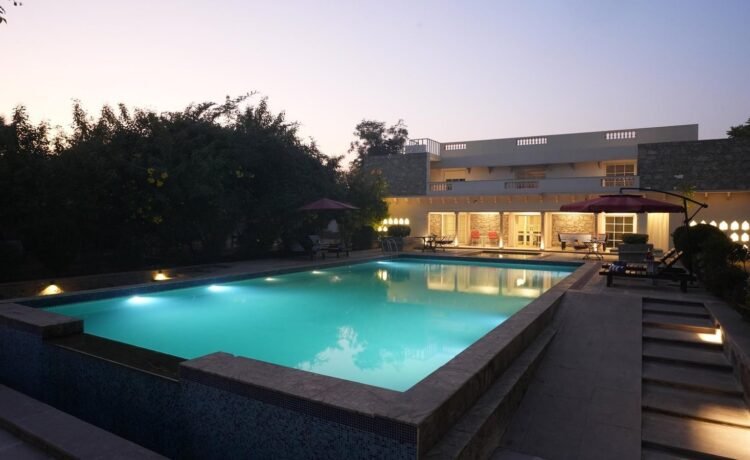
It is 6:40 p.m. and the sun has gone. So somebody asks whether the telescopes are out yet.
They are not. Because the sky still has an hour of light left in it, and nobody can see a thing.
That gap surprises most first-timers. So this guide explains the real clock behind stargazing session timings.
First, you will learn why twilight, not sunset, sets the start. Then you will see how the timing shifts across the year.
Also, you will see how a session usually unfolds. Finally, you will know what makes a night run long or short.
The Short Answer
Sessions start when the sky is properly dark, not when the sun sets. So that is usually well over an hour after sunset.
They typically run for a couple of hours. Still, a clear moonless night often stretches longer.
Neither figure is fixed. Because sunset moves through the year, the start time moves with it.
The moon shifts things too. So a bright moon can push the good observing later, after it sets.
Most places therefore confirm the night’s timing on the day. That is not vagueness. Instead, it is the only honest way to schedule around the sky.
Q: Can I just ask for a fixed time when booking?
A: You can ask, and you will get a guide. Still, expect it to be confirmed on the day. Because sunset, cloud and moonrise all move, a fixed slot booked months ahead is rarely the best one.
Twilight Is the Real Clock
Sunset is not darkness. Instead, it is the beginning of a long fade.
Astronomers split that fade into three stages, each defined by how far the sun has dropped below the horizon.
Civil twilight ends when the sun is 6 degrees down. At that point the brightest stars and planets appear, and you can still make out the landscape (Source: US National Weather Service, 2026 — Definitions of Twilight).
Nautical twilight ends at 12 degrees. So the horizon is still faintly visible, but detailed outdoor work needs a light (Source: US National Weather Service, 2026 — Definitions of Twilight).
Astronomical twilight ends at 18 degrees. Then the sky reads as fully dark to a casual observer (Source: US National Weather Service, 2026 — Definitions of Twilight).

That last stage is the one that matters. Because faint objects such as galaxies and nebulae need the sun more than 18 degrees down, real deep-sky work waits for it (Source: US National Weather Service, 2026 — Definitions of Twilight).
So a good session often opens during twilight with the moon or a bright planet. Then it moves to fainter targets once the sky finishes darkening.
Q: How long after sunset is it fully dark?
A: Roughly an hour to an hour and a half at Indian latitudes. Because the sun sets at a steep angle here, twilight is shorter than in Europe. Still, it is far longer than most people expect.
What Shifts Your Start Time Through the Year
Three things move the clock. Here is how each one behaves.
| What changes | Effect on start time | Effect on session length |
|---|---|---|
| Season | Later start in summer, earlier in winter | Longer nights in winter |
| Moon phase | Little change to the start | Best hours move to after moonset |
| Cloud cover | Delays or interrupts the start | Can shorten the night considerably |
| Group size | Slightly later start while everyone gathers | Longer if there are many telescope turns |
Winter is the quiet winner here. Because darkness falls early and lasts long, you get more usable hours without a late night.
Summer works the other way. So a session may not truly begin until quite late.
There is one more Indian factor. At Astroport Sariska, astronomy activities pause through the rainy season, from June until August.
So the practical season runs from September round to late May. Autumn and winter give the most reliable skies within it.
Q: Which season gives the best session?
A: Winter, on balance. Because the air is dry and stable, star images stay sharp. Also, darkness arrives early, so you are not up until 2 a.m.
How a Session Usually Runs
Most nights follow a similar arc. So here is the shape of it.
-
Gather before dark. First, everyone assembles while there is still light. Because this is when briefings and safety notes happen, it saves fumbling later.
-
Start with the obvious. Then the moon or a bright planet comes first. They cut through twilight easily.
-
Let eyes adapt. Meanwhile, the group gives their eyes twenty to thirty minutes away from screens (Source: NASA, 2026 — How to Find Good Places to Stargaze).
-
Run a constellation tour. Next, someone walks the group through the naked-eye sky and how to navigate it.
-
Move to deep-sky targets. So once full darkness lands, star clusters, nebulae and galaxies come into range.
-
Finish with questions. Finally, the last stretch is usually the most relaxed, and often the best part.
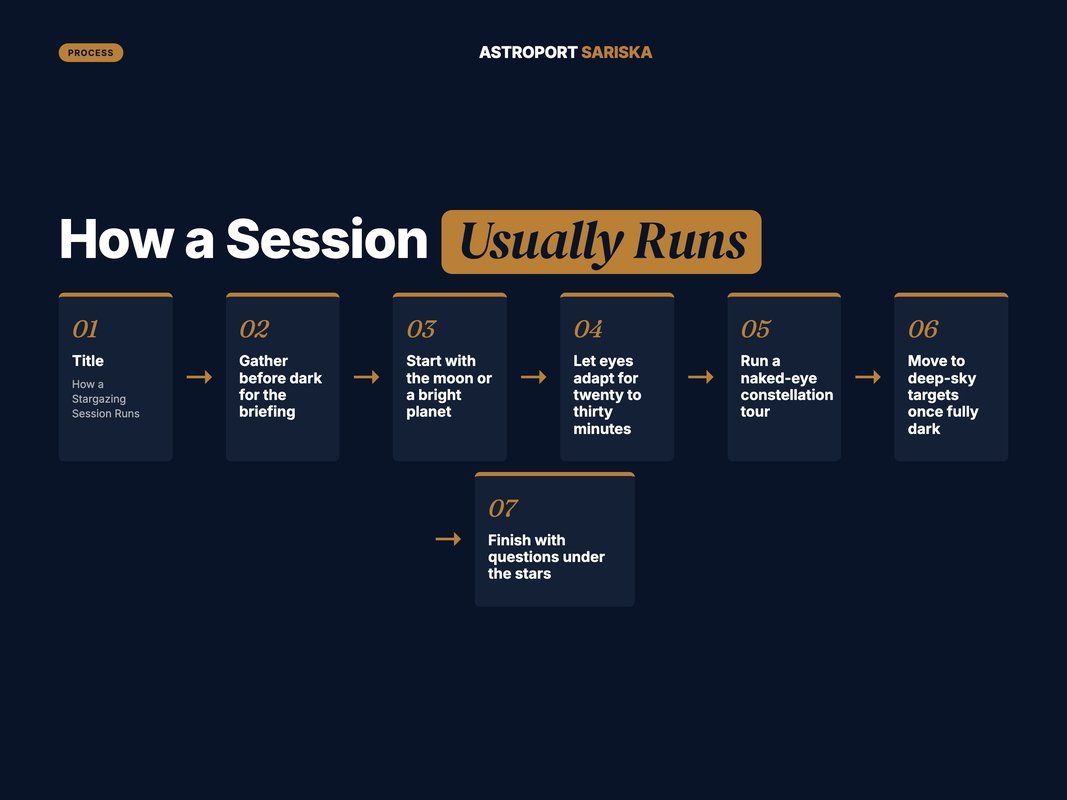
Nobody is locked to that order. Because the sky decides, a good astronomer reorders things constantly.
Q: When is the best bit?
A: Usually the second half. So by then your eyes are fully adapted, the sky has darkened further, and the group has stopped chattering.
What Makes a Night Run Long or Short
Two nights at the same site can feel completely different. Here is what separates them.
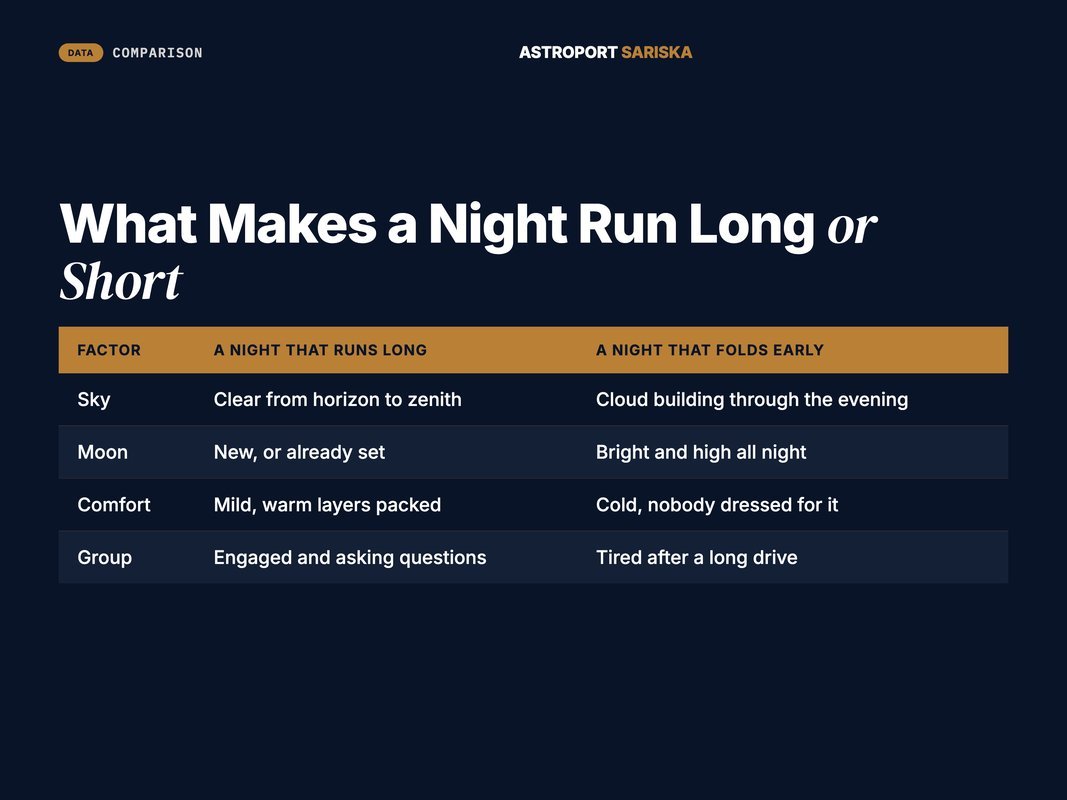
A long night needs a clear sky, no moon and a group willing to stay out. Also, comfortable temperatures help more than people admit.
A short night usually comes down to cloud. Meanwhile, cold is the second culprit, because standing still gets chilly fast.
So dress for a night colder than the forecast suggests. Because you are not moving, you lose heat quickly.
Q: Do sessions get cancelled if it clouds over?
A: Rarely cancelled outright. So astronomers usually switch to talks, telescope demos or sky maps while watching for gaps. Also, thin cloud still allows the moon and bright planets.
Getting the Most From Your Night
Small preparations change the experience completely.
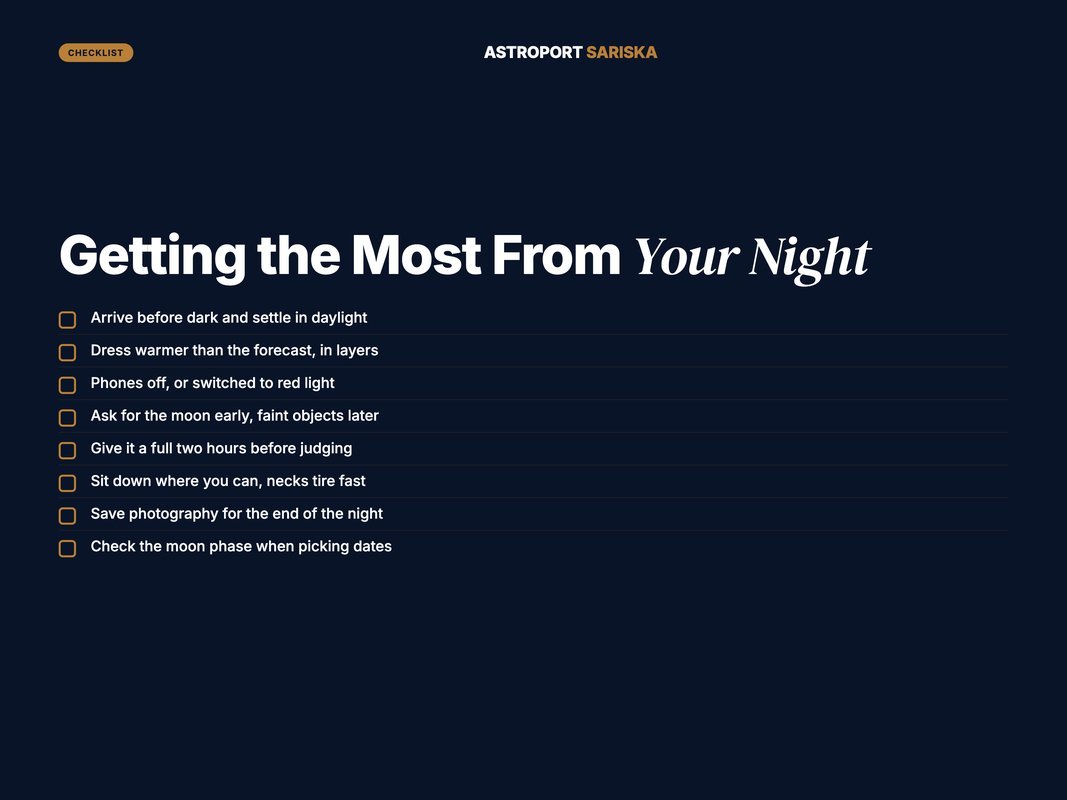
- Arrive before dark, so you settle in daylight
- Dress warmer than the forecast suggests, in layers
- Keep phones off, or switch to a red-light setting
- Ask for the moon early, then the faint objects later
- Give the session a full two hours before judging it
- Sit down where you can, since necks tire quickly
- Save photography for the end of the night
- Check the moon phase before you pick your dates
Also, ask questions. Because resident astronomers usually enjoy the tangents, the session gets better when people engage.
Q: What is the single most common mistake?
A: Checking a phone. So one bright screen resets everybody’s night vision, not just yours. Red light solves it entirely.
Why Astroport Sariska
Timing only matters if the sky is worth waiting for. So the site does the heavy lifting.
Astroport Sariska is India’s first astronomy resort. It sits at Tehla in the Aravalli hills, beside the Sariska Tiger Reserve in Alwar, Rajasthan.
The drive is about four to five hours from Delhi NCR. So you can arrive in daylight and be settled well before twilight ends.
That matters more than it sounds. Because arriving late costs you the adaptation window, an afternoon arrival genuinely improves your night.
The skies here are dark enough for the fainter half of the session to work. Guests see thousands of stars on a clear night, against a couple of dozen from central Delhi.
Sessions are run by resident astronomers with professional telescopes. Also on offer are constellation tours, astrophotography sessions, telescope-making workshops and safe solar observation by day.
Do check the calendar before booking. Astronomy activities pause through the rainy season, from June until August.
Days fill easily too. For example, there are jeep safaris into Sariska, farm walks and a spa. Plan your stay around a moonless night.
Conclusion
So the honest answer is that sunset is not the start time. Full darkness is, and it arrives well over an hour later.
Twilight runs in three stages, ending when the sun is 18 degrees below the horizon. Only then do faint objects become reachable.
Most sessions then run about two hours. Still, clear moonless nights stretch on, and cloudy ones fold early.
Three levers decide your night. Check the season, check the moon, and arrive before dark.
Do that and the timing takes care of itself. Plan your stargazing night and give the sky a proper window.
FAQ
Q: What time do stargazing sessions usually start?
A: They begin once the sky is genuinely dark, which is well after sunset rather than at it. That point shifts through the year with the seasons. Most resorts confirm the exact time on the day, because it depends on sunset and the moon.
Q: How long does a stargazing session last?
A: Typically a couple of hours, though it varies with the sky and the group. Cloud can cut it short, while a clear moonless night often runs longer. Your eyes also need twenty to thirty minutes just to adapt.
Q: Why don’t sessions start right after sunset?
A: Because the sky stays lit for a long time after the sun goes down. The sun has to drop about 18 degrees below the horizon before the sky reads as fully dark. Until then, faint objects simply cannot be seen.
Q: Do stargazing sessions run in every season?
A: Not everywhere. At Astroport Sariska, astronomy activities pause through the rainy season, from June until August. Outside that window, clear-sky months in autumn and winter are the most reliable.
Q: What happens if it is cloudy on the night?
A: Sessions usually adapt rather than cancel outright. Astronomers often switch to talks, telescope demonstrations or sky-mapping while waiting for gaps in cloud. Thin cloud still allows the moon and bright planets.
Q: Is a late-night session better than an early one?
A: Often yes, for two reasons. The sky keeps darkening for a while after twilight ends, and your eyes keep gaining sensitivity for over an hour. Late sessions also avoid the moon on many nights.
Q: Should children attend the full session?
A: Most families do the first hour and then decide. Younger children usually enjoy the telescope views of the moon and planets, which come early. The fainter deep-sky observing later suits older kids and adults better.