
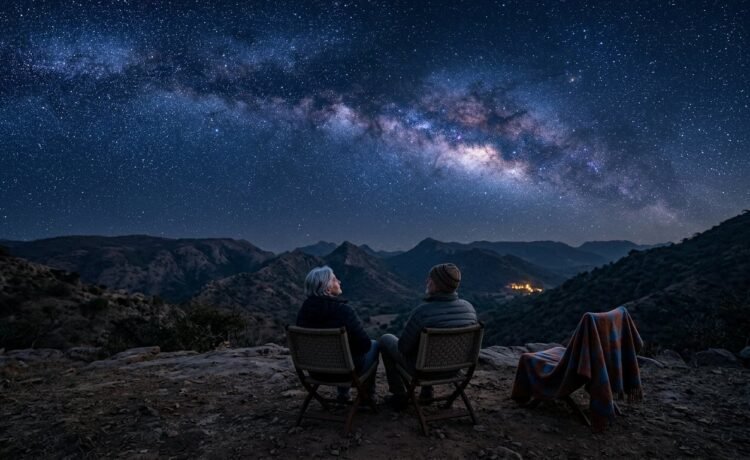
It is half past ten, and the telescope is pointed at Orion. Your breath drifts past the eyepiece like smoke.
Then your toes start to complain. A few minutes later, your fingers join in.
That is when most first-timers learn the real lesson of a desert winter. The sky is generous, but the night is cold.
So this guide covers what to wear stargazing Rajasthan winter nights really ask for. It is not a full trip list. For that, see our complete astronomy trip packing list.
Instead, this one zooms in on the cold. First, you will see why the night feels colder than the forecast. Then you will build your layers and sort out feet, hands and head.
After that, you will pack a small night kit and learn what to leave behind. Finally, there are notes for children and older travellers.
Why a Winter Night in the Aravallis Feels So Cold
Daytime in a Rajasthan winter is gentle. In fact, the afternoons are often warm enough for a T-shirt.
But the night is a different place. In Alwar, the average January low is about 7.6°C (Source: Wikipedia, 2026 — Alwar climate table, 1991–2020).
December is not far behind, with an average low of about 9.5°C (Source: Wikipedia, 2026 — Alwar climate table, 1991–2020).
Some nights go much lower. The coldest reading on record in Alwar is −0.8°C, set in January (Source: India Meteorological Department, 2026 — Climatological Tables 1991–2020).
Those numbers tell only half the story, though. Because you stand still for hours, your body makes very little heat of its own.
Clear skies add to it. Since there is no cloud cover overhead, the ground gives up its warmth soon after sunset.
So the best stargazing nights are also the coldest ones. That is not bad luck. It is simply how a dry, clear winter sky behaves.
The Standing-Still Problem
A winter walk in Delhi feels fine in a sweater. Yet a night on an observing lawn is not a walk.
You stand at a telescope, wait your turn, and look up. Meanwhile, the cold creeps in through your feet.
That is why you should dress for a night colder than the forecast. Plan for the low, not the evening.
Q: Which winter months are the coldest for stargazing?
What to Wear Stargazing in a Rajasthan Winter: Three Layers
Think in layers, not in one heavy coat. Several thin layers trap warm air between them.
Health agencies give the same advice. The US Centers for Disease Control and Prevention suggests several loose layers and a water-resistant coat (Source: CDC, 2026 — Winter Weather Prevention).
Loose matters more than people think. Because tight clothes squeeze out the air, they insulate less.
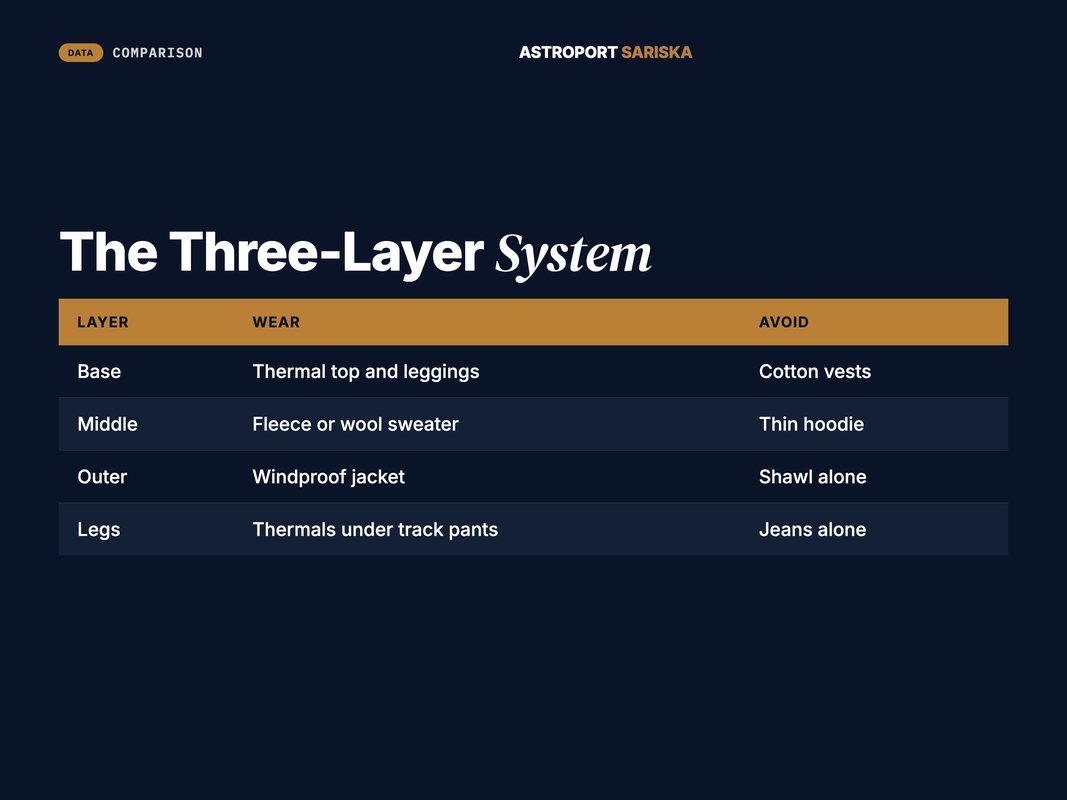
Here is how the layers split the work.
| Layer | What to wear | What to avoid |
|---|---|---|
| Base | Thermal top and leggings | Cotton vests that hold sweat |
| Middle | Fleece, wool sweater or down vest | A single thin hoodie |
| Outer | Windproof, water-resistant jacket | An open shawl on its own |
| Legs | Thermals under track pants or trousers | Jeans on their own |
Start with the base. Thermals hold a thin, warm layer against your skin. So pick wool or synthetic if you can, since cotton stays damp.
Then add warmth in the middle. A fleece or a wool sweater does most of the insulating.
Finally, block the wind. Even a light breeze steals heat fast when you are not moving.
You Probably Own Most of It Already
You do not need mountain gear for this. Good cold night stargazing clothing is mostly what a Delhi winter already asks for.
Thermals, a fleece and a windcheater cover most nights. So check your cupboard before you shop.
If you do buy something, start with the base layer. Then add a windproof shell, since it does the most work.
Where the Shawl Fits In
Many of us travel with a shawl or a stole. It is a lovely extra layer, and easy to pack.
Still, wear it over a jacket, not instead of one. Because a shawl lets wind through, it works best as the final wrap.
It also doubles as a lap blanket when you sit. So bring one, but do not rely on it alone.
Q: Is a heavy coat enough on its own?
Feet, Hands and Head: Where the Cold Gets In
Most people dress their body well and forget the edges. Yet the edges are where a winter night wins.
The CDC lists the parts to cover first: nose, ears, toes, cheeks, chin and fingers (Source: CDC, 2026 — Winter Weather Prevention).
That list reads like a stargazer’s weak spots. So here is how to protect each one.
Feet First
Cold feet end more stargazing nights than cloud does. Because you stand on cold ground, the chill climbs up through your soles.
So wear closed shoes or boots, never sandals. Then add thick wool socks, and pack a spare pair.
Change into the dry pair just before the session. Damp socks from the day lose their warmth quickly.
Hands That Still Work
Gloves are essential, but bulky ones get in the way. After all, you will want to touch a focus knob or your phone.
So try two layers. Thin liner gloves let you work, and warm mittens go over them between turns.
Also keep a hot cup handy. A steel flask of chai warms the hands as much as the stomach.
Head, Ears and Neck
A woolly cap or a monkey cap covers your head and ears. Meanwhile, a scarf or muffler seals the gap at your collar.
That collar gap matters. Since you tilt your head back to look up, a cold draught slides down your neck.

Q: Mittens or gloves for stargazing?
The Red Torch and the Small Night Kit
Once you are dressed, the rest of the kit is small. But each item earns its place.
The red torch comes first. Red light has the smallest effect on your night vision (Source: NASA, 2026 — How to Find Good Places to Stargaze).
That matters because your eyes adapt slowly. Full night vision can take half an hour or more to arrive (Source: NASA, 2026 — How to Find Good Places to Stargaze).
So one white flash undoes it all. Worse, it undoes it for everyone near you.
A headlamp with a red mode is ideal. Otherwise, tape red cellophane over a small torch.
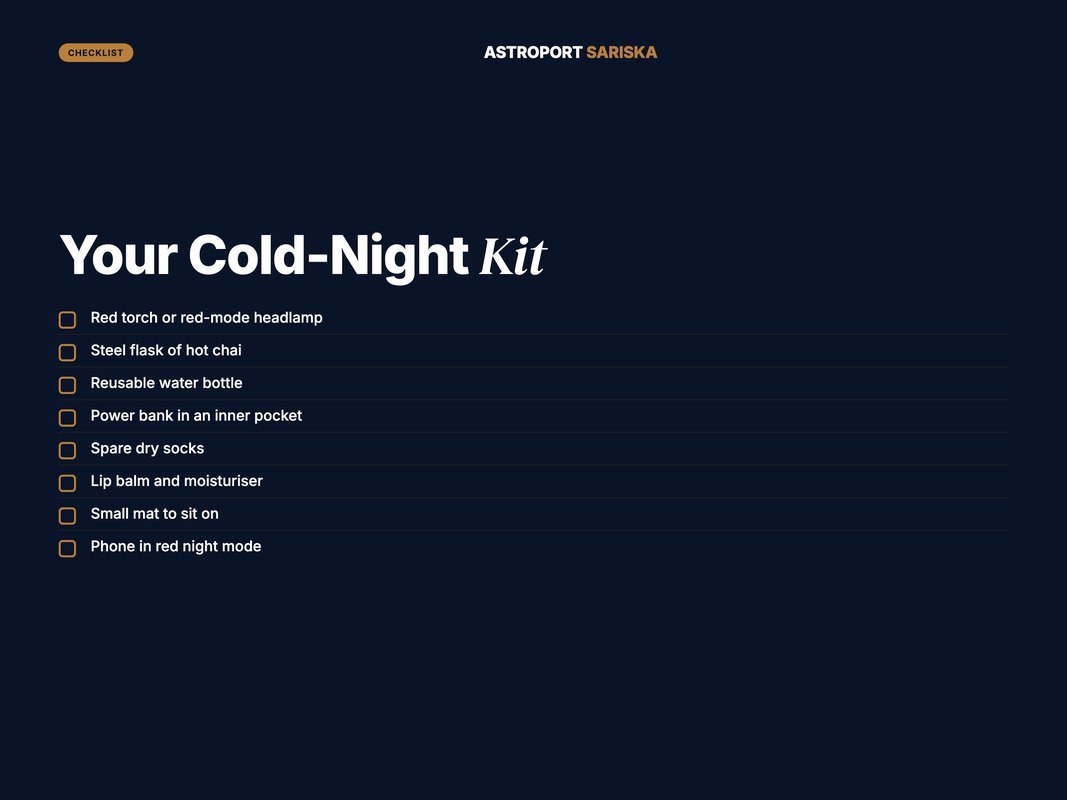
Here is the rest of the cold-night kit.
- Red torch or red-mode headlamp.
- Steel flask of hot chai or soup.
- Reusable water bottle
- Power bank in an inner pocket.
- Spare pair of dry socks.
- Lip balm and a light moisturiser.
- Small mat or folded blanket to sit on.
- Phone set to a red night mode.
The power bank point is easy to miss. Because cold drains batteries, keep phones and power banks close to your body.
Dry air matters too. So lip balm and moisturiser save you from cracked lips by the second night.
Late at night, dew can settle on benches and mats. Because damp spreads the cold, a mat with a waterproof base keeps you drier.
That small mat earns its place in any stargazing packing list India winters call for. Plus, it makes lying back to watch for meteors far more pleasant.
If you are timing your evening, our guide to stargazing session timings explains when the dark really begins.
Q: Can I just use my phone torch?
What Not to Bring on a Cold Stargazing Night
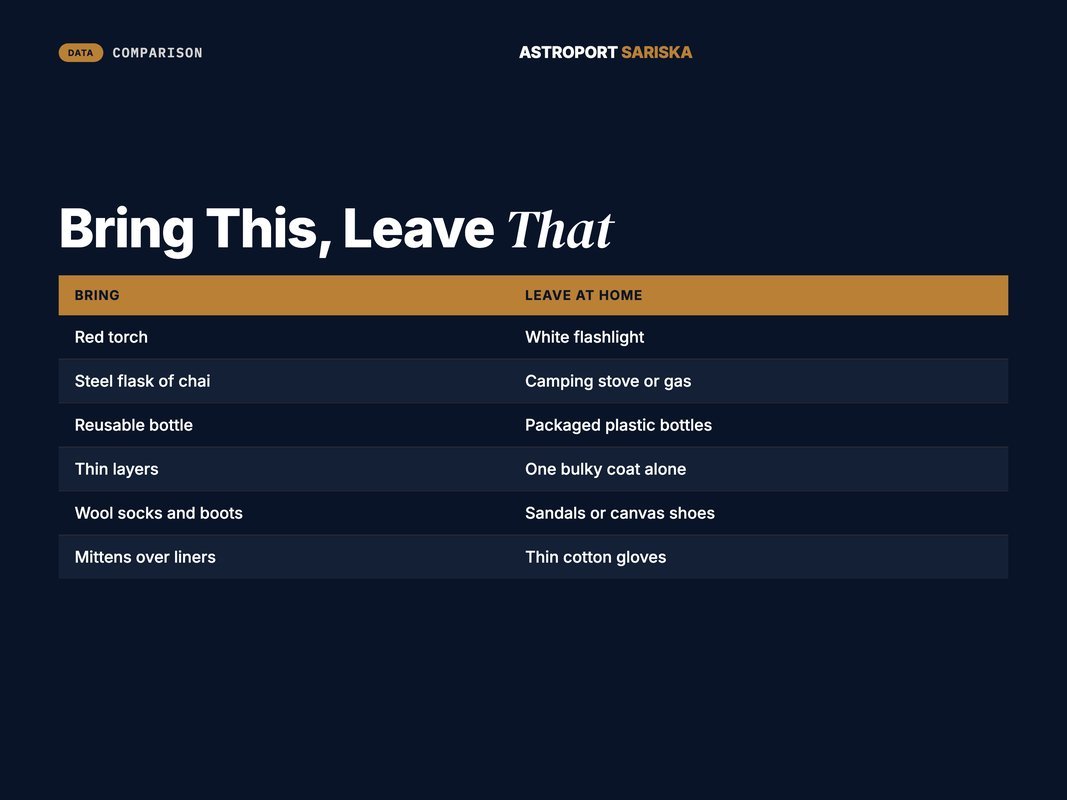
A good stargazing packing list India travellers can trust also says what to leave behind. Some items are useless, and some are not allowed.
Start with heat sources. Flammable objects are prohibited on the resort premises (Source: Astroport Sariska, 2026 — Resort Terms and Conditions).
So leave camping stoves, gas canisters and burners at home. Instead, rely on layers and a hot flask.
Next, skip packaged water. The resort is a no-plastic zone and has removed packaged water bottles (Source: Astroport Sariska, 2026 — Home).
Guests are encouraged to bring reusable items instead (Source: Astroport Sariska, 2026 — Resort Terms and Conditions). So pack a steel bottle and a steel flask.
Also, leave the bright white flashlight behind. It spoils the dark for the whole lawn.
Finally, skip the portable speaker. Loud music is not allowed at the resort (Source: Astroport Sariska, 2026 — Resort Terms and Conditions).
Jeans, Sandals and Other Traps
Jeans feel warm at dinner. However, they turn cold and stiff once the night settles.
Canvas shoes are another trap. Because thin soles sit right on the cold ground, your feet chill fast.
And cotton gloves barely help at all. So swap them for wool or fleece.
Q: Should I bring my own telescope?
Dressing Children and Older Travellers for the Cold
Kids and grandparents feel the night differently. So they need a little more planning.
Children
Children often get cold before they say so. Then the evening ends in tears rather than wonder.
The American Academy of Pediatrics advises several thin layers, plus insulated boots, mittens or gloves, and a hat (Source: AAP, 2026 — Winter Safety Tips).
It also advises regular indoor breaks to warm up (Source: AAP, 2026 — Winter Safety Tips).
So plan short stints outside. Then come in for a warm drink, and head back out.
Watch for the warning signs as well. Shivering means the body is trying to warm up. Sluggish or clumsy behaviour means it is time to go inside (Source: AAP, 2026 — Winter Safety Tips).
For more ideas, read our guide to stargazing with young children.
Older Travellers
The CDC counts older adults without enough warm clothing among those at higher risk in the cold (Source: CDC, 2026 — Winter Weather Prevention).
So give elders the warmest layers in the group. A chair, a blanket over the knees and a hot drink make a long session easy.
Good footwear matters for safety too. Because paths are dark, sturdy shoes and a red torch help prevent stumbles.
Our senior-friendly stargazing guide covers pacing and comfort in more detail.
Q: How long can kids stay out on a cold night?
How to Dress for the Night, Step by Step
Timing your layers matters as much as packing them. Here is the order that works.
-
Lay it all out. First, set out every layer before the sun goes down.
-
Eat a warm dinner. Then head out with a hot meal inside you.
-
Dress in your room. Next, put on thermals, the middle layer and the jacket indoors.
-
Swap into dry socks. Also change socks right before you step out.
-
Add the edges. Meanwhile, pull on the cap, scarf, liners and mittens.
-
Fill the flask. Finally, carry something hot to hold.

Dress fully before you leave. Because adding layers in the dark means torches and fumbling, it costs everyone night vision.
Then peel off a layer if you get warm. That is far easier than finding one you left behind.
Q: When should I put on my warm layers?
Why Astroport Sariska
Cold nights are worth it when the sky is truly dark. So the place matters as much as the socks.
Astroport Sariska is India’s first astronomy resort. It sits at Village Roopwaas, Tehla, beside Sariska Tiger Reserve near Gate No. 2 in Alwar (Source: Astroport Sariska, 2026 — Contact Us).
It is an easy road trip from Delhi NCR. Gurgaon is about 212 km away, roughly three hours by expressway (Source: Astroport Sariska, 2026 — Contact Us).
So you can arrive in daylight and unpack your layers before the cold sets in.
Resident astronomers run the sessions with professional telescopes. Meanwhile, the Orbit Restaurant serves a seasonal menu with home-grown ingredients (Source: Astroport Sariska, 2026 — Our Facilities).
That makes a warm dinner before the session easy. Then the Sparsh Spa is there for the slow morning after.
Winter is prime sky season here. In fact, astronomy activities pause only from June until August (Source: Astroport Sariska, 2026 — Resort Terms and Conditions).
Plan your winter stargazing night and pack the layers.
Conclusion
So the sky does not care what you wear. But your evening does.
Plan for the night-time low, not the warm afternoon. Then build three layers: thermals, a warm middle and a windproof shell.
Next, guard the edges. Wool socks, boots, liner gloves under mittens, a cap and a scarf do most of the work.
Pack a red torch, a hot flask and spare socks. Also leave the stove, the plastic bottles and the white torch at home.
That is what to wear stargazing in a Rajasthan winter. Dress warm, stay out longer, and see more. Book your winter night under the stars.
FAQ
Clothing and Kit
Q: What should I wear for stargazing in Rajasthan in winter?
A: Wear three layers: thermals, a fleece or wool sweater, and a windproof jacket. Then add wool socks, boots, a cap, a scarf and gloves. Dress for the night-time low, not the warm afternoon.
Q: How cold does it get at night near Sariska in winter?
A: December and January nights are the coldest, and some come close to freezing. Because you stand still while stargazing, it feels colder than the forecast. So always pack for the low.
Q: What is the most important item on a cold-night stargazing packing list?
A: Warm footwear and thick socks. Cold feet end more sessions than almost anything else. A red torch comes a close second, because it protects everyone’s night vision.
Q: Why do stargazers use red torches?
A: Red light has the smallest effect on night vision. Your eyes take a long time to adapt to the dark, and white light resets them. So a red torch lets you walk safely without spoiling the view.
Rules, Children and Older Travellers
Q: What should I not bring to a stargazing night?
A: Leave white flashlights, camping stoves and gas canisters at home. Flammable objects are prohibited at Astroport Sariska, and single-use plastic is discouraged. Carry a steel flask and a reusable bottle instead.
Q: How do I keep children warm while stargazing?
A: Dress them in several thin layers with a hat, mittens and insulated boots. Then plan short stints with indoor warm-up breaks. If a child turns sluggish or clumsy, take them inside.
Q: Is cold night stargazing clothing different for older travellers?
A: The layers are the same, but go one step warmer. Also add a chair, a blanket over the knees and a hot drink. Sturdy shoes and a red torch help on dark paths too.