
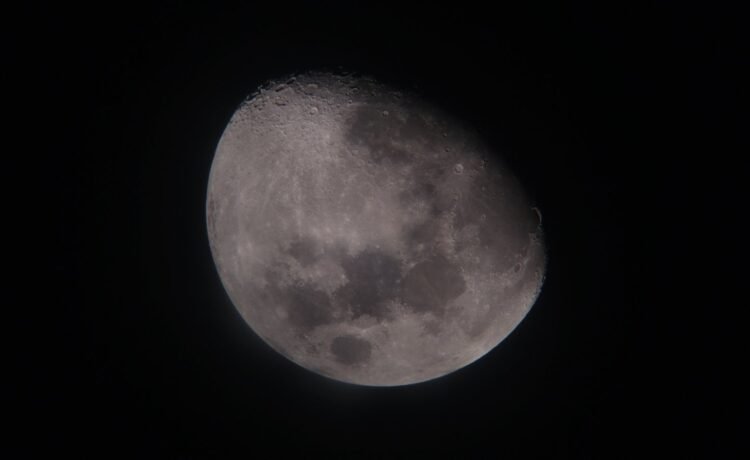
Picture one full day. At dawn you track pugmarks in a forest jeep. By night you trace the Milky Way through a telescope. So yes, a safari and stargazing trip fits into one place.
It sounds like two holidays. So most people assume you must choose. You do not. In fact, this combo is exactly what Sariska is built for.
The reason is simple. So the forest comes alive at dawn and dusk. Meanwhile, the sky comes alive after dark. These two windows barely overlap, so one base can hold both. Astroport Sariska sits right by Sariska Tiger Reserve, which makes the pairing effortless.
This guide walks you through the whole rhythm. The dawn safari. A slow, restful day. The dark-sky night. What you may see in the forest and overhead. A simple one-to-two-night plan. And who this trip suits best. Let us begin where the day does.
A quick promise first. This will stay honest throughout. Safaris do not promise tigers. Skies do not promise stars. Yet the trip still works, and here is exactly why.
How One Day Holds Both
The trick is timing. Nature splits the day for you. Wildlife and stars simply keep different hours.
Animals move most in the cool early morning and late evening. The midday heat sends them into the shade. So safaris run at dawn and dusk, when the forest is awake.
This is why early starts matter so much. The light is soft and golden then. Tracks are fresh from the night. Predators and prey are both on the move.
The stars work in reverse. They only appear once the Sun is gone. Then the real show begins, hours after the last safari ends.
So your single day naturally splits in two. The forest claims the edges of the light. The galaxy claims the deep dark in between sleep.

So there is no clash. Your day has a morning act, a quiet interval and a night act. One base serves all three.
That is the heart of a safari and stargazing trip. You are not racing between two destinations. Instead, you stay put and let the day unfold around you.
Think of it as one long, slow rhythm. The forest opens your day. The sky closes it. In between, you simply breathe.
So the magic is in the gaps. Other trips cram and rush. This one asks you to wait, watch and look up.
Q: Why do safari and stargazing fit in one trip?
A: Because they use different hours. Wildlife stirs at dawn and dusk, while stars appear only after dark. One base near the reserve holds both, with restful gaps in between.
The Dawn Safari
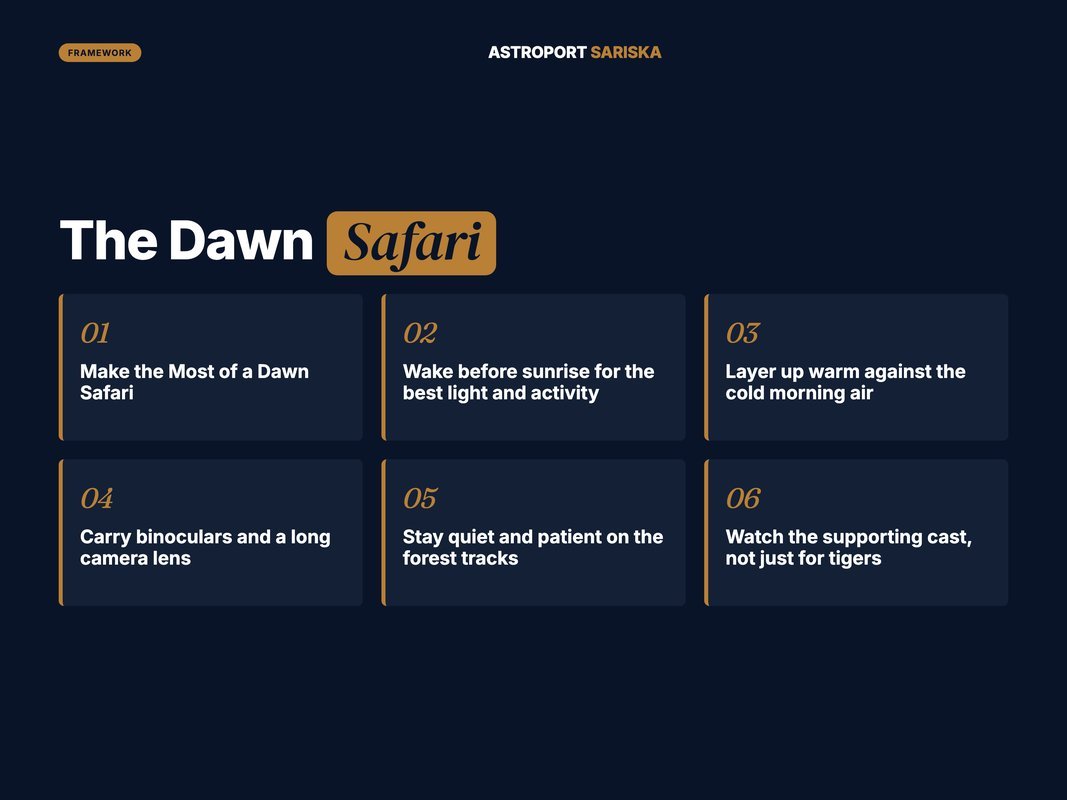
Set your alarm early. The best safari light comes just after sunrise. So the day starts before most holidays even wake up.
You ride in a shared, seated vehicle along fixed forest tracks. Basically, this is wildlife on the forest’s terms. So there is no trekking and no chasing.
Sariska is a tiger reserve in the Alwar district of Rajasthan, part of the Aravalli Range (Source: Wikipedia, 2026 — Sariska Tiger Reserve). It became part of India’s Project Tiger back in 1978 (Source: Wikipedia, 2026 — Sariska Tiger Reserve). So you are riding through a serious conservation landscape.
No Tiger Is Guaranteed
Now the honest part. A tiger sighting is never guaranteed. Tigers are shy, wide-ranging and few. Many drives end without one, and that is normal.
So go in with open eyes. The reserve is real wilderness, not a show. Some mornings the forest stays quiet and still. Other mornings it bursts with life.
Also, dress for the cold start. Dawn in winter can be sharp. A warm layer and a cap make the early ride far easier.
So treat the drive itself as the reward. The morning forest is quiet and cool. Mist often hangs over the grass. Even a slow morning feels like a privilege out here.
But the forest still delivers. You may meet leopards, jackals and herds of deer. Meanwhile, birds call from every direction. Ultimately, the chase is the point, not the trophy.
Q: Is the tiger safari guaranteed to show a tiger?
A: No. Tigers are rare and elusive, so any sighting is luck. The drive is seated and vehicle-based along set tracks. Even tiger-free, you often spot leopards, deer and dozens of birds.
What You May See in the Forest
The cast is rich, even on a quiet morning. Tigers headline the reserve. Yet the supporting roles steal many a drive.
Apart from the Bengal tiger, Sariska holds leopards, jungle cats, caracals, striped hyenas and golden jackals (Source: Wikipedia, 2026 — Sariska Tiger Reserve). You will also see plant-eaters like chital, sambar deer, nilgai and wild boar (Source: Wikipedia, 2026 — Sariska Tiger Reserve).
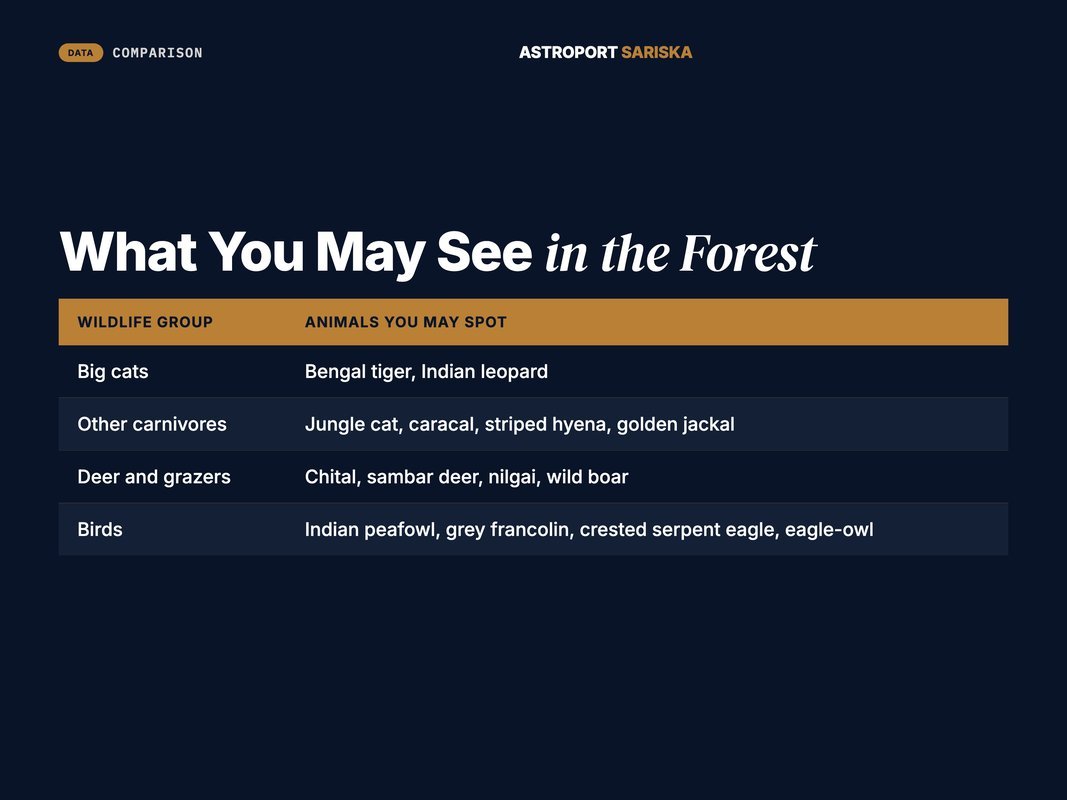
Then there are the birds. The reserve is alive with them all year. Look for the Indian peafowl, grey francolin, sandgrouse, the crested serpent eagle and the Indian eagle-owl (Source: Wikipedia, 2026 — Sariska Tiger Reserve).
So pack patience and a long lens. Also bring binoculars if you have them. The forest rewards a slow, watchful eye more than a fast one.
Each season shifts the cast a little. Winter brings clearer air and active mornings. Summer dawns can feel sparse before the heat builds. So an autumn or winter visit usually pays off most.
Q: What animals live in Sariska besides tigers?
A: Plenty. The reserve holds leopards, jungle cats, hyenas and jackals, plus chital, sambar deer, nilgai and wild boar. Birds like peafowl, eagles and owls are common. Read more in the best time to visit Sariska guide.
The Slow Middle of the Day
After the safari, the pace drops. This is by design. The hot hours are for rest, not action.
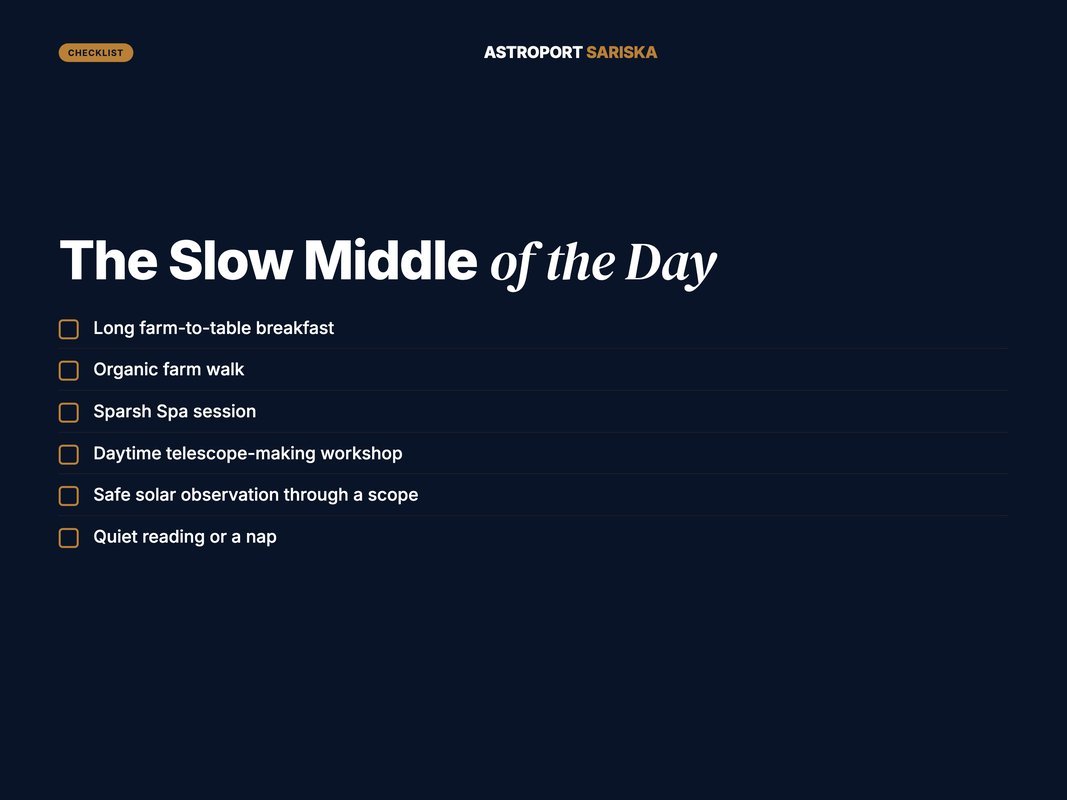
So you slow right down. A long breakfast. Then a farm walk. Maybe a quiet read under a tree. The day is yours to waste well.
At Astroport, the middle hours fill themselves. There is an organic farm and farm-to-table food. The Sparsh Spa stays open. You can also try a daytime telescope-making workshop or a solar observation session.
So the quiet is never boring. You can nap, eat well or learn something new. Some guests walk the farm rows. Others simply sit with chai and a view.
A solar session is a nice surprise here. You safely watch the Sun through a special scope. So the astronomy starts long before dark.
This gap matters more than it looks. It bridges the early dawn start and the late night ahead. Without it, the day would simply exhaust you.
Then, as the light softens, the mood shifts again. The forest quietens. Soon the first stars blink on. So the night act is about to begin.
Q: What do you do between the safari and stargazing?
A: You rest and recharge. Enjoy a slow breakfast, a farm walk, a spa hour or a daytime astronomy workshop. The quiet middle bridges the early start and the late night.
The Dark-Sky Night
Now look up. This is why you came after dark. Sariska’s distance from city glow makes the difference.
The night sky here is genuinely dark. So far more stars appear than you ever see from a city. From a dark site, the naked eye can take in around 2,000 stars on a clear, moonless night (Source: EarthSky, 2024. How many stars on a clear, moonless night?).
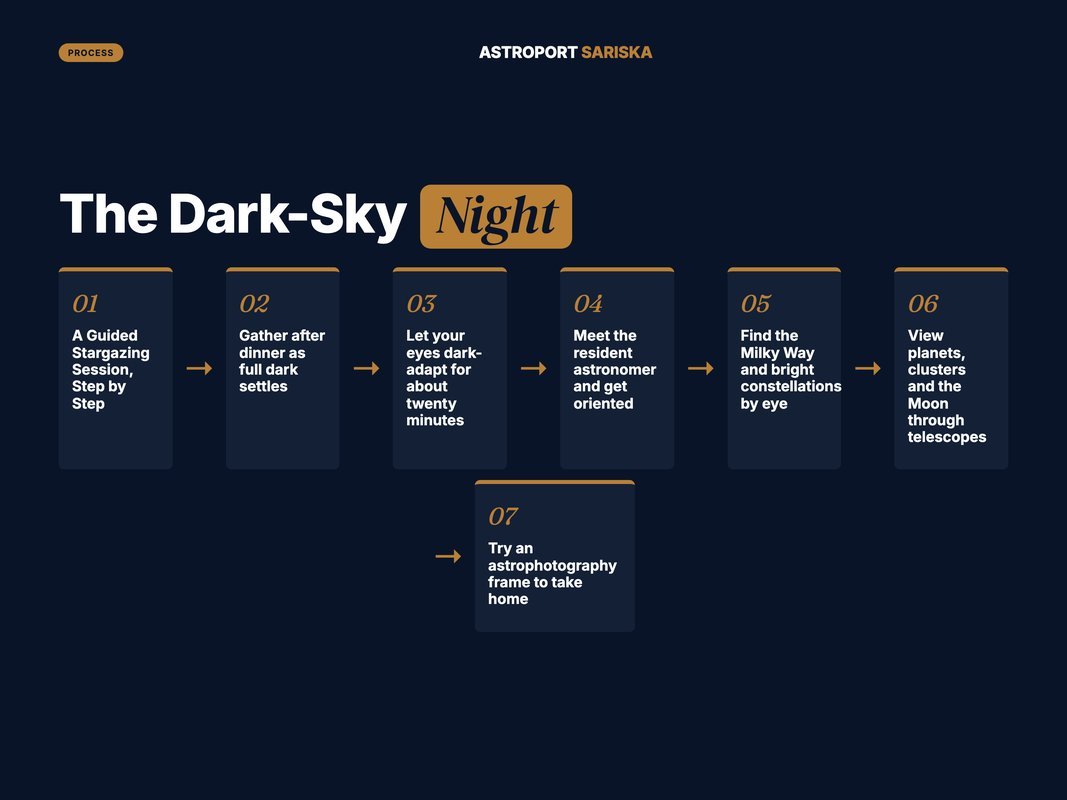
So what fills that sky? The Milky Way arches overhead in season. Planets shine steadily. Star clusters and the Moon’s craters snap into focus through a scope. See the full sky menu in what you can see at night in Sariska.
The contrast with the city is the real shock. From a balcony in Delhi, you might count a handful of stars. Here, the sky is crowded and deep. That difference alone stops most first-timers mid-sentence.
So give your eyes time to adjust. Dark adaption takes about twenty minutes. Skip your phone screen, and the faint stars slowly emerge.
Timing Your Star Night
The timing is in your hands too. A bright Moon washes out faint stars, so aim near a new moon. NASA suggests the two weeks either side of the new moon as the best window (Source: NASA, 2024. How to Find Good Places to Stargaze).
At Astroport, you are not alone with a star chart. Resident astronomers run the session. Professional telescopes do the heavy lifting. So even a first-timer leaves having actually seen something.
The astronomers also tell the stories. They name the constellations overhead. They explain what a planet really is. So the sky stops being random dots and starts to make sense.
You can go hands-on too. An astrophotography class shows you how to shoot the stars. So you leave with photos, not just memories.
Q: What can you see in the Sariska night sky?
A: On a clear, dark night, the Milky Way, planets, star clusters and thousands of stars. From a dark site you can see around 2,000 stars by eye. Telescopes and astronomers reveal far more.
A Simple Safari and Stargazing Trip Plan
You do not need a long holiday. A single weekend does it. Still, two nights make the trip feel unhurried.
One night gives you one safari and one star session, weather allowing. Two nights add a second safari window and a clouds backup. So if one evening fogs over, the next can still deliver. For a longer template, see this three-day astronomy weekend from Delhi.
Here is how an ideal first day flows, hour by hour.
- Pre-dawn wake-up. Rise early, grab tea and layer up for the cool air.
- Morning tiger safari. Ride the forest tracks while the animals are active.
- Late breakfast back at the resort. Refuel and warm up after the drive.
- Slow midday. Take a farm walk, a spa hour or a daytime workshop.
- Sunset and dinner. Enjoy farm-to-table food as the light fades.
- Guided stargazing. Meet the astronomers and look through the telescopes.
- Campfire wind-down. End the night under the open Aravalli sky.
So a second day simply repeats the best parts. Another dawn safari for a fresh shot at a sighting. Another night under the stars. Two nights, two chances, far less rush.
Q: How many nights do I need for this combo trip?
A: One works, but two is better. A single night gives one safari and one star session. A second night adds another safari and a weather backup, so the whole trip feels calmer.
Who This Trip Suits
This pairing is not for everyone. But it fits more people than you would think. The mix is its strength.
So who really thrives here? Anyone who likes variety in a single stay. The trip suits both planners and dreamers alike.
It suits curious travellers who want two experiences in one. Naturally, families enjoy it, since the safari is seated and easy. Couples like the slow, romantic nights. Likewise, solo travellers find both the forest and the sky humbling.
A few honest caveats help. The early starts and bumpy tracks can tire very young children. Anyone with mobility issues should plan gentle afternoons. And no one should expect a guaranteed tiger.
So set the right expectation. Come for the whole rhythm, not a single ticked box. Then both halves of the trip feel like a win.
In short, this trip rewards the patient. The forest may hide its big cat. The clouds may hide the stars. Yet over a slow weekend, something usually opens up.
So pack curiosity above all. Bring warm layers, binoculars and an easy pace. Then let Sariska set the schedule for you.
Q: Is this trip good for families and older travellers?
A: Mostly, yes. The safari is seated, so there is no trekking. Early mornings and rough tracks can tire small kids or less mobile guests. Balance them with calm afternoons and an easy night.
Quick Facts: Safari and Stargazing at Sariska
Quick Facts
– Sariska is a tiger reserve in Alwar, Rajasthan, set in the Aravalli Range (Source: Wikipedia, 2026 — Sariska Tiger Reserve).
– It joined India’s Project Tiger conservation network back in 1978 (Source: Wikipedia, 2026 — Sariska Tiger Reserve).
– Besides tigers, the reserve holds leopards, hyenas, jackals, sambar deer and nilgai (Source: Wikipedia, 2026 — Sariska Tiger Reserve).
– From a dark site, the naked eye can see around 2,000 stars on a clear, moonless night (Source: EarthSky, 2024 — How many stars on a clear, moonless night?).
– The darkest skies fall near the new moon; NASA flags the two weeks either side as best (Source: NASA, 2024 — How to Find Good Places to Stargaze).
Why Astroport Sariska
Astroport Sariska is India’s first purpose-built astronomy resort. It also sits near Sariska Tiger Reserve in Alwar, Rajasthan. The drive is about 4 to 5 hours from Delhi NCR, or roughly 200 km. So the whole combo fits into one easy weekend.
The location does the work. By day, the reserve is right there for your safari. By night, the dark Aravalli sky opens overhead. On a clear night, guests can see 4,000-plus stars, versus about 20 from inside Delhi.
The astronomy here is hands-on, not a side show. Resident astronomers and professional telescopes run every session. You can also try a telescope-making workshop, an astrophotography class or a solar observation. For a deeper look at lodging, see this Sariska resorts guide.
There is a full world between the two acts too. An organic farm feeds the farm-to-table kitchen. The Sparsh Spa, yoga under the stars and nightly campfires fill the gaps. The whole resort runs on solar power.
So you never feel stranded between events. There is always a quiet thing to do. You can swap a noisy itinerary for a slow, full one. That balance is the whole point of coming here.
So one base, one trip, two unforgettable halves. The forest by day and the galaxy by night. Plan your stay and let Sariska do the rest.
Conclusion
So, can you combine a tiger safari and stargazing in one trip? Yes, easily. Sariska’s natural rhythm makes the pairing feel obvious once you are there.
You chase pugmarks at dawn. You rest through the heat. Then you trace constellations after dark. One base holds the whole arc, with no rushing between places.
Just set fair expectations. No safari guarantees a tiger, and clouds can hide the stars. But across a two-night stay, the odds stack in your favour. And the forest, the farm and the sky never disappoint.
Ready to wake up to a safari and fall asleep under the stars? Reach out to Astroport Sariska and plan your dark-sky weekend near Delhi NCR.
FAQ
Q: Can you do a tiger safari and stargazing on the same trip?
A: Yes. Sariska runs on a natural day-night rhythm. You take a tiger safari in the cool early morning, rest through the day, then stargaze after dark. One base, one trip, two very different experiences. Astroport Sariska sits right by the reserve, so both fit into a single weekend.
Q: Will I definitely see a tiger on the safari?
A: No. A safari is a wild encounter, not a zoo, so sightings are never guaranteed. You ride in a shared vehicle along set forest tracks. Even without a tiger, you often spot leopards, sambar deer, nilgai and many birds. The forest itself is the reward.
Q: What can you see in the night sky at Sariska?
A: On a clear, dark night you can see the Milky Way, planets, star clusters and thousands of stars. From a dark site you can spot around 2,000 stars with the naked eye. Astroport adds professional telescopes and resident astronomers to show you more.
More Combo Trip Questions
Q: How many nights do I need for a safari and stargazing trip?
A: One night works, but two is better. Just one night gives you one safari and one star session, weather permitting. Then a second night adds another safari window and a backup if clouds roll in. Two nights make the trip feel unhurried.
Q: Is the safari suitable for families and older travellers?
A: Yes, for most. The safari is seated and vehicle-based, so there is no trekking. Early starts and bumpy tracks can tire very young children or anyone with mobility issues. Plan calm afternoons to balance the early mornings.
Q: What is the best time of year for this combo trip?
A: October to April is ideal. The monsoon has cleared, so skies are darker and clearer for stargazing. Cooler weather also makes the daytime safari far more comfortable. Winter nights near a new moon give the best star views.