
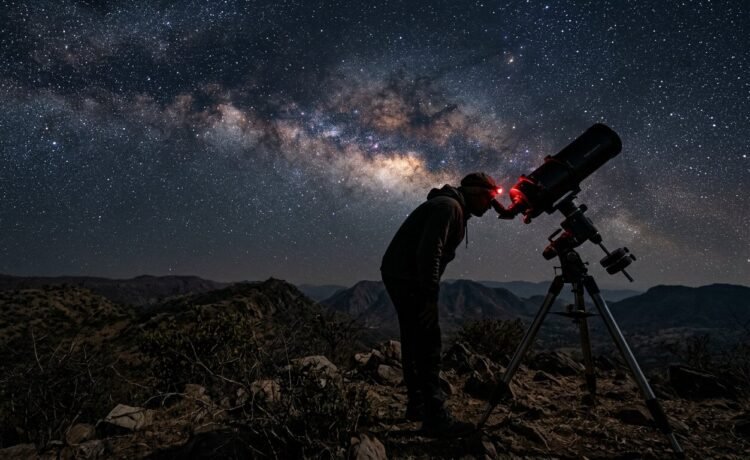
You picture a solo stargazing trip. A clear, dark sky. Just you and a thousand stars. No notifications. No small talk you did not ask for.
So that is the pull of a solo stargazing trip. But the question is simple: is a solo stargazing trip worth it? For many busy people, the answer is a quiet yes. Because solitude and dark skies fit together well, you get awe, calm, and a real break from screens.
So this guide is honest, not breathless. First, we cover why solo and stargazing pair so well. Next, the post walks through what to expect travelling alone to an Aravalli resort near Delhi NCR. Then it looks at who it suits, from tired professionals to first-time soloers and women on their own. Also, we share simple tips and a clear plan. So read on.
Why a Solo Stargazing Trip Just Fits
Some trips beg for a crowd. But a stargazing trip does not.
So the night sky asks for stillness. You lie back, you look up, and you go quiet. Also, that suits doing it alone. Still, there is no one to perform for. There is just wonder.
Also, solo travel is booming, so you are in good company. In fact, more than half of travellers now consider going alone. In 2023 that figure was 54%, and it rose to 59% in 2024 (Source: Solo Traveler, 2024 — solo travel statistics). Among Gen Z and Millennials, 76% planned a solo trip in 2025 (Source: Solo Traveler, 2025 — solo travel statistics).
Then stargazing adds something rare: awe. Looking up at a sky full of stars makes you feel small in a good way. So that feeling has real perks, which we will get to. For now, know this. Still, quiet plus awe is a strong combination. Doing it solo only deepens both.
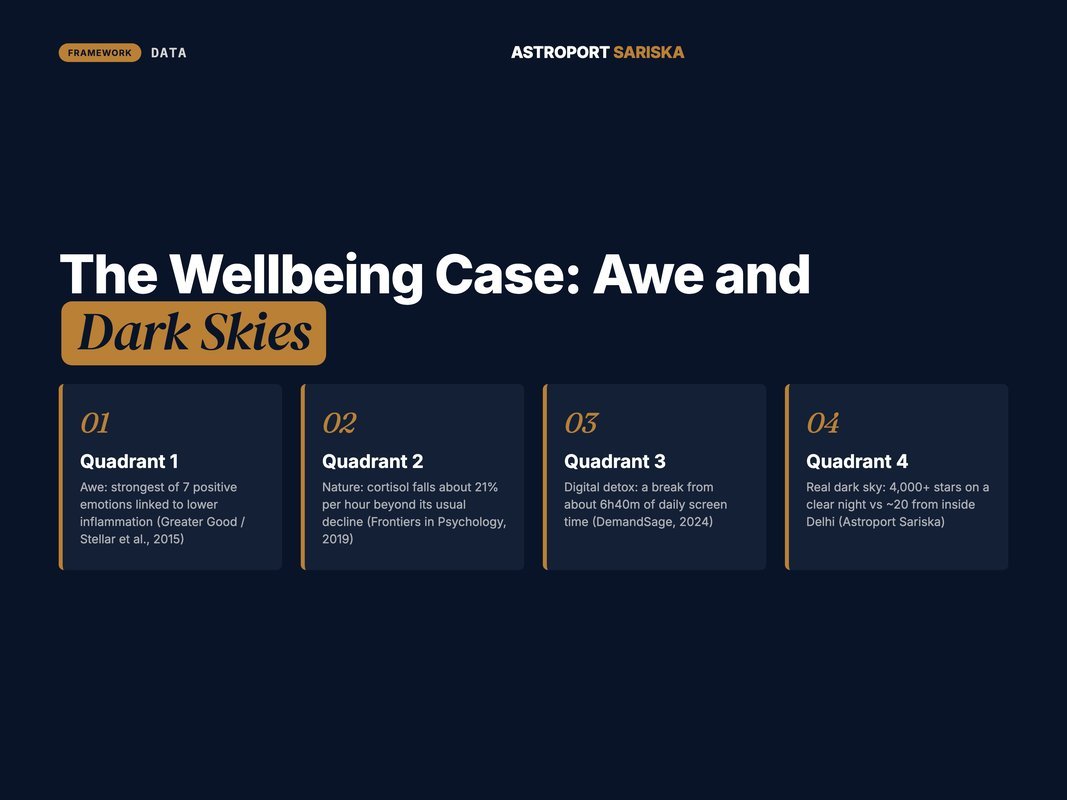
Also, there is a digital-detox angle. In fact, we stare at screens about 6 hours and 40 minutes a day on average (Source: DemandSage, 2024 — screen time statistics). But a dark sky is the opposite of a glowing phone. So you swap the feed for the stars.
Q: Won’t a solo stargazing trip feel lonely?
A: Rarely, in practice. You are alone for the quiet parts and that is the point. But group telescope sessions bring easy company. You meet other guests, share a “wow”, then drift back to your own pace.
What to Expect: The Drive and Arrival
So let us be practical. First, a solo trip starts with a drive.
Astroport Sariska sits about 4 to 5 hours from Delhi NCR, around 200 km away (Source: Astroport Sariska — plan your trip). It is near Sariska Tiger Reserve in Alwar, Rajasthan. So it is far enough to lose the city glow. Yet close enough for a weekend.
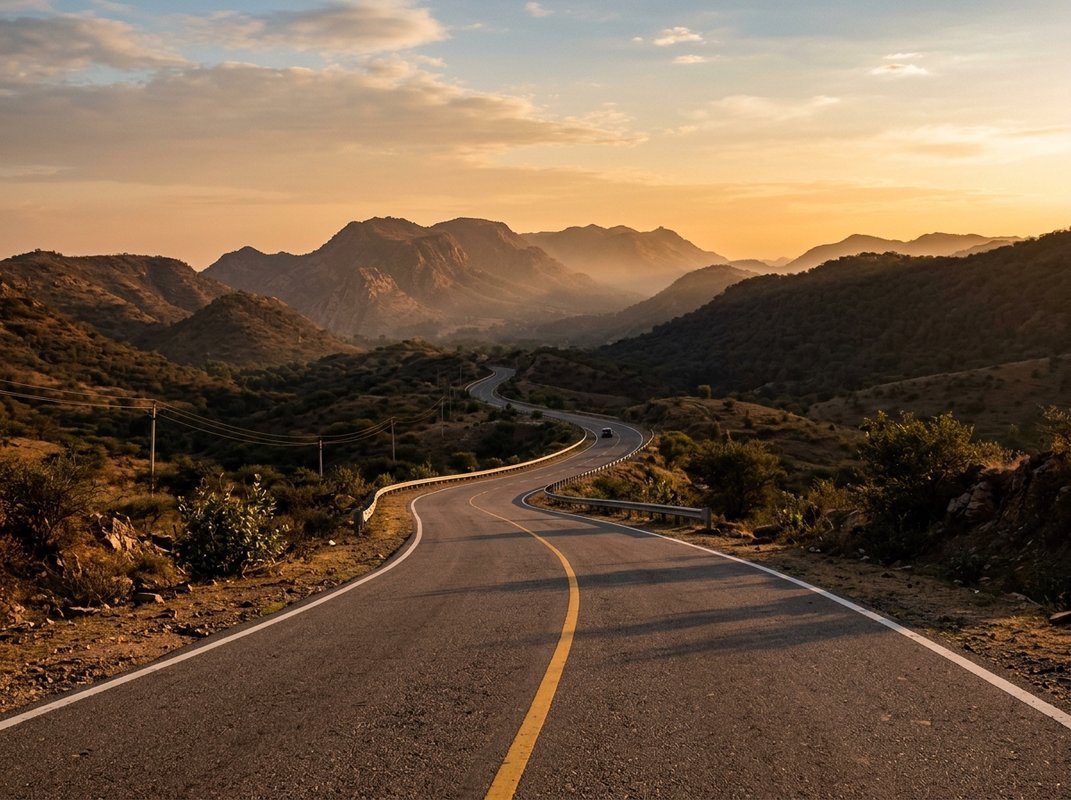
Also, the drive is half the reset. Then highways give way to the soft folds of the Aravallis. Your shoulders drop. So your phone goes quiet.
But one rule matters most: travel in daylight. So leave in the morning. Then aim to reach before dusk. Because rural roads are easier and calmer by day.
Still, arrival is gentle. You check in, you settle, you breathe. Also, the grounds run on solar power, so the place feels off-grid in the best way (Source: Astroport Sariska — about the resort). Meanwhile, staff are around. Other guests are around too. So you are alone, but never on your own out there.
Q: How long is the drive from Delhi, really?
A: Plan for 4 to 5 hours, give or take traffic. That is roughly 200 km. Start early so you arrive in daylight. The road through the Aravallis is part of the charm.
The Social-But-Not-Forced Vibe
So here is the worry most soloers share. Will I have to make friends?
No. So that is the quiet magic of a guided session. Because it is social on your terms.
First, by day you can keep to yourself. Then read on your verandah. Next, walk the organic farm. Also, sit with chai and do nothing at all.
Then night falls and the telescope comes out. So a resident astronomer leads the session. Next, strangers gather around one eyepiece. Then someone gasps at Saturn’s rings. So you all share that moment.
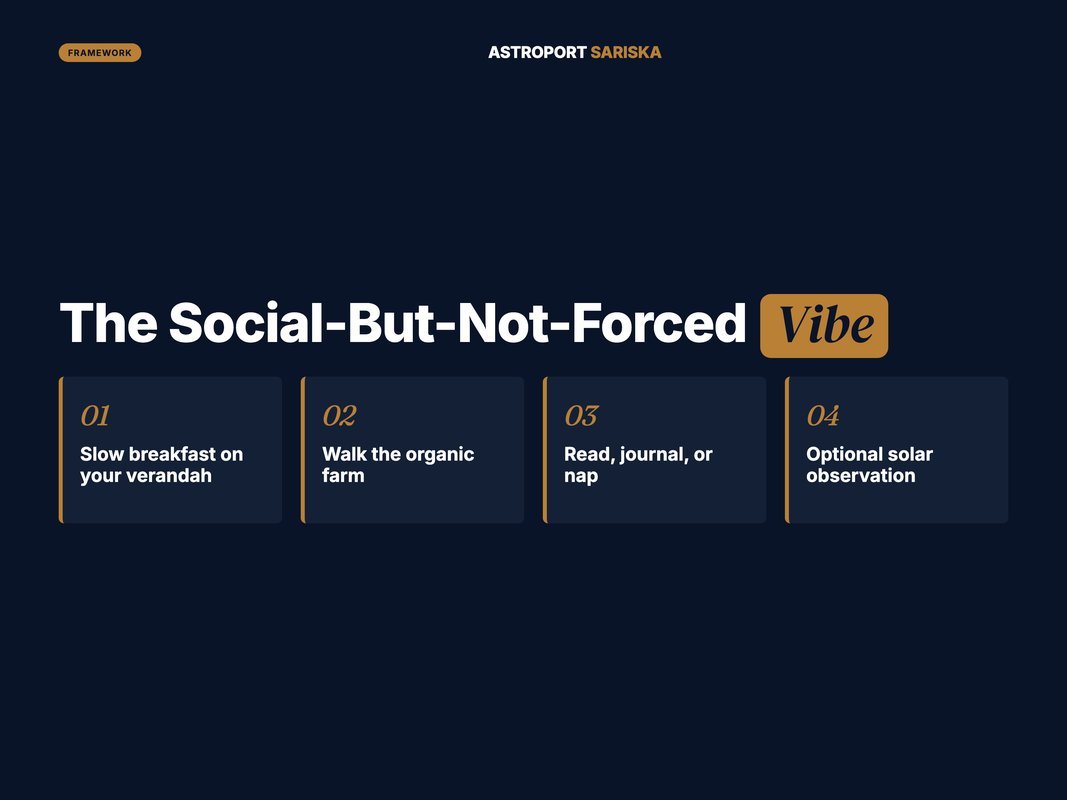
Still, you can chat as much or as little as you like. So some people swap stories for an hour. Meanwhile, others just nod, look, and soak it in. Both are fine. Because no one is keeping score.
Also, meals work the same way. Eating alone sounds awkward until you do it. Then it feels like a small luxury. So bring a book. Next, order the farm-to-table thali. Instead, let the silence be nice.
Q: Do I have to join group activities if I am shy?
A: Not at all. Sessions are open, not mandatory. Join the telescope tour, then slip away when you want quiet. The staff are warm and never pushy. You set the rhythm.
Who a Solo Astro Trip Really Suits
Not every trip fits every person. But this one fits a few types very well.
The burnt-out professional. First, you work hard. Your brain never stops. So a dark-sky weekend is a hard reset. No meetings. No glow. Just stars and slow mornings.
The first-time soloer. Nervous about going alone? Then start here. Because a staffed resort with set sessions is a soft landing. So you get freedom with a safety net.
The woman travelling solo. Indeed, Indian women are choosing solo trips like never before. In fact, one travel platform saw women’s solo bookings grow nearly nine times year on year (Source: Outlook Traveller / Scapia, 2026 — Indian women solo travel data). So a small resort with staff, lit paths, and group sessions tends to feel comfortable. First, pick a place with clear reviews. Then arrive by day. Also, tell someone your plans. Still, trust your gut on anything that feels off.
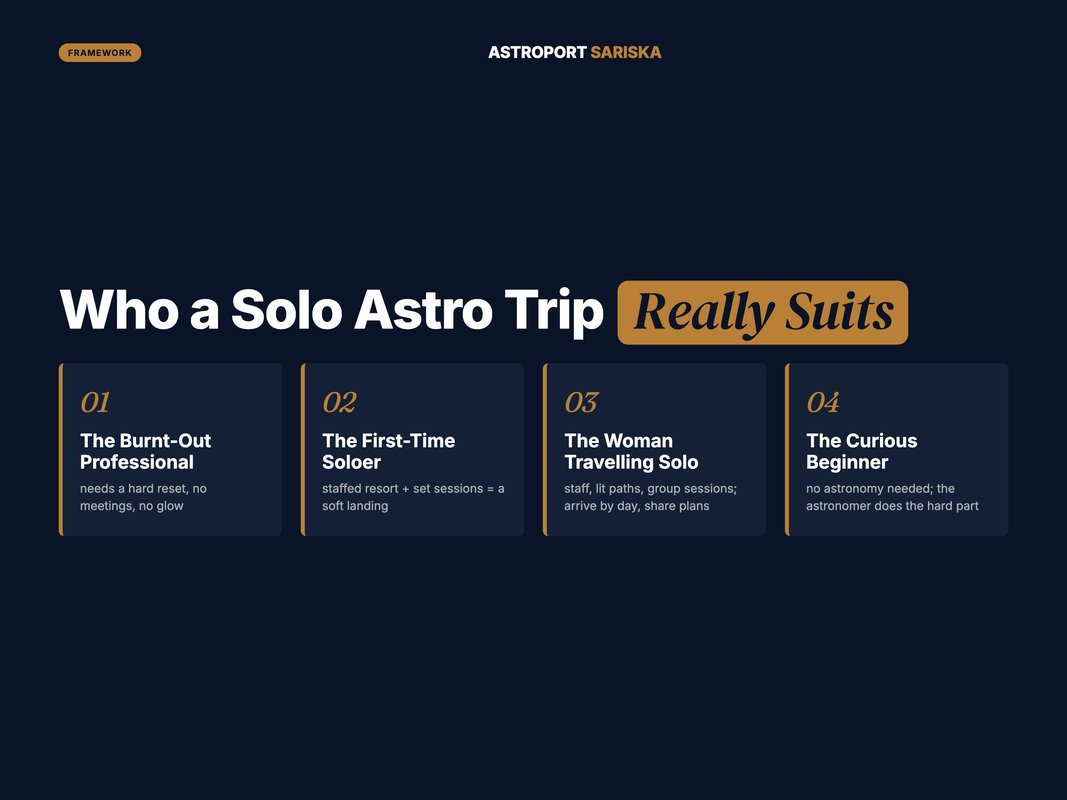
Also, it suits the curious. Because you do not need to know astronomy. So the astronomer does the hard part. Then you just look up and learn.
Q: Is a solo stargazing trip good for a woman travelling alone?
A: For many, yes. Choose a staffed resort with strong reviews and guided sessions. Drive in daylight and share your itinerary. The group sessions offer easy company, and the quiet is yours to keep.
The Wellbeing Case: Awe and Dark Skies
So this is the part people underrate. Indeed, a starry sky is good for you.
In fact, most of us never see one. Light pollution hides the Milky Way from about 80% of people in North America, and a third of humanity worldwide (Source: National Geographic, 2016 — light pollution and the Milky Way). So from inside Delhi you might catch 20 stars. Yet at Astroport you can see over 4,000 on a clear night (Source: Astroport Sariska — dark-sky experience).
So that gap is the whole point. Because awe needs a big sky to land.
Also, awe pays off. For example, in one UC Berkeley study, awe was the strongest predictor of lower inflammation markers among seven positive emotions (Source: Greater Good Science Center / Stellar et al., 2015 — can awe boost health). In fact, people who felt more awe had lower levels of a stress-linked cytokine.
How Nature and Solitude Seal the Reset
Also, nature helps, and fast. So just 20 to 30 minutes outdoors is the sweet spot for lowering stress. In that window, cortisol drops about 21% per hour beyond its normal daily fall (Source: Frontiers in Psychology, 2019 — a 20-minute nature break). So a whole night under the stars is the deluxe version of that pill.
So the wellbeing case is simple. First, dark skies bring awe. Then awe and nature calm the body. Also, solitude lets it sink in.
Q: How does stargazing actually help my wellbeing?
A: It blends two boosters. Awe, which is linked to lower inflammation, and nature, which lowers cortisol in about 20 minutes. Add a screen break and quiet, and you get a real reset.
Quick Facts: Solo Stargazing by the Numbers
So here are a few figures to anchor the case. Also, each one is sourced.
Quick Facts
– Solo travel is mainstream: 59% of travellers considered going alone in 2024, up from 54% in 2023 (Source: Solo Traveler, 2024 — solo travel statistics).
– Indian women’s solo bookings grew nearly 9x year on year on one travel platform (Source: Outlook Traveller / Scapia, 2026 — Indian women solo travel).
– Awe was the strongest of 7 positive emotions linked to lower inflammation (Source: Greater Good Science Center / Stellar et al., 2015 — awe and health).
– 20–30 minutes in nature is the sweet spot; cortisol falls about 21% per hour beyond its usual decline (Source: Frontiers in Psychology, 2019 — 20-minute nature break).
– About 80% of North Americans cannot see the Milky Way due to light pollution (Source: National Geographic, 2016 — light pollution).
Tips and Prep for Your Solo Astro Weekend
Good prep makes a solo trip easy. So here is what works.
First, pick your night well. So book a clear-sky weekend near a new moon. Because with little moonlight, faint stars and the Milky Way pop (Source: EarthSky, 2024 — best moon phase for stargazing). Also, check the forecast a day or two ahead.
Second, join the astronomer-led session. Because it is the heart of the trip. So you learn the sky and meet a few people.
Next, pair it with a dawn safari. Indeed, Sariska has tigers, leopards, and 200-plus bird species (Source: Astroport Sariska — Sariska safari). So stars by night, wildlife by morning. A full reset.
Also, pack warm layers. Because Aravalli nights get cold, even after warm days. So a jacket, socks, and a beanie matter at the eyepiece.
Finally, tell someone your plans. So share your route and dates with a friend. Also, keep your phone charged for the road.
So use the checklist below so nothing slips.
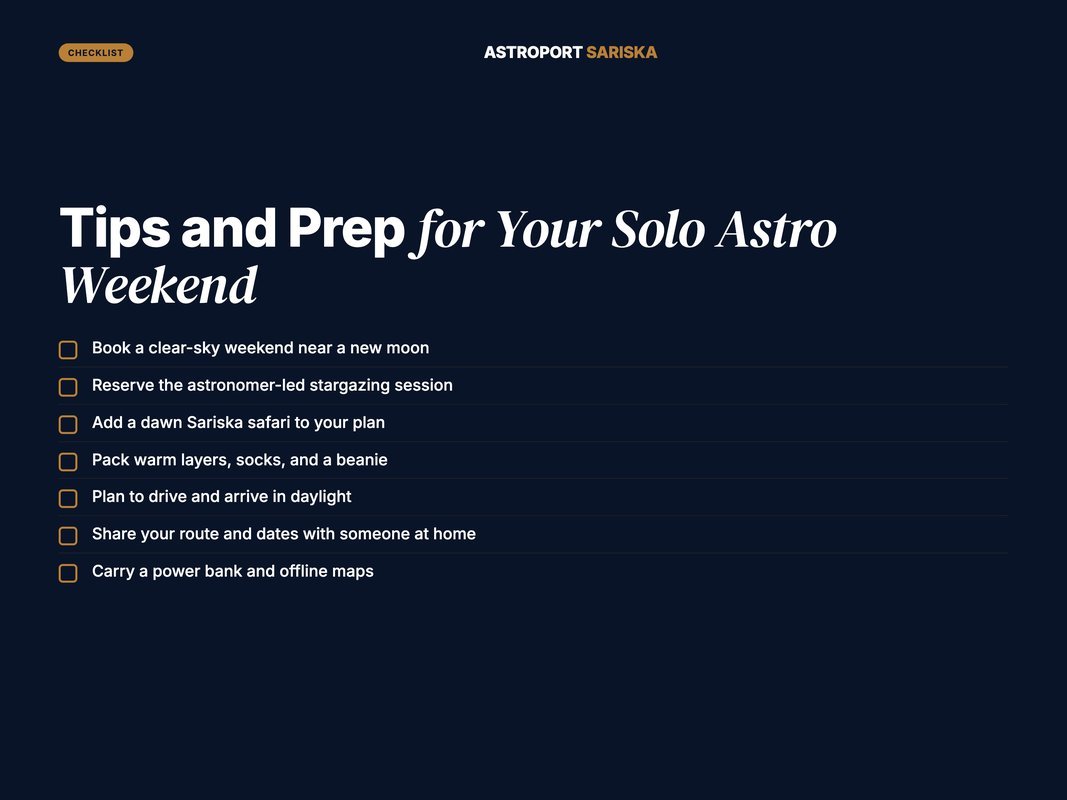
- Book a clear-sky weekend near a new moon
- Reserve the astronomer-led stargazing session
- Add a dawn Sariska safari to your plan
- Pack warm layers, socks, and a beanie
- Plan to drive and arrive in daylight
- Share your route and dates with someone at home
- Carry a power bank and offline maps
Q: What is the single best tip for a first solo astro trip?
A: Time it to a new-moon, clear-sky weekend. Dark skies make or break stargazing. Then join the guided session and let the astronomer do the rest.
Solo vs Group Stargazing Trip: Which Fits You?
Both ways are good. Still, they just feel different. So here is an honest comparison.
| Factor | Solo stargazing trip | Group stargazing trip |
|---|---|---|
| Pace | Fully your own | Shared with the group |
| Quiet and reflection | Deep and easy | Comes in pockets |
| Company | Meet new people at sessions | Travel with people you know |
| Flexibility | Change plans freely | Agree plans together |
| Cost-sharing | You carry it solo | Split rooms and travel |
| Best for | A reset and self-time | Bonding and shared memories |
So pick solo if you crave space and a clean break. Instead, pick group if you want to share the wonder with friends.
Also, many people end up doing both, in different seasons. So there is no wrong choice. Because the stars look just as good either way.
Q: Is solo or group stargazing better?
A: It depends on your goal. Solo wins for quiet, freedom, and a reset. Group wins for bonding and splitting costs. The night sky rewards both, so choose by mood.
Plan Your Solo Astro Weekend: A Simple Process
Ready to book? So follow these steps in order. Because it keeps planning calm.
- Check the moon. First, find the next new-moon weekend. So that gives the darkest sky (Source: timeanddate, 2024 — new moon).
- Watch the weather. Next, look for a clear forecast a day or two out. Because clouds are the only real enemy.
- Book your stay. Then reserve a room at Astroport Sariska for that weekend. Also, note the session timing.
- Plan the drive. So set a morning start from Delhi NCR. Then arrive in daylight, around 4 to 5 hours out.
- Add a safari. Also, slot a dawn Sariska safari into your schedule.
- Pack smart. So bring warm layers, a power bank, a book, offline maps, and basic meds.
- Tell someone. Finally, share your full plan with a friend before you leave.
So that is it. Seven steps and you are set.
Q: How far ahead should I plan a solo astro weekend?
A: Two to four weeks is comfortable. That lets you target a new moon and book a room. Keep an eye on the forecast in the final days.
Why Astroport Sariska
Astroport Sariska is India’s first purpose-built astronomy resort. So it brings stargazing, wildlife, and slow luxury into one dark-sky place. For a solo traveller, that mix is gold.
So you get resident astronomers and pro telescopes. Also, you can join constellation tours, an astrophotography masterclass, or even a telescope-making workshop. Meanwhile, by day there is solar observation, a Sariska safari, and the organic farm.
Also, it is built for quiet. Yoga under the stars. The Sparsh Spa. Campfires that invite easy chat, never forced. So you can be as social or as still as you like.
Still, the setting does the heavy lifting. So over 4,000 stars on a clear night, near Sariska Tiger Reserve in Alwar, Rajasthan (Source: Astroport Sariska — the experience). Also, the whole resort runs on solar power, so it feels gently off-grid.
Also, it is close. So about 4 to 5 hours from Delhi NCR. Near enough for a solo weekend, yet far enough to feel away.
So if you want a reset under real dark skies, this is a soft, safe place to start. Then plan your solo stay and let the night do the rest.
Conclusion
So, is a solo stargazing trip worth it? For most people who need a reset, yes.
So you get quiet, awe, and a real break from screens. Also, you set your own pace all weekend. Then at the telescope, you find easy company when you want it. Alone, but not lonely.
Also, the wellbeing case is real. In fact, awe is linked to lower inflammation. Meanwhile, nature lowers stress in minutes. So a dark sky over the Aravallis brings both, with thousands of stars you cannot see at home.
So plan it simply. First, pick a clear, new-moon weekend. Then drive in daylight. Next, join the guided session. Also, pack warm and tell a friend your plans.
Then look up. So the sky is waiting, and it is yours. Plan your solo stay at Astroport Sariska and trade the city glow for 4,000 stars.
FAQ
Is it worth it, and is it safe?
Q: Is a solo stargazing trip worth it?
A: For many people, yes. A solo stargazing trip gives you quiet, awe, and a real screen break. You set your own pace. You also meet other guests at the group telescope session, so you are alone but not lonely. If you want a reset, it is hard to beat.
Q: Is it safe to travel alone to an Aravalli stargazing resort near Delhi?
A: A staffed resort with guided sessions is a gentle way to start solo travel. You are on private grounds with hosts and other guests nearby. Drive in daylight, share your plans with someone at home, and keep your phone charged. Treat it like any first solo trip and you will feel at ease.
Q: Can a woman do a solo stargazing trip comfortably?
A: Many do. Indian women are choosing solo trips in record numbers. A small resort with staff, lit paths, and group sessions tends to feel comfortable. Pick a place with clear reviews, arrive by day, and tell someone your itinerary. Trust your gut on any plan that feels off.
Distance, timing, and the solo experience
Q: How far is Astroport Sariska from Delhi NCR?
A: It is about 4 to 5 hours from Delhi NCR, near Sariska Tiger Reserve in Alwar, Rajasthan. That is roughly 200 km. It is far enough to escape city glow, yet close enough for a weekend. Leave in the morning to arrive in daylight.
The solo experience day to day
Q: Will I feel awkward eating alone or during downtime?
A: Less than you fear. Most solo guests grow to like a quiet meal and slow mornings. Bring a book or a journal. The astronomer-led session gives easy company when you want it. The vibe is social but never forced.
Q: When is the best time for a solo astronomy trip in India?
A: Aim for a clear-sky weekend near a new moon. With little moonlight, faint stars and the Milky Way show best. Winter months also bring crisp, clear Aravalli air. Check the moon phase before you book.
Do I need any astronomy know-how?
Q: Do I need to know astronomy to enjoy a stargazing trip alone?
A: Not at all. Resident astronomers run the sessions and point the telescope for you. You just look and listen. First-timers often leave knowing a few constellations by name. Curiosity is the only kit you need.