
You picture the trip. A dark sky, a warm drink, a sky full of stars. So the best time to visit an astro resort becomes the big question. Should you go in summer, or wait for winter?
It is the right call to make. Your season shapes everything. It decides how clear the sky is. Then it sets how the days feel. And it even shapes what wildlife you might spot.
This guide settles it, season by season. We weigh winter, summer and the monsoon. We look at star quality, comfort, wildlife and crowds. You get a clear two-column comparison and a months-ranked table too.
By the end, you will know exactly when to book. The short answer leans one way. But the full picture has some lovely surprises.
What “Best Season” Really Means at a Dark-Sky Resort
First, let us define the goal. A great astro trip needs more than dark sky. It needs the four C’s. Clear skies, comfort, creatures and crowds.
So the best time to visit an astro resort is a balance. You want long, clear nights for the stars. You also want days you can enjoy. The two do not always peak together.
Astronomy gives one rule of thumb. Winter, with its longer nights and clearer air, is widely called the best time for stargazing (Source: EarthSky, 2024 — Top 10 stargazing tips). The dry desert air over Rajasthan only sharpens that edge.
But comfort and wildlife pull their own way. So no single month wins on every front. Instead, you pick the trade-off that fits your trip.

So keep those four C’s in mind. They are the lens for every season below. One season may ace the sky but lose on comfort. Another may flip it.
The rest of this guide scores each season on those four C’s. Then it ranks the months. Read on, and the choice gets easy.
Q: What makes one season better than another for an astro resort?
A: It comes down to four things. Clear skies, daytime comfort, wildlife activity and crowd levels. Winter usually leads on sky and comfort. Summer and the monsoon shine on a couple of fronts.
Winter at an Astro Resort: October to March
Winter is the headline act. From October the monsoon has pulled back and the air dries out. So this is when the Aravalli sky truly opens up.
The nights are the prize. Winter nights are long, so you get more dark hours under the stars. The cold, dry desert air also means steady, transparent skies. This is the best time to visit Sariska for stargazing.
EarthSky backs the logic. Longer nights and clearer winter air make this the top stargazing stretch of the year (Source: EarthSky, 2024 — Top 10 stargazing tips). Add a new moon and the sky goes pitch dark. Winter also frames a different cast of constellations by season.
Days are kind too. Winter afternoons are mild and easy for the safari, the farm tour and a walk. So you can fill the day and still have energy for the night.
Winter also suits families and first-timers. The weather is gentle, so kids stay happy. The long nights mean an early start to stargazing. So you are not waiting up late for the dark.
The One Catch: It Gets Cold
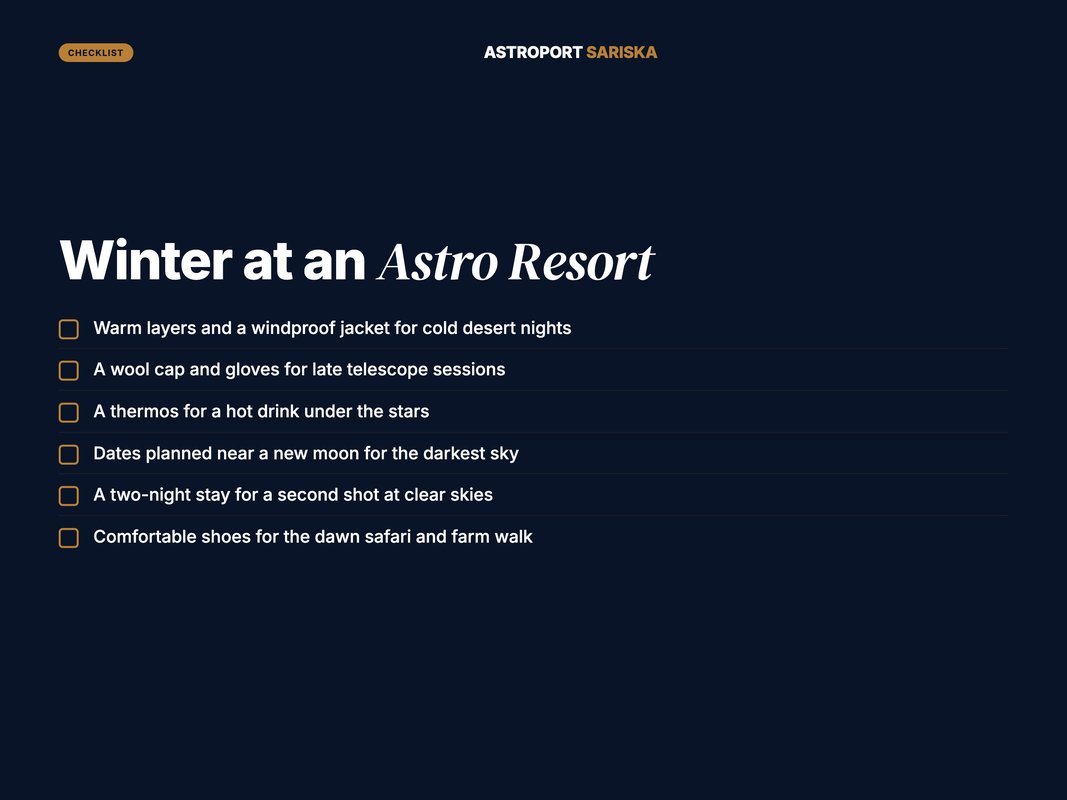
There is a trade-off. Winter nights in the desert turn genuinely cold. That same chill is what keeps the sky so clear.
So you simply dress for it. Warm layers, a cap and a hot drink do the job. A campfire bridges the gaps between telescope sessions. The cold is a small price for the clearest nights of the year.
Q: Why is winter best for stargazing in Rajasthan?
A: The monsoon has gone, so the air is dry and clear. Nights are also longer, giving more dark hours. The cold desert air keeps the sky steady. Just pack warm layers for the chilly nights.
Summer at an Astro Resort: April to June
Summer is the bold choice. The headline draw is the Milky Way. Its bright core climbs high on warm-season evenings.
So the galactic center is the star turn. The center of the Milky Way broadens into a wide river of stars in the south through these months (Source: EarthSky, 2024 — Time to see the starlit Milky Way). The Teapot of Sagittarius points right at it from about July to September (Source: EarthSky, 2024 — Teapot points to galactic center). For more, see the Milky Way by season.
Nights are warm and easy on the body. So you can sit out under the sky in light clothing. No heavy layers needed after dark.
But the days are the hard part. Summer is Rajasthan’s hottest season, running from about April to June (Source: IMD, 2026 — India Meteorological Department). So daytime heat is intense across the region.
The Catch: Heat and Haze
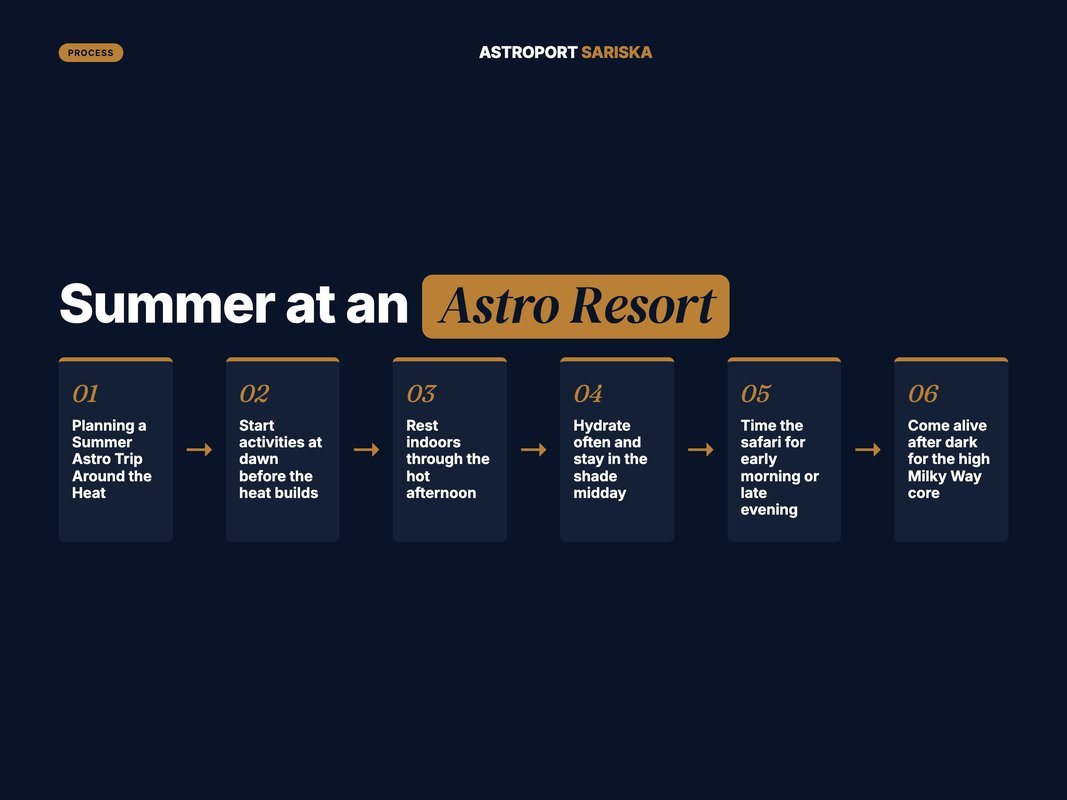
Haze is the other summer risk. Hot, dusty pre-monsoon air can dull the sky. So a clear summer night is glorious, but less of a sure thing. You also rework the day around the heat.
The smart summer plan is simple. Keep daytime activity early or late. Rest through the hot afternoon. Then come alive for the warm, Milky-Way nights.
Q: Is summer good for seeing the Milky Way?
A: Yes, the bright core is highest on warm-season evenings. So it looks dramatic then. But you still need a dark, haze-free night. And the daytime heat in Rajasthan is intense, so plan around it.
Monsoon at an Astro Resort: July to September
The monsoon is the wild card. The southwest monsoon sweeps India from about June to September (Source: IMD, 2026 — Monsoon Information). It withdraws between early September and early October (Source: Wikipedia, 2026 — Monsoon of South Asia).
So star odds drop in these months. Cloud is common and rain rolls through. A full clear night becomes rare, not routine.
But the trade-off is real beauty. The hills turn lush and green. Wet earth scents the air. Then the whole landscape softens and comes alive.
So the monsoon suits a different trip. The safari and the farm shine when everything is green. The spa and the campfire still run. You simply keep your star hopes flexible.
There is one bonus too. Late September can deliver crystal nights as the rain pulls out. So the very end of the monsoon teases the clear season to come.
The washed air helps as well. A fresh rain clears dust from the sky. So the gaps between clouds can be remarkably transparent. Catch one of those nights, and the stars feel close enough to touch.
Q: Should I visit an astro resort during the monsoon?
A: Only if stars are a bonus, not the goal. From June to September, cloud and rain are common. But the green hills make the safari and farm lovely. For reliable clear skies, wait for winter.
Summer vs Winter: The Head-to-Head
Time to settle the main fight. Summer and winter both have a case. But they win on very different things.
So here is the honest split. Winter takes clear skies, comfort and steady viewing. Summer takes the dramatic Milky Way core and warm, layer-free nights.
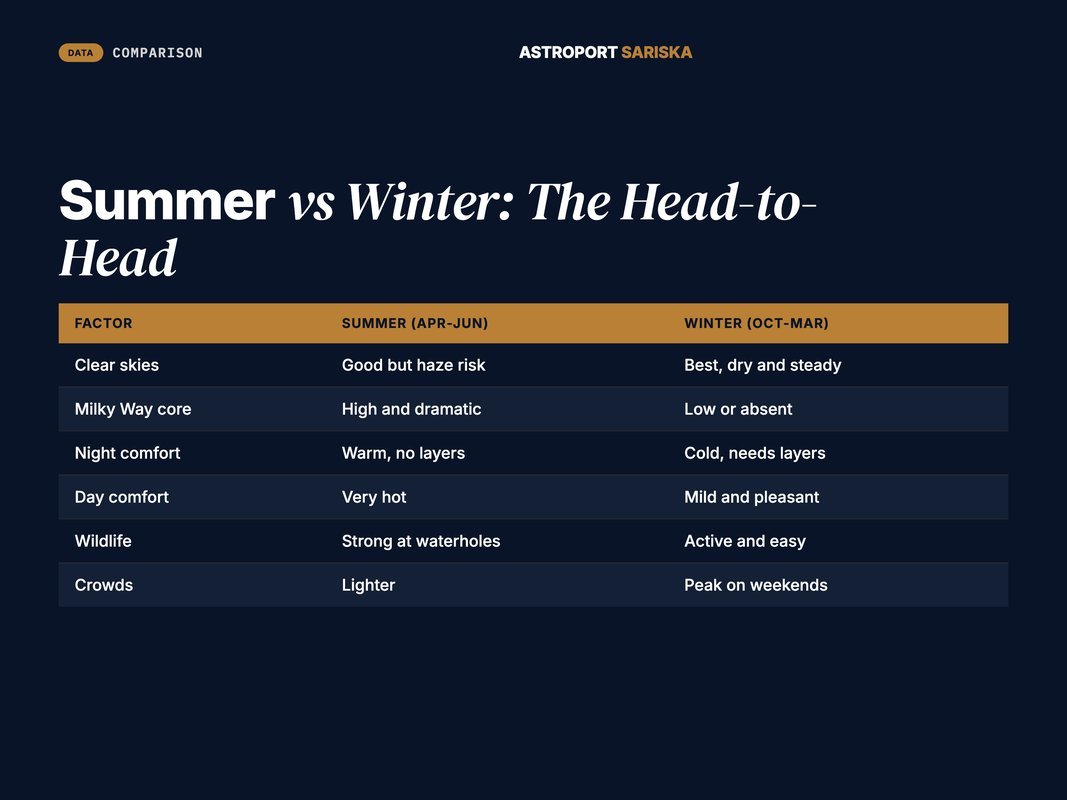
Think about what matters most to you. Chasing the brightest galactic core and happy in the heat? Lean summer. Want the clearest, most reliable nights in comfort? Winter is your season.
There is a timing nuance too. Summer puts the Milky Way core high after dark. So you do not have to stay up past midnight. Winter shows the core low or not at all, but it gifts more clear nights overall.
For most travellers, winter is the safer bet. It simply stacks more of the four C’s in your favour. The sky is clearer, the days are kinder, and the wildlife is easy to find. So unless the bright core is your one goal, winter rarely disappoints.
Q: Is summer or winter better overall for an astro resort?
A: Winter, for most people. It wins on clear skies, comfort and reliable viewing. Summer wins on the bright Milky Way core and warm nights. If clear stars are the goal, choose winter.
Wildlife, Crowds and the Months Ranked
Stars are not the only draw here. The Sariska Tiger Reserve sits right next door. So wildlife shapes the season choice too.
Summer can be strong for sightings. As waterholes shrink in the heat, animals gather to drink. So tiger and deer sightings can rise. But the heat makes long drives tough.
Winter is the gentle middle ground. Wildlife is active and the safari is comfortable. The birdlife is rich, with the reserve home to 200-plus species. It pairs perfectly with clear-sky nights.
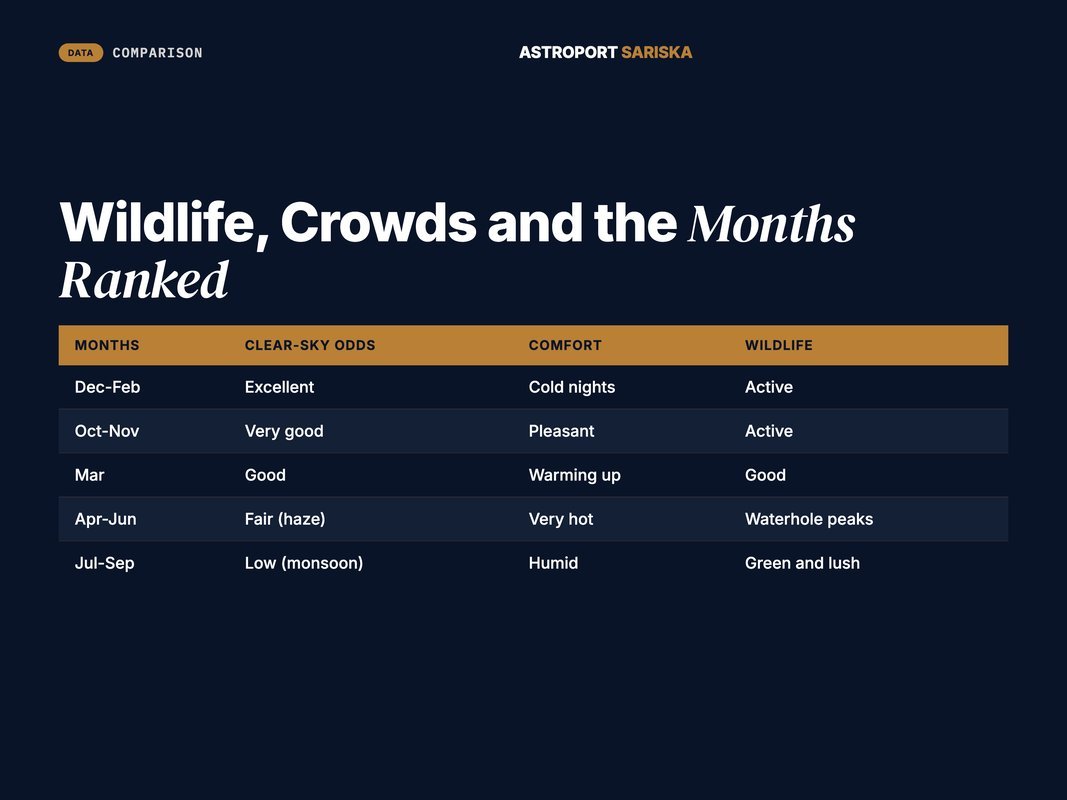
Crowds matter as well. Winter is peak season, so weekends fill fast. The shoulder weeks are the quiet secret. Late September, early October and late March bring thinner crowds and calmer rates.
So the value play is clear and simple. Book a shoulder week near a new moon. You get good skies, fewer people and an easier, calmer pace.
Crowds also change the mood at night. A quieter resort means a calmer sky session. So the telescope queue is short and the dark feels yours. That is part of why the shoulder weeks feel so special.
Q: When is the quietest time to visit an astro resort?
A: The shoulder weeks. Late September, early October and late March see fewer guests than peak winter weekends. Skies are often clear then too. These weeks offer great value for a relaxed trip.
Quick Facts: Best Time to Visit an Astro Resort
Quick Facts
– Winter, with longer nights and clearer air, is widely called the best season for stargazing (Source: EarthSky, 2024 — Top 10 stargazing tips).
– Summer is Rajasthan’s hottest season, running from about April to June (Source: IMD, 2026 — India Meteorological Department).
– The southwest monsoon runs across India from about June to September, the cloudiest stretch of the year (Source: IMD, 2026 — Monsoon Information).
– Monsoon withdrawal happens between early September and early October, opening the clear season (Source: Wikipedia, 2026 — Monsoon of South Asia).
– The bright Milky Way core is highest on warm-season evenings, broadening across the southern sky (Source: EarthSky, 2024 — Time to see the starlit Milky Way).
Why Astroport Sariska
Astroport Sariska is India’s first purpose-built astronomy resort. It sits near Sariska Tiger Reserve in Alwar, Rajasthan. The drive is about 4 to 5 hours from Delhi NCR, or roughly 200 km. So a dark-sky weekend is genuinely easy.
The dark sky is the whole reason to come. On a clear night, guests can see 4,000-plus stars overhead. From inside Delhi, you might catch about 20. The Aravalli darkness does the heavy lifting, in every season.
And the resort is built for all of them. Resident astronomers read the sky and run the sessions. So winter brings long, crisp nights and summer brings the high Milky Way core. The professional telescopes track whatever the season offers, from constellations to planets.
There is a full world beyond the eyepiece too. Safaris track tigers, leopards and 200-plus bird species. An organic farm feeds the farm-to-table kitchen. The Sparsh Spa, yoga under the stars and nightly campfires round it out. The whole resort runs on solar power.
So the season just changes the flavour, never the magic. Plan your stay and let the Aravalli sky do the rest.
Conclusion
So, summer or winter? The honest answer leans to winter. It gives the clearest, most reliable nights, in real comfort. That makes it the best time to visit an astro resort for most travellers.
But summer has its own pull. The bright Milky Way core and warm, layer-free nights are special. Just plan around the heat and watch for haze.
The shoulder weeks are the quiet winner for value. Late September, early October and late March bring clear skies and calmer crowds. Pair any date with a new moon for the darkest sky.
Ready to pick your season? Reach out to Astroport Sariska, choose your dates, and plan a dark-sky escape near Delhi NCR.
FAQ
Q: What is the best time to visit an astro resort in Rajasthan?
A: Winter, from October to March, is the best time. The monsoon has cleared and the desert air turns dry and crisp. Nights are long and clear, which is ideal for stargazing. Days are pleasant, though nights get cold. Pack warm layers.
Q: Is summer or winter better for stargazing in Rajasthan?
A: Winter wins for clear, steady skies and comfort. Summer offers the bright Milky Way core high overhead, but days are very hot and haze can build. For the most reliable star-filled nights, choose the winter months.
Q: Can you see the Milky Way better in summer?
A: The bright galactic center of the Milky Way is highest on summer and late-summer evenings. So the core looks most dramatic then. But you still need a dark, moonless, haze-free night. A clear winter night also shows the Milky Way well.
More on Comfort and Heat
Q: How hot does it get at an astro resort in Rajasthan in summer?
A: Summer in Rajasthan runs from about April to June. It is the hottest season, with very high daytime heat across the region. Nights stay warm. Activities shift to early morning and after dark. Winter is far more comfortable for a full-day trip.
Q: Should I visit during the monsoon?
A: The southwest monsoon runs from about June to September and brings cloud and rain across India. Star odds drop then. The hills do turn lush and green, so it is lovely for the safari and the farm. For clear skies, wait for the dry season.
More on Timing and Value
Q: When are the shoulder months and are they worth it?
A: Late September, early October and late March are the shoulder weeks. The crowds thin and the rates are calmer. Skies often turn clear right after the monsoon withdraws. These weeks can offer great value and still-good stargazing.
Q: Is winter too cold to stargaze in Rajasthan?
A: Winter nights in the Aravallis get genuinely cold, but it is very manageable. Warm layers, a cap and a hot drink handle it. The cold air is exactly what makes the sky so dry and clear. A campfire keeps the chill away between viewings.