

You look up. The sky is full of stars. Then your shoulders drop. And the day’s noise fades.
Most of us know this feeling. But we just do not know why it works. In fact, there is real science behind why stargazing feels calming. That feeling is awe.
So what is awe? It is what we feel before something vast. A sky full of stars is one of the purest triggers we have. And researchers have spent years asking what awe does to the mind and body.
The answers are gentle, but real. Awe seems to shrink our worries. It also softens the ego. Still, the biggest shift is this: it pulls us out of our own heads.
This is a wellbeing story, not a medical one. Of course, no telescope can replace a doctor. But the calm under a dark sky is not your imagination. So here is what the science says, and how to feel it yourself.
What Awe Actually Is
Let us start simple. So awe is more than just “wow”.
Researchers define awe as the feeling we get near something vast. Something so big it bends how we see the world. And a night sky does this well.
The Greater Good Science Center at UC Berkeley studies this. So they link awe with less stress and more meaning. They also tie it to kindness and humility (Source: Greater Good Science Center, UC Berkeley — The Benefits of Feeling Awe).
So the night sky checks every box. It is vast. The light is old. And it sits far beyond us. You cannot quite wrap your mind around it.
That gap is the point. Indeed, awe lives in that gap.
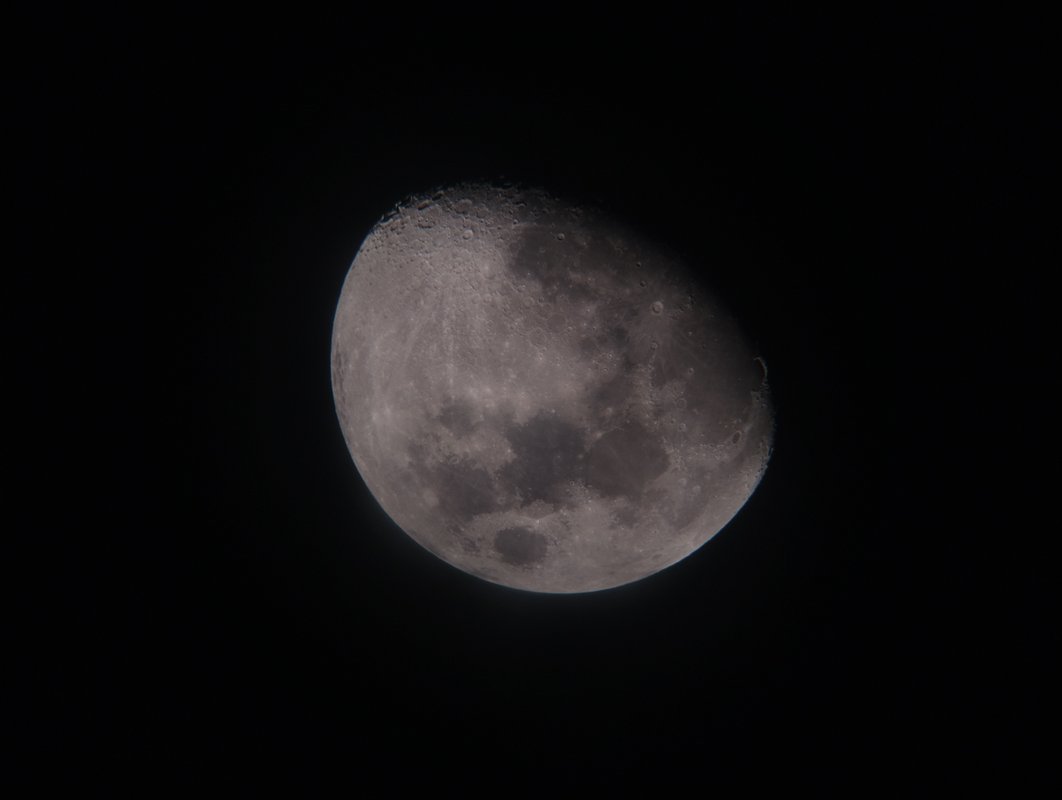
Also, awe is easy to find. You do not need a mountain or an ocean. So you just need a clear, dark sky and a few quiet minutes.
Q: Is awe the same as happiness?
A: No. Happiness is warm and close. But awe is cooler and bigger. So it points you outward, not inward. That is why it feels so different from a normal good mood.
The “Small Self” Effect
So here is the heart of it. Awe makes you feel small. And feeling small can feel wonderful.
Psychologists Dacher Keltner and Paul Piff studied this. Across five studies of more than 2,000 people, awe shrank the focus on the self. So they call this the small self (Source: Piff et al., 2015, Journal of Personality and Social Psychology — Awe, the Small Self, and Prosocial Behavior).
Think about what that means. When the self shrinks, so do its worries. The bills. The inbox. The endless to-do list.
These worries get smaller too. But they do not vanish. They just stop feeling so loud.
The same research found something sweet. Awe made people more generous. It also made them kinder and less entitled. For example, in one study people stood in a grove of tall trees. After, they helped a stranger more (Source: Piff et al., 2015, Journal of Personality and Social Psychology — Awe, the Small Self, and Prosocial Behavior).
So a star-filled sky works like those trees. Maybe better. Indeed, nothing makes you feel small quite like the universe.
Q: Does feeling small mean feeling bad about myself?
A: No, and this matters. The small self is not low self-worth. It is a gentle release from self-focus. People report relief, not shame.
Why the Mind Calms Down
So awe shifts your focus. But why does that calm you?
A busy mind chews on itself. Scientists call this rumination. Basically, it is the loop of worry that runs in the background.
Still, nature seems to break that loop. In one study, people walked for 90 minutes in nature. Their rumination dropped. So did activity in a brain region tied to that worry loop (Source: Bratman et al., 2015, PNAS — Nature experience reduces rumination).
A city walk did not do this. But the nature walk did.
So a dark sky takes this further. It is nature plus awe in one view. Then your attention has somewhere vast to rest.
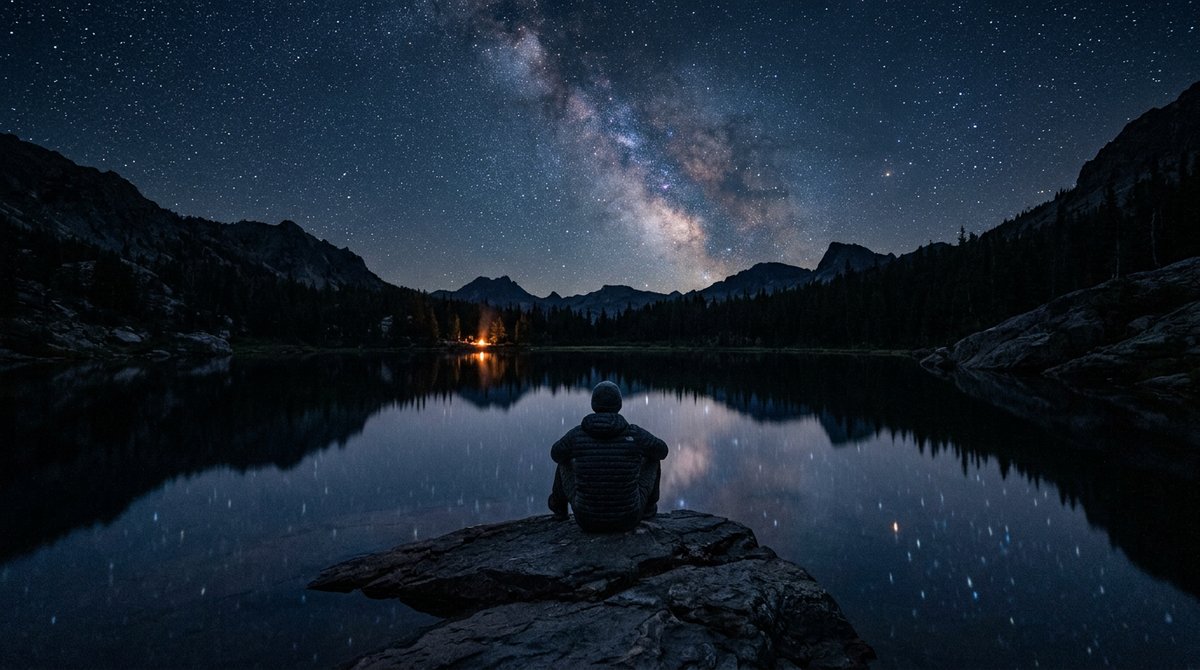
There is a body side too. In fact, awe was the strongest of seven positive feelings linked to lower inflammation. Researchers tied frequent awe to lower IL-6, a marker of inflammation (Source: Stellar et al., 2015, Emotion journal — via ScienceDaily).
One caution here. This is a link, not proof of cause. So a calmer life may simply make more room for awe. Still, the science is honest about that, and so are we.
Q: Will one night of stargazing fix my stress?
A: No single night is a cure. But the research is real. Awe and nature are tied to less worry. Think of it as care, not a quick fix.
The 4 Ingredients of an Awe-Filled Night
Awe is not random. Instead, it tends to show up under the right conditions. So here is the recipe.
1. A genuinely dark sky. You need stars, and lots of them. But light pollution hides most of them. A dark sky brings them back.
2. No screens. A phone pulls you back into your own head. It also wrecks your night vision. So put it away.
3. Time to slow down. Awe needs a few unhurried minutes. Then your eyes adjust. And your breath slows on its own.
4. A sense of vastness. Look for scale. The Milky Way. A wide horizon. Also, the deep dark between stars.
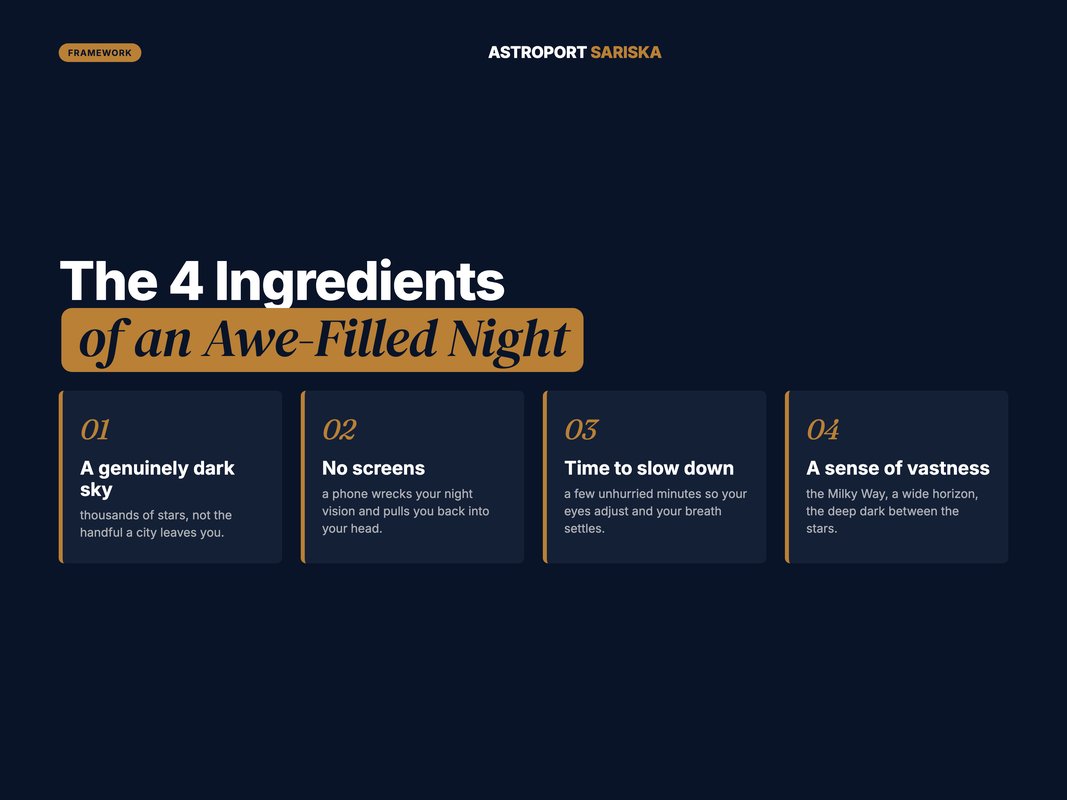
So get these four right and awe tends to follow. But miss them, and a starry sky can pass you by.
Q: Which ingredient matters most?
A: A dark sky comes first. Without real darkness, the other three have little to show. Everything starts with stars you can actually see.
City Night vs Dark-Sky Night
The difference is not small. In fact, it is night and day, you could say.
From inside a big city, you might see about 20 stars. The glow drowns out the rest. Indeed, light pollution now hides the Milky Way from most of the world’s people (Source: Falchi et al., 2016, Science Advances — via NPR).
But a true dark sky is a different planet. At Astroport Sariska, guests see 4,000-plus stars on a clear night. So the Milky Way returns. And the sky has depth again.
That depth is what awe needs. Twenty stars do not bend your mind. But thousands do.
| Feature | City Night | Dark-Sky Night |
|---|---|---|
| Stars visible | About 20 | 4,000-plus |
| Milky Way | Hidden | Bright and clear |
| Screen light | Everywhere | None |
| Mind’s response | Still buzzing | Slows down |
| Awe trigger | Weak | Strong |
So the takeaway is clear. The calm you want needs the dark you rarely get.
Q: Why can’t I just stargaze from my balcony?
A: You can try, and it is still nice. But city glow steals the stars. Fewer stars means weaker awe. For the full effect, you need real darkness.
How to Get the Calm: A Simple Checklist
You do not need gear or training. Instead, you need a dark sky and a little intent. So use this list.
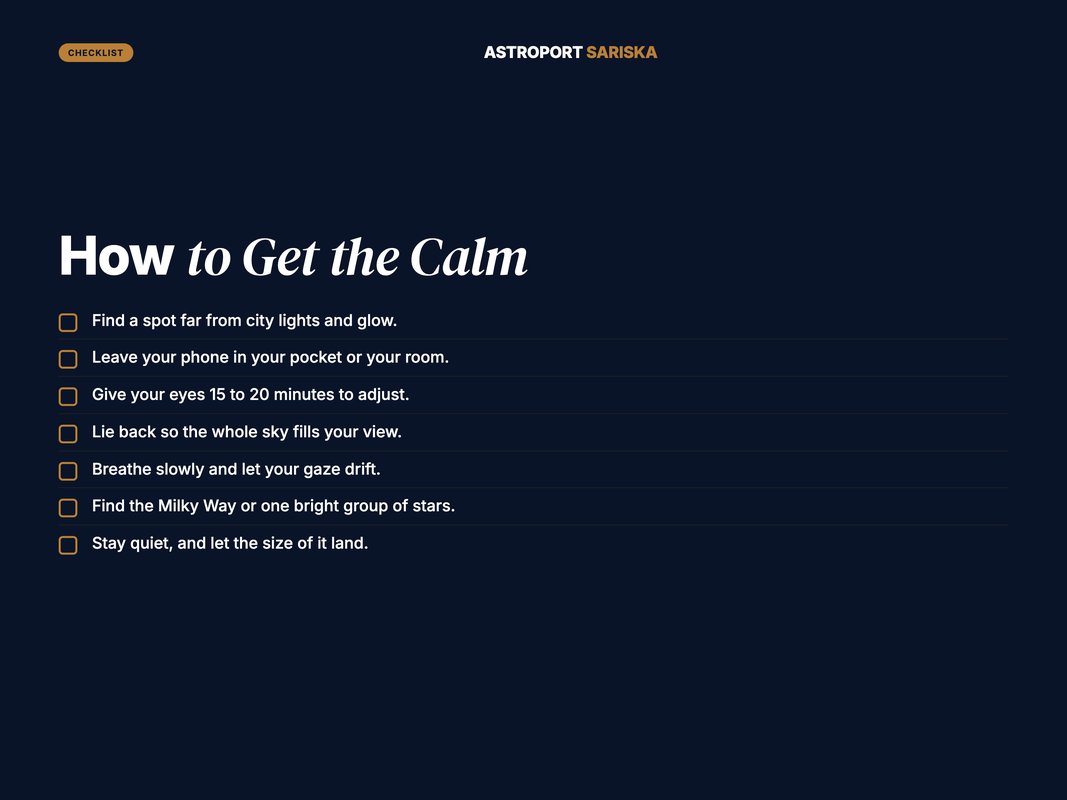
So that is the whole method. No app. No effort. Just darkness, patience, and the sky.
In fact, many guests say the calm starts before the first telescope. It starts the moment the city noise is gone.
Q: Should I stargaze alone or with people?
A: Both work well. Alone feels deep and quiet. Together, awe builds a sense of bond. Research links shared awe with feeling part of something.
Why a Dark Sky Helps You Switch Off
There is one more piece. So the night sky helps you log off.
Awe and nature ask for your full attention. But a screen does the opposite. It keeps you scrolling and self-focused.
So a dark sky almost forces a detox. Bright screens ruin your night vision. So you put the phone away to see the stars at all.
That break has knock-on effects. For example, less screen time at night is tied to easier rest. And a slow, quiet evening helps the body wind down.
So under a dark sky, your breath slows without trying. There is nothing to do. Nowhere to be. Just you and a few thousand stars.
Q: Is this the same as a digital detox?
A: It overlaps. A dark sky gives you a real reason to unplug. The stars are the reward for switching off. That makes the break feel easy, not forced.
Quick Facts: The Science of Awe at a Glance
- Across 5 studies of over 2,000 people, awe shrank self-focus and raised generosity (Source: Piff et al., 2015, Journal of Personality and Social Psychology — Awe, the Small Self, and Prosocial Behavior).
- A 90-minute nature walk lowered rumination and quieted a worry-linked brain region (Source: Bratman et al., 2015, PNAS — Nature experience reduces rumination).
- Of 7 positive emotions, awe was the strongest tied to lower inflammation (IL-6) (Source: Stellar et al., 2015, Emotion journal — via ScienceDaily).
- Older adults who took weekly 15-minute “awe walks” for 8 weeks felt more joy and less daily distress (Source: Sturm et al., 2020, UCSF — Awe Walks Boost Emotional Well-Being).
- Light pollution now hides the Milky Way from most of the world’s people (Source: Falchi et al., 2016, Science Advances — via NPR).
Why Astroport Sariska
Awe needs the right conditions. So Astroport Sariska is built around them.
We sit in the Aravalli hills, in Alwar, Rajasthan. The resort is about 4 to 5 hours from Delhi NCR. So it is close enough for a weekend. Yet far enough to lose the city glow.
The sky here is genuinely dark. On a clear night, guests see 4,000-plus stars. The Milky Way arcs overhead. So that is the vastness awe runs on.
Our resident astronomers guide the night. You look through professional telescopes. Then you learn the constellations. And you watch planets and star clusters up close.
But the calm starts before any of that. It starts with no city, no glow, and no reason to check your phone. Also, the whole place is solar-powered and quiet by design.
By day, you can add a Sariska safari. You can also join yoga under the stars. Or you can eat from our organic farm. The nights, though, are the heart of it.
So this is the easiest awe you will ever find. Plan a stay and let the sky do the work. Plan your trip to Astroport Sariska.
Conclusion
The calm you feel under a starry sky is real. Indeed, it has a name, and it has science behind it.
So awe shrinks the self and the worries that come with it. Then nature quiets the worry loop in the brain. And a dark sky brings both at once, in one wide view.
Still, none of this is a cure. It is care. Basically, it is a gentle, drug-free way to feel lighter and more present.
But the catch is the sky itself. Most of us live under a glow that hides the stars. So you have to go where the dark still lives.
That is what we built. A genuinely dark Aravalli sky, a short drive from Delhi NCR, with no phones and no city light to get in the way. Come look up. Book a stay and feel the calm for yourself.
FAQ
Q: Why does stargazing feel so calming? A: A vast sky triggers awe. Awe shifts focus away from the self and quiets worry. Researchers call this the small self. Daily awe is linked with less stress and better well-being.
Q: Is awe actually good for your health? A: Studies link awe with lower stress and more kindness. One study tied awe to lower levels of an inflammation marker. This is wellbeing research, not medical treatment. It is not a cure for any condition.
Q: What is the small self effect? A: It is the feeling of being small before something vast. Your own worries shrink with you. People report more generosity and humility. It does not mean feeling worthless.
Q: Do I need a dark sky to feel awe? A: No, awe can come from many things. But a sky full of stars is one of the easiest triggers. A dark sky shows thousands of stars. A bright city sky shows very few.
Q: How does leaving my phone help? A: Screens pull attention back to the self. Nature lets attention rest and wander. A dark sky needs your eyes adjusted to the dark anyway. Putting the phone away helps both your eyes and your mind.
Q: Where can I see a truly dark sky near Delhi? A: Astroport Sariska sits in the Aravalli hills in Alwar, Rajasthan. It is about 4 to 5 hours from Delhi NCR. On a clear night guests see thousands of stars. There is no city glow nearby.