
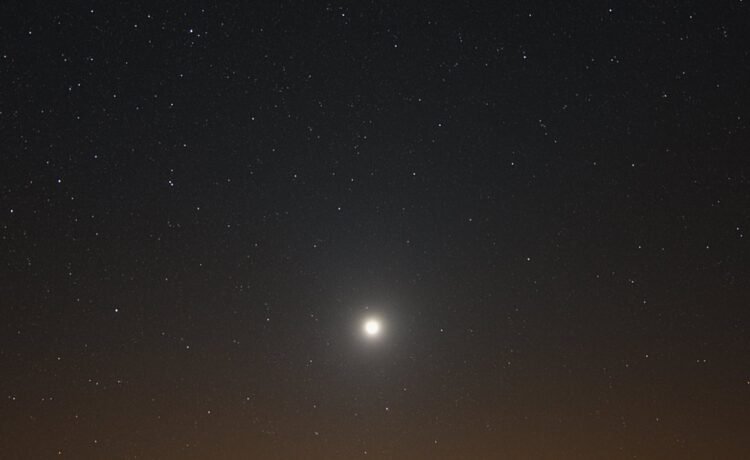
Somebody always asks this on a rooftop in Vasant Kunj. They point at a hazy orange sky and want to know where the stars went.
Then a plane goes past, and it is the brightest thing up there.
So here is the honest answer, without the marketing gloss. You cannot see the Milky Way near Delhi from inside the city. But you can see it properly within a few hours’ drive.
This guide explains why. First, you will learn what Delhi’s sky is actually doing. Then you will see how far you really need to go.
Also, you will learn what your eyes need from you. Finally, you will get a field test to judge any sky yourself.
The Short Answer
From central Delhi: no. Not on any night, in any season, with any amount of patience.
From the city edge: still no. Because the glow follows you, Gurugram and Noida change nothing.
From two hours out: sometimes, faintly, on the best winter nights. So you might catch a vague brightening near the horizon.
From four to five hours out, in the Aravallis: yes, clearly. Then the band stretches overhead with visible structure.
That last jump is not gradual. Instead, it feels like a switch flipping.
So the question is really about distance and direction, not about eyesight. Almost everyone can see it, given the right sky.
Q: Is my eyesight the problem?
A: Almost certainly not. Because the Milky Way is a large, diffuse glow, sharp vision barely matters. So what matters is the darkness of your sky and how long your eyes have adapted.
Why Delhi’s Sky Hides It
Cities do not just add light. They add a dome of it.
Streetlights, hoardings and windows throw light upward. Then dust and water droplets in the air scatter it back down.
That scattered layer is called skyglow (Source: US National Park Service, 2026 — Light Pollution).
Skyglow does not sit over the city alone. Because the atmosphere carries it outward, it spills into the countryside for a long way.
The National Park Service has documented city glow more than 200 miles from its source (Source: US National Park Service, 2026 — Light Pollution).
Cloud makes it dramatically worse. Because clouds reflect that upward light straight back down, they can brighten a city sky by up to 1,000 times (Source: US National Park Service, 2026 — Light Pollution).
So a cloudy night in the countryside is dark. Meanwhile, a cloudy night in Delhi is bright orange.
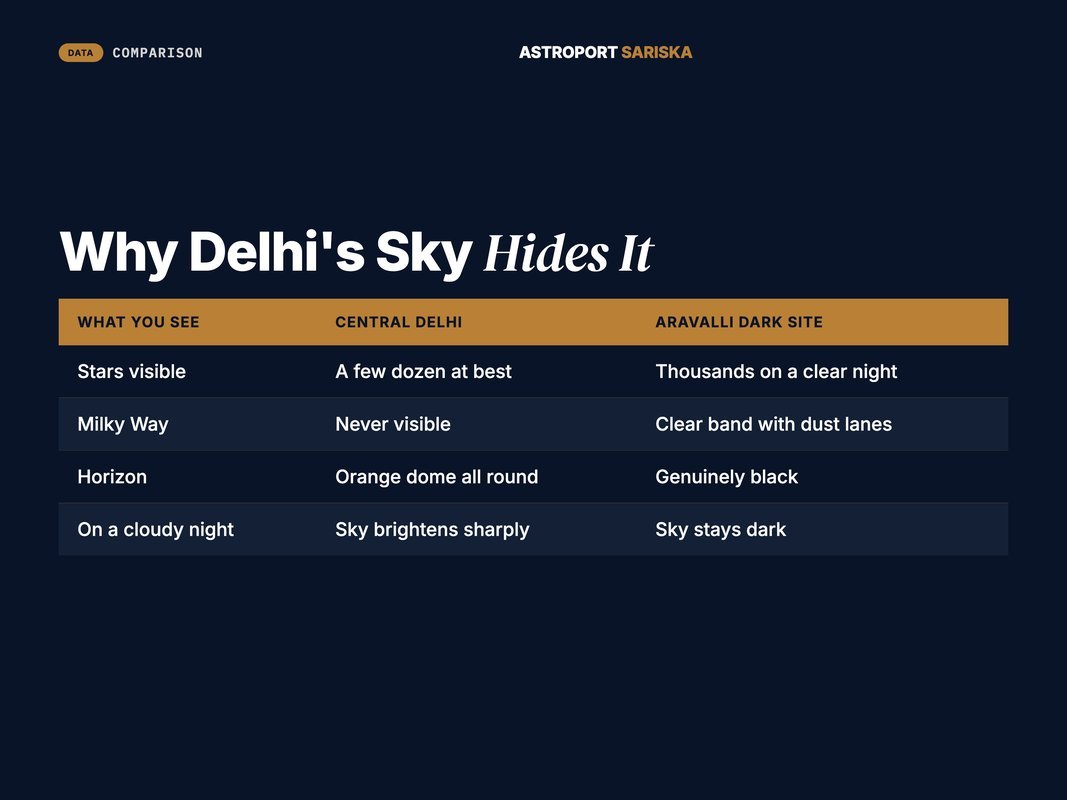
The problem is also growing. Night skies worldwide have been brightening by roughly 9.6 percent a year, which doubles the glow every eight years (Source: US National Park Service, 2026 — Light Pollution).
And this is not just an Indian issue. Skyglow already hides the Milky Way from more than a third of humanity (Source: Falchi et al., 2016 — World Atlas of Artificial Night Sky Brightness).
Q: Would a power cut let me see it from Delhi?
A: Not really. Because the glow comes from the whole region, one dark colony makes little difference. So you would need most of the NCR dark at once.
How Far Do You Have to Drive?
Distance is the lever you control. Here is roughly what each band buys you.
| Distance from Delhi | Drive time | What you can see | Milky Way? |
|---|---|---|---|
| Inside the city | None | A few dozen bright stars, planets, the moon | No |
| NCR edge, 30 to 50 km | Under 1 hour | Slightly more stars, still an orange dome | No |
| Around 100 to 150 km | Two to 3 hours | Constellation shapes become clear | Barely, on the best nights |
| Beyond 200 km, Aravalli hills | Four to 5 hours | Thousands of stars, dark horizons | Yes, clearly |
Direction matters as much as distance. Because you want the city behind you, heading southwest into Rajasthan works better than staying in the plains.
Terrain helps too. So low hills can physically block the glow from towns beyond them.
That combination is why the Aravallis near Sariska work. You get distance, direction and a ridge line all at once.
Timing on the road matters too. So leaving Delhi in the afternoon gets you settled before dark.
Because arriving late costs you the adaptation window, most people underestimate it. Meanwhile, an early arrival lets you watch the sky change gradually.
One more practical point. Weekend traffic out of the NCR is heavy on Friday evenings.
So a Saturday morning departure is often faster. Then you have the whole afternoon spare.
Q: Can I just drive out for an hour after work?
A: You can, but expect little. Because the NCR dome extends well past the ring roads, an hour rarely clears it. So a real Milky Way night needs a proper trip.
What Your Eyes Actually Do in the Dark
Half the battle is biological, and most people skip it.
Your eyes shift into night mode slowly. So the pupil widens within seconds, but the real change takes far longer.
Inside your retina, a light-sensitive pigment rebuilds itself in darkness. Because that chemistry is slow, sensitivity keeps climbing for half an hour or more.
Astronomers allow twenty to thirty minutes as a minimum (Source: NASA, 2026 — How to Find Good Places to Stargaze).
But one glance at a phone undoes most of it. So the screen is the single most common mistake on a stargazing night.

Red light is the fix. Because red wavelengths barely affect that pigment, a red torch lets you see your feet without resetting your vision.
There is a second trick worth knowing. Look slightly beside a faint object rather than straight at it.
That is called averted vision. So the outer retina, which is more light-sensitive, does the work instead.
Q: How long until I am fully dark-adapted?
A: You get most of the benefit in twenty to thirty minutes. Still, sensitivity keeps improving for well over an hour. So the second half of a session is usually the best part.
Five Signs Your Sky Is Dark Enough
Forget instruments. These five checks tell you everything, in order of difficulty.
One: you can see the Little Dipper completely. Its faint stars vanish first under any glow.
Two: the horizon is genuinely black. So if any direction shows a dome of orange, that side is compromised.
Three: you can see colour in bright stars. Then Betelgeuse reads orange and Rigel reads blue-white.
Four: the Milky Way appears as a band. Because this is the real threshold, everything below it is preparation.
Five: you can see dark lanes inside the band. That is a genuinely excellent sky, and rare in northern India.
Work down the list on any night. So you will know exactly where your site sits.
Most NCR rooftops fail at sign one. Meanwhile, a good Aravalli site clears all five.
The ladder is useful because it is honest. So it stops you blaming the weather when the real issue is glow.
It also travels well. Because the signs need no equipment, you can run them anywhere in the country.
Keep a note of your results. Then you build a personal map of sites over a year or two.
Sign three surprises people most. Because star colour is obvious once you look for it, they wonder how they missed it before.
Q: What if I get to sign three but not four?
A: You are close, and probably fighting a nearby town. So try moving a short distance to put a ridge or building between you and it. Also, check the moon has actually set.
A Simple Field Test You Can Run Tonight
Here is a repeatable method. So you can score any location before committing to it.
-
Pick a moonless night. First, check the moon phase, and wait for moonset if needed.
-
Get outside and stay out. Then give yourself a full thirty minutes with no screens.
-
Face away from the brightest horizon. Because you want your best chance, put the glow behind you.
-
Count the stars in a familiar square. Next, use a constellation you know and count what you can see.
-
Run the five signs. So work down the list above and note where you stop.
-
Repeat in a month. Finally, compare. Because conditions vary a lot, one night is not a verdict.

So this costs nothing and takes half an hour. Also, it is a good way to prove to yourself that the drive is worth it.
Q: Is there an app that does this for me?
A: Light pollution maps help you plan, certainly. Still, they cannot see tonight’s haze or the new floodlight next door. So the field test beats the map on the night.
Your Naked-Eye Milky Way Checklist
Run through this before you set out.
- Moonless night, or a window after moonset
- Season checked, since the bright core is up from about February to October
- Site at least a few hours from the NCR glow
- Clear-sky forecast, rechecked on the day
- Thirty screen-free minutes for dark adaptation
- Red torch only, never a white one
- Warm layers, because Aravalli nights cool quickly
- Ground mat or reclining chair for your neck
- A full hour set aside, not fifteen minutes

Also, go with low expectations on your first attempt. Because skies vary, the second trip is often the one that delivers.
Q: What is the most common mistake?
A: Giving up too early. So people step outside, glance up for two minutes, and decide there is nothing there. Because the eye needs half an hour, patience is the whole skill.
Why Astroport Sariska
You need distance, direction and darkness. So the Aravallis southwest of Delhi tick all three.
Astroport Sariska is India’s first astronomy resort. It sits at Tehla, beside the Sariska Tiger Reserve in Alwar, Rajasthan.
The drive is about four to five hours from Delhi NCR. So it clears the city dome completely, which is the whole point.
The resort describes its setting as one of the darkest skies in India. In practice, guests see thousands of stars on a clear night. Meanwhile, central Delhi offers a couple of dozen.
At that level, the band is not subtle. So the dust lanes show, and sign five on the list above becomes achievable.
You also get people who know the sky. Resident astronomers run the stargazing sessions with professional telescopes. Also, there are constellation tours and astrophotography sessions.
One timing note. Astronomy activities pause each year from 1 June to 15 August during the monsoon. So aim for October onwards if the Milky Way core is your goal.
Days are not wasted either. For example, there are jeep safaris into Sariska, farm walks and a spa. Meanwhile, the property runs entirely on solar power. Plan your stay for a moonless week.
Conclusion
So the answer is no from Delhi, and a clear yes from the Aravallis.
Nothing about your eyes is the problem. Instead, it is the orange dome sitting over the whole NCR.
Three things fix it. Get several hours out, pick a moonless night, and give your eyes thirty screen-free minutes.
Then work the five signs. Because they tell you honestly how good your sky is, they beat any app.
The first time the band resolves overhead, it reorganises your sense of scale. So it is worth the drive, and worth the wait. Plan your dark-sky trip and see it properly.
FAQ
Q: Can you see the Milky Way from inside Delhi?
A: No. The skyglow over Delhi is far brighter than the Milky Way itself, so the band is completely washed out. On a good winter night you may see a few dozen of the brightest stars, but nothing more.
Q: How far from Delhi do you have to go to see the Milky Way?
A: Far enough that no city dome touches your horizon, which in practice means a few hours of driving. Short hops to Gurugram or Noida change nothing. Sites in the Aravallis, several hours out, are where the band genuinely appears.
Q: Do you need a telescope to see the Milky Way?
A: No. The Milky Way stretches across the entire sky, so a telescope shows far too narrow a slice. Your own dark-adapted eyes are the right instrument for it.
Q: How long do your eyes take to adjust to the dark?
A: About twenty to thirty minutes for most of the gain, and longer for full sensitivity. A single glance at a phone screen resets much of that progress. Use a red light instead of a white one.
Q: What does the Milky Way actually look like to the naked eye?
A: It looks like a soft, uneven band of light across the sky. Think of thin cloud that never drifts. Under really dark skies you can see dark dust lanes cutting through it. It has structure and depth, but not the colour a camera captures.
Q: Does the moon stop you seeing the Milky Way?
A: Yes, almost completely. Even a half moon floods the sky with enough light to erase the band. Plan your night within a few days of the new moon, or wait until the moon has set.
Q: Which months work best for Milky Way viewing near Delhi?
A: October is the most reliable, since the bright galactic core is up soon after dark and the monsoon has cleared. March through May also works, though only in the pre-dawn hours. November to January the core is not visible at all.