
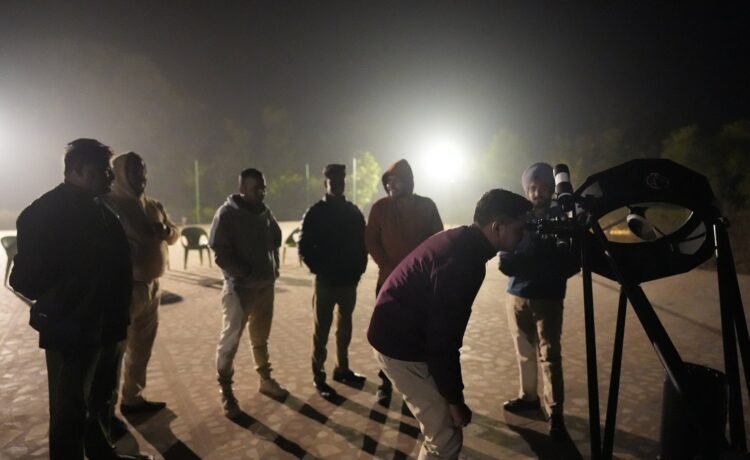
You set an alarm for 2 a.m. You drive out past the last streetlight. Then you wait, staring up, while nothing happens for eleven long minutes.
And then the sky tears open.
That is the deal with meteor showers. So they ask for patience, and they pay in moments you remember for years. But only some nights are worth the trouble.
This meteor shower calendar India 2026 sorts the year for you. First, you will see every major peak date. Then you will learn what the hourly rates really mean. Also, you will see which moon phases quietly ruin half the list.
Finally, you will know which four nights deserve a proper trip. So let us start with how a shower actually works.
How a Meteor Shower Actually Works
A meteor shower is not random. In fact, it runs on a timetable set by orbits.
Comets and a few asteroids leave debris behind them. So each one lays down a long, thin trail of dust and grit.
Earth crosses those same trails every year. Then the grains slam into our air at enormous speed (Source: NASA, 2026 — Meteors and Meteorites).
Most are no bigger than a grain of sand. Still, they burn up in a bright streak. That flash is the meteor.
Because Earth returns on schedule, the dates repeat. So a shower that peaks in mid-December will do so again next December.
Each shower seems to spread out from one point in the sky. Astronomers call that point the radiant. Also, the shower takes its name from the constellation the radiant sits in.
So the Geminids radiate from Gemini. Meanwhile, the Perseids radiate from Perseus. Still, you do not need to find either one.
Meteors streak right across the whole sky. Therefore, looking up broadly beats hunting for a constellation.
Speed matters too, and it varies a lot. Some showers throw slow, drifting streaks. Others fire fast, sharp lines that are gone before you focus.
That difference comes from geometry. Because some trails meet Earth head on, those grains arrive far quicker. Meanwhile, trails we catch up with from behind produce lazier meteors.
Colour changes as well. Iron burns yellow, while magnesium leans blue-green. So a bright meteor can show a faint tint if you catch it well.
Q: Do meteor showers happen at the same time every year?
A: Yes, more or less. Because Earth crosses the same debris trails on the same orbital dates, peaks shift by only a day or two. So a calendar planned a year ahead stays accurate.
The Full 2026 Meteor Shower Calendar
Here is the year in one place. Rates below are the zenithal hourly rate, explained in the next section.
| Shower | Active period | Peak night | Rate at peak | Moon at peak |
|---|---|---|---|---|
| Quadrantids | Dec 26 – Jan 16 | Jan 2–3 | 120 | Full, very bright |
| Lyrids | Apr 15 – Apr 29 | Apr 21–22 | 18 | Thin crescent |
| Eta Aquariids | Apr 15 – May 27 | May 5–6 | 50 | Gibbous |
| Southern Delta Aquariids | Jul 12 – Aug 23 | Jul 30–31 | 25 | 98% full |
| Alpha Capricornids | Jul 3 – Aug 15 | Jul 30–31 | 5 | 98% full |
| Perseids | Jul 17 – Aug 24 | Aug 12–13 | 100 | New moon |
| Orionids | Oct 2 – Nov 7 | Oct 21–22 | 20 | 80% full |
| Southern Taurids | Sep 20 – Nov 20 | Nov 4–5 | 5 | 18% lit |
| Northern Taurids | Oct 20 – Dec 10 | Nov 11–12 | 5 | 7% lit |
| Leonids | Nov 6 – Nov 30 | Nov 16–17 | 15 | 45% lit |
| Geminids | Dec 4 – Dec 17 | Dec 13–14 | 150 | 21% lit, sets early |
| Ursids | Dec 17 – Dec 26 | Dec 21–22 | 10 | 94% full |
(Source: American Meteor Society, 2026 — Meteor Shower Calendar)
Notice how uneven the year is. So two showers tower over the rest.
Also notice the moon column. Because it decides more than most people expect, it gets its own section below.
Q: Are all twelve of these worth watching?
A: Not really. So the minor showers give you five to twenty meteors an hour at best. Still, they are pleasant if you happen to be under a dark sky. But only a handful justify a planned trip.
What ZHR Really Means
Every calendar quotes a peak rate. Yet almost nobody explains it, so expectations get wrecked.
That number is the zenithal hourly rate, or ZHR. It is a laboratory figure, not a forecast.
ZHR assumes three perfect conditions at once. First, a completely dark sky. Second, the radiant sitting straight overhead. Third, a single observer watching the whole sky (Source: International Meteor Organization, 2026 — Visual observation of major showers).
In practice, you never get all three. So your real count always lands lower.
The radiant is usually partway up, not overhead. Meanwhile, some meteors slip past behind you. Also, even superb skies have a little natural glow.
A useful rule is to halve the quoted number. Then halve it again if the moon is up.
Timing shifts things further. Because the radiant climbs through the night, your count rises with it. So the same shower can triple in rate between 10 p.m. and 3 a.m.
Your own eyes matter more than people expect. A rested observer simply sees more. Meanwhile, a tired one blinks through the faint ones.
So the Geminids at 150 might really give you sixty an hour from a dark site. Still, sixty meteors an hour is a spectacular night.
But from a city balcony, that same shower might give you three. Therefore, the number on the calendar is a ceiling, not a promise.
Q: So is the ZHR figure useless?
A: Not at all. Because it is measured the same way for every shower, it compares them fairly. So use it to rank nights against each other, rather than to predict your own count.
The Moon Is the Real Deal-Breaker
Look again at that calendar. Then look only at the moon column.
Moonlight is the single biggest thing standing between you and a good night. Because most meteors are faint, a bright sky simply erases them.
The Quadrantids show the problem perfectly. They fire at 120 an hour, which is superb. Yet in 2026 they peak under a full moon (Source: American Meteor Society, 2026 — Meteor Shower Calendar).
So a strong shower gets flattened by a bright sky. As a result, January is a write-off this year.
The Ursids in late December have the same trouble. Also, the Delta Aquariids in late July peak under a 98 percent moon.
But two peaks land beautifully. The Perseids fall on a new moon in August. Meanwhile, the Geminids get a thin crescent that sets early in the evening.

That is the whole game. So before you book anything, check the moon first and the rate second.
Q: Can I still watch a shower if the moon is up?
A: You can, with a trick. So put a building, ridge or tree between you and the moon. Then watch the darker half of the sky. Still, expect a fraction of the meteors you would see on a moonless night.
Which 2026 Peaks Are Worth Travelling For
Not every peak deserves a four-hour drive. But four of them genuinely do.
Here is the shortlist, ranked by what you will actually see.
One: the Geminids, December 13 to 14. The densest shower of the year, at 150 an hour. Also, the crescent moon sets early, so the sky goes properly dark (Source: NASA, 2026 — Geminids).
Better still, the radiant rises soon after dark. So you can start in the evening instead of waiting for 2 a.m.
Two: the Perseids, August 12 to 13. A rate near 100, under a brand new moon (Source: NASA, 2026 — Perseids).
The catch in India is weather, not sky. Because August sits inside the monsoon, cloud is the real risk.
The Two Outside Bets
Three: the Eta Aquariids, May 5 to 6. Around 50 an hour, from debris shed by Halley’s Comet.
They favour the pre-dawn hours. Still, May skies here are usually clear and settled.
Four: the Orionids, October 21 to 22. Only 20 an hour, and an 80 percent moon.
So why include them? Because October skies in Rajasthan are crisp and post-monsoon clear. Also, Halley’s dust makes them fast and bright.
The Leonids in mid-November deserve a mention too. Their rate is modest now, at roughly fifteen an hour.
Still, they carry history. Every thirty-odd years they have produced true storms. So watchers keep an eye on them out of respect.
The Taurids are the odd ones out. Because they trickle along at five an hour, nobody travels for them.
Yet they are famous for fireballs. So a single Taurus fireball can outshine a hundred ordinary meteors.

So that is your travel list. Two unmissable nights, and two worth a look.
Q: If I can only make one trip in 2026, which night should it be?
A: December 13 into 14, for the Geminids. Because the rate is the highest of the year and the moon behaves, it is the safest bet. Also, north Indian December skies are dry and steady.
What a Peak Night Actually Feels Like
Numbers do not prepare you for the real thing. So here is the honest version.
You arrive before dark and let your eyes adjust. That takes twenty to thirty minutes with no phone screen (Source: NASA, 2026 — How to Find Good Places to Stargaze).
Slowly, the sky deepens. Then stars you never knew existed start filling the gaps.
The first meteor usually catches you sideways. So you turn your head a fraction too late and miss it properly.
Then nothing, for a while. Because meteors arrive in clumps, patience is part of the design.
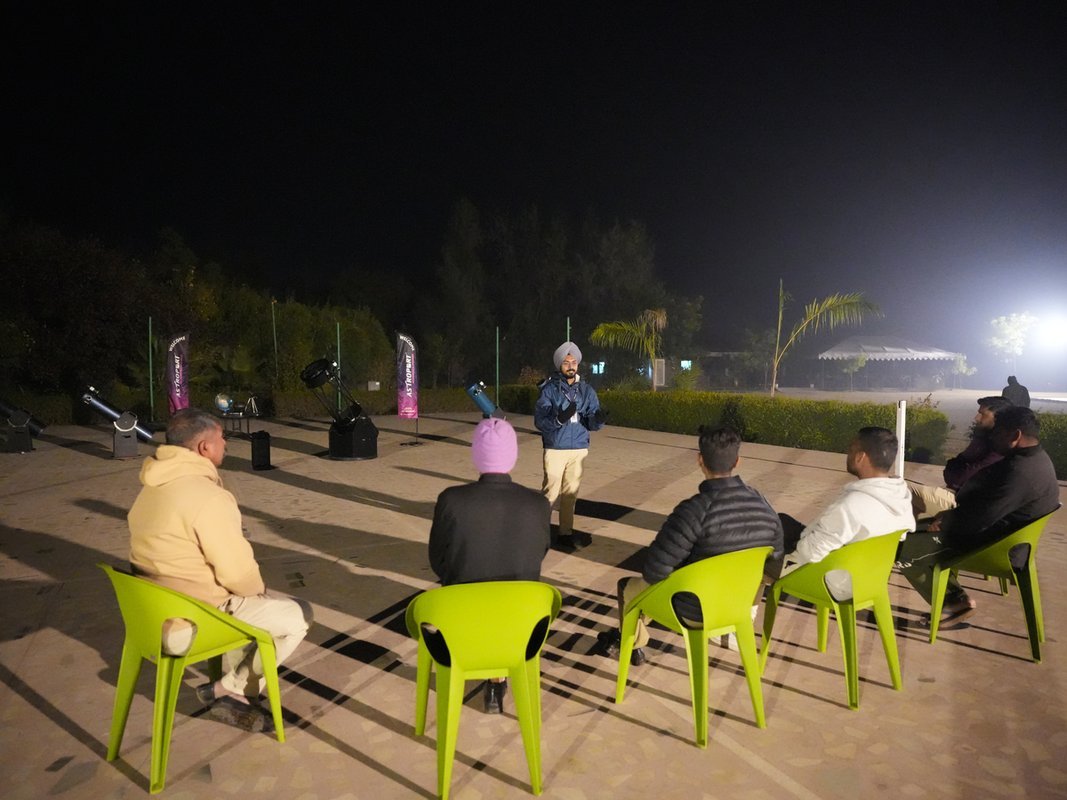
Then three arrive inside a minute. One of them is a fireball, bright enough to throw a shadow.
Somebody gasps. Somebody else laughs. So the whole group goes quiet again, waiting.
That rhythm is the experience. Still, no photograph really carries it.
The cold arrives quietly, about an hour in. So people who packed properly stay put. Meanwhile, the rest drift back indoors and miss the best hour.
Sound plays its part as well. Because a real dark site is far from traffic, the quiet is total. Then a nightjar calls, and everyone jumps.
Q: How long should I plan to stay out?
A: Give it at least ninety minutes. Because activity comes in bursts, a short visit can easily land in a quiet patch. So the longer you stay, the better your odds.
How to Plan a Meteor Trip: Six Steps
Good meteor nights are mostly logistics. So work through these in order.
-
Pick your peak from the calendar. First, choose a date with a high rate and a dark moon. Also, look at the season and likely weather.
-
Book a genuinely dark site. Then get well clear of city skyglow. Because this single choice changes your count more than anything else.
-
Check the moonset time. So aim your best hours for after the moon has dropped. Even a half moon costs you plenty.
-
Watch the forecast from three days out. Meanwhile, stay flexible if cloud is building. Sometimes the night before the peak is the clearer bet.
-
Arrive before dark. Then let your eyes adapt fully. Also, set up your chair and layers while you can still see.
-
Stay put and look up. Finally, give it a couple of hours. Because rates climb through the night, the late session is usually the best.
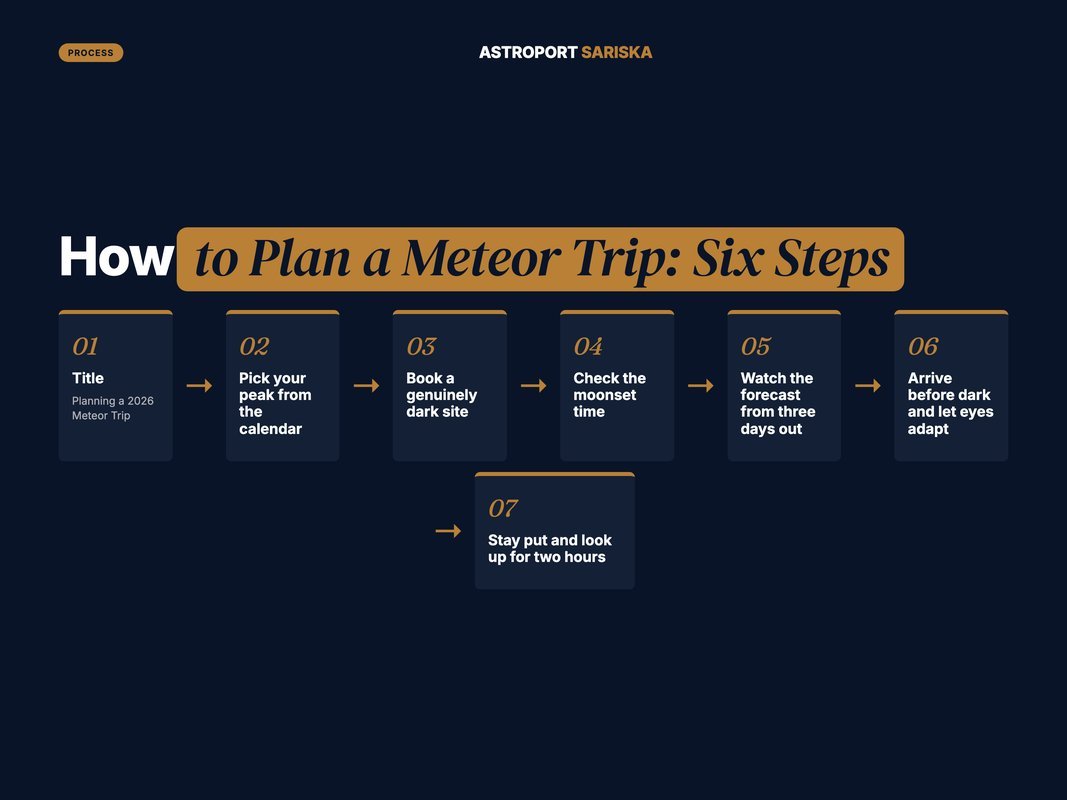
So that is the whole method. Still, the hardest step is simply committing to the date.
Q: Should I watch on the exact peak night or the night before?
A: The peak night, if the sky is clear. Because rates fall off sharply either side, a day’s error costs you a lot. Still, a clear night before beats a clouded-out peak.
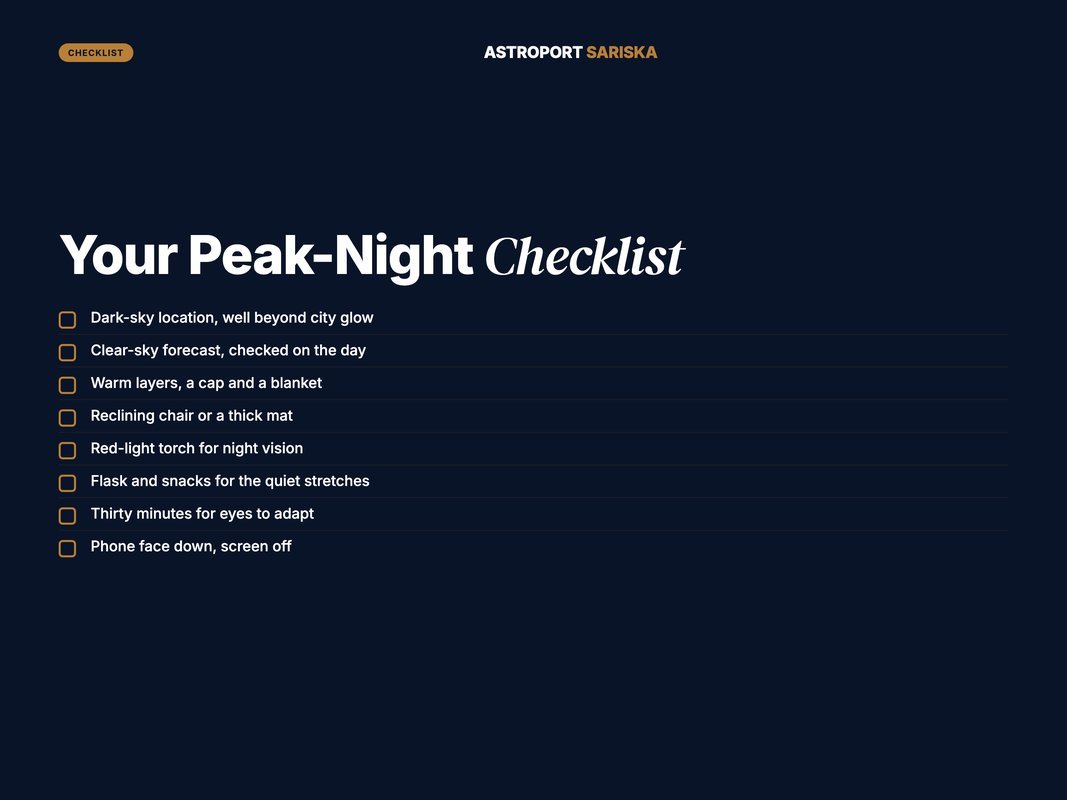
Your Peak-Night Checklist
Comfort decides how long you last outside. So pack properly.
- Dark-sky location, well beyond the city glow
- Clear-sky forecast, checked again on the day
- Warm layers, a cap and a blanket, even in Rajasthan
- Reclining chair or a thick mat to lie on
- Red-light torch, to protect your night vision
- Flask and snacks for the long, quiet stretches
- Thirty minutes set aside for your eyes to adapt
- Phone face down, screen off
Also, leave the telescope at home. Because it narrows your view, it works against you here.
Binoculars are no better for this. So save them for the moon or a star cluster later in the night.
One more habit helps enormously. Instead of scanning around, pick a patch of sky and hold it. Then let the meteors come to you.
Q: What do people most often forget?
A: Warmth. So desert nights drop far colder than the daytime suggests. Because you are lying still for hours, the chill sets in fast. Bring more layers than you think you need.
Why Astroport Sariska
A meteor calendar is only half the plan. So the other half is where you stand when the peak arrives.
Astroport Sariska is India’s first astronomy resort. It sits in the Aravalli hills at Tehla, beside the Sariska Tiger Reserve in Alwar.
The drive is roughly four to five hours from Delhi NCR. So a peak night becomes a weekend, not an ordeal.
The skies here are the point. Because the resort sits far from any city dome, guests see thousands of stars on a clear night. Meanwhile, central Delhi offers a couple of dozen.
You also get help reading the sky. Resident astronomers run stargazing sessions with professional telescopes. Also, there are astrophotography sessions, telescope-making workshops and safe solar observation by day.
One honest note on timing. Astronomy activities pause each year from 1 June to 15 August, during the monsoon. So plan your meteor trip outside that window.
There is more to the stay than the sky. For example, days bring jeep safaris into Sariska and walks through the organic farm. Meanwhile, meals come largely from that farm, and the whole property runs on solar power.
So for the Geminids in December, the pieces line up neatly. Dark skies, expert hosts, and a warm bed afterwards. Plan your stay around a peak date.
Conclusion
The 2026 calendar is generous, but not evenly. So most nights on it are pleasant rather than remarkable.
Two stand out clearly. The Perseids in August bring a new moon and a rate near 100. Then the Geminids in December bring 150 an hour and a moon that sets early.
Everything else depends on the same two levers. First, the moon. Second, how dark your sky is.
You need no gear at all. Just warm layers, a clear night, and somewhere far from streetlights.
So pick your date now, while the good ones are still free. Then book the dark sky to go with it. Plan your 2026 meteor trip and give the year’s best night a real chance.
FAQ
Q: Which meteor shower is the best one to see in India in 2026?
A: The Geminids, peaking on the night of December 13 into December 14. They are the densest shower of the year, and in 2026 the Moon is only a thin crescent that sets early. The Perseids on August 12 to 13 are a close second, with a new moon and warm weather.
Q: How many meteor showers happen in 2026?
A: Around a dozen showers are worth watching, and only four or five reward a dedicated trip. The rest are minor, with rates of five to twenty meteors an hour. A shower is worth travelling for when a high rate lands on a dark, moonless night.
Q: What does ZHR mean on a meteor shower calendar?
A: ZHR stands for zenithal hourly rate. It is the number of meteors one observer would see per hour under a perfect dark sky with the radiant straight overhead. Real counts are always lower, so treat ZHR as a ceiling rather than a promise.
Q: Why does the moon phase matter so much for meteor watching?
A: Moonlight floods the sky and hides faint meteors, which are most of them. A full moon can cut your count by three quarters or more. Always check the moon phase before you book a trip around a peak date.
Q: Do I need a telescope to watch a meteor shower?
A: No. Meteors flash across the whole sky in a second, so a telescope shows far too small a patch. Your own eyes are the correct tool. Lie back, take in as much sky as you can, and stay patient.
Q: How far from Delhi do I need to go to see meteors properly?
A: Far enough to leave the city glow behind, which usually means a few hours of driving. Astroport Sariska sits in the Aravalli hills about four to five hours from Delhi NCR. The jump in visible meteors is dramatic once the skyglow drops away.
Q: What time of night are meteor showers strongest?
A: Most showers build after midnight and peak in the small hours before dawn. That is when your side of Earth turns to face the debris stream head on. The Geminids are the friendly exception, since their radiant rises soon after dark.