
Every December, the sky puts on a quiet fireworks show. The Geminids are the year’s richest meteor shower. They are bright, fast, and reliable.
In 2026, India gets a front-row seat. The peak falls on the night of December 13 into December 14. The Moon stays out of the way. That makes this a rare, clean year.
This guide covers the Geminids meteor shower India 2026 in full. First, you will learn what the Geminids are. Then you will get the exact peak night and the moon phase. Next, you will see why they suit Indian skywatchers so well. Also, you will learn how to watch them with just your eyes.
Finally, we will show why a dark-sky spot beats your rooftop. So let us begin.
What Are the Geminids?
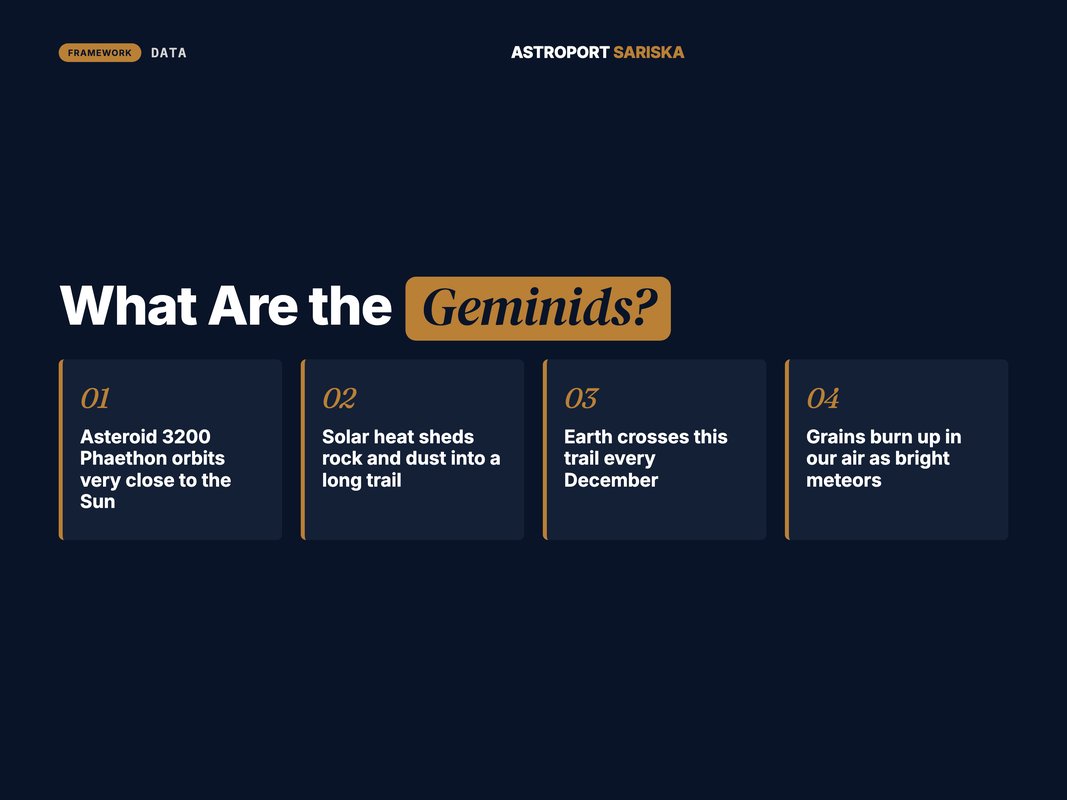
The Geminids are a meteor shower. They show up each year in mid-December. So they are one of the best and most reliable showers we get.
Most showers come from comets. But the Geminids are odd. In fact, their source is an asteroid called 3200 Phaethon (Source: NASA, 2026 — Geminids).
Phaethon swings very close to the Sun. So the heat bakes its surface. Then bits of rock and dust break off. Eventually, they drift into a long trail in space.
Each December, Earth plows through that trail. Then the tiny grains hit our air at high speed. So they burn up in a flash. As a result, we see them as shooting stars.
Geminid meteors are bright and fast. Also, many glow with a soft yellow tint. So they are easy to spot once your eyes adjust.
The meteors seem to spread out from one point. Notably, that point sits in the constellation Gemini, the Twins. So that is how the shower got its name.
Still, you do not need to find Gemini. Instead, the meteors streak right across the whole sky. So just look up and stay patient.
Q: Why are the Geminids special compared to other showers?
A: First, they are the densest shower of the year. Second, they come from an asteroid, not a comet, which is rare. Also, they are bright and easy to see. So that mix makes them a favourite.
The 2026 Peak: When to Look Up
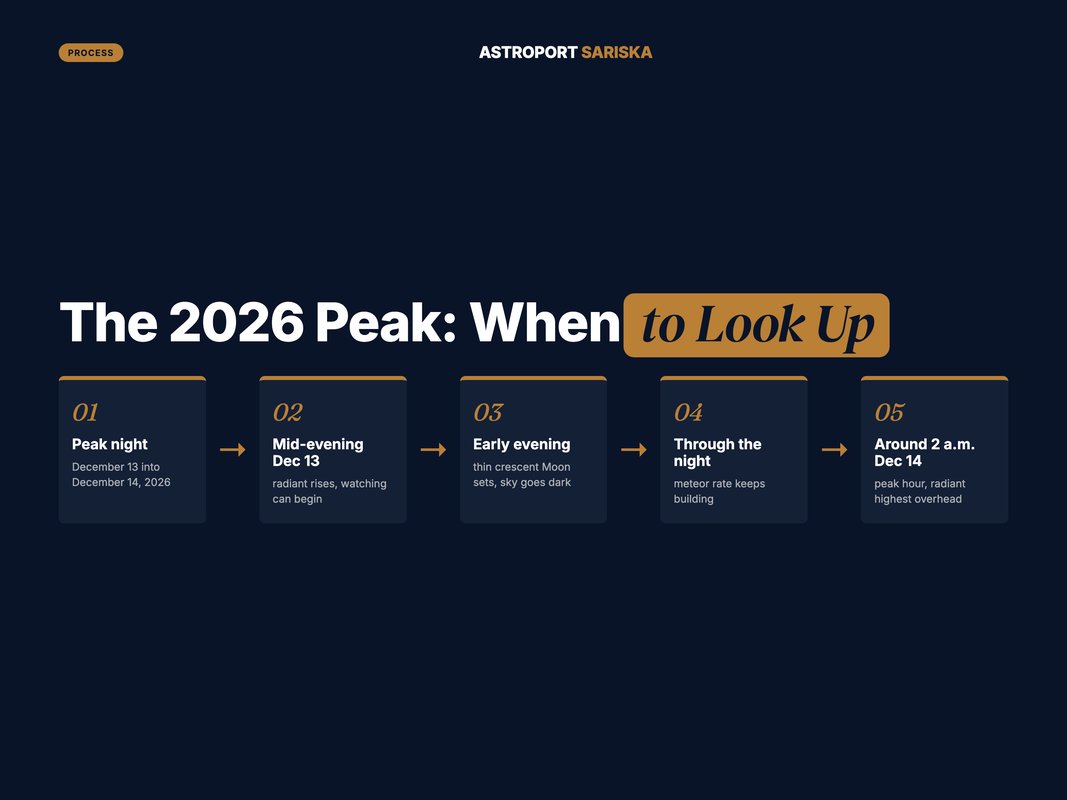
Mark your calendar now. The Geminids peak on the night of December 13 into December 14, 2026.
Still, the shower runs longer than that. Activity builds from about December 4. Then it fades by December 17 (Source: timeanddate.com, 2026 — Geminids Meteor Shower).
But the peak night is the one to plan around. So the rate climbs hour by hour after dark.
The radiant in Gemini rises near sunset. So you can start watching by mid-evening on the 13th (Source: EarthSky, 2026 — Geminid meteor shower).
Then activity keeps building through the night. Usually it is strongest near 2 a.m. local time. Then Gemini rides high overhead.
Here is the best part for 2026. The Moon is a thin waxing crescent at peak. Also, it sets early in the evening (Source: EarthSky, 2026 — Geminid meteor shower).
So a dark sky means more meteors. Meanwhile, bright moonlight washes out the faint ones. But in 2026, you skip that problem.
So a clear, moonless sky and a strong shower line up. That is why 2026 is a year worth the effort.
Q: What is the single best hour to watch in 2026?
A: So aim for the small hours, near 2 a.m. on December 14. By then the radiant sits high. Also, the Moon has set. As a result, the sky is at its darkest and richest.
Why the Geminids Suit India
Many showers are a struggle to watch. But the Geminids are kinder. So they fit Indian skywatchers well, for three clear reasons.
First, the timing. The radiant climbs soon after dark. So you do not have to wait until 3 a.m. to start. As a result, families and first-timers can watch in the evening (Source: NASA, 2026 — Geminids).
Second, the rate. The Geminids are dense. So under dark skies, you can see a meteor every minute or two. Indeed, few showers are this generous.
Third, the sky angle. From most of India, the radiant climbs high overhead. So a high radiant means more visible meteors. Meanwhile, low ones get hidden by the horizon.
Also, December nights here are cool and often clear. Monsoon clouds are long gone. So the air is crisp and steady.
Q: Is December a good month to stargaze in India?
A: Yes. Because the monsoon has passed, skies are often clear. Also, nights are cool and dry. Meanwhile, the air is steady, which keeps stars sharp. So it is one of the best stargazing windows of the year.
How to Watch the Geminids: A Simple Process
You need no gear. No telescope. No app. Just your eyes and a little patience. So follow these steps.
-
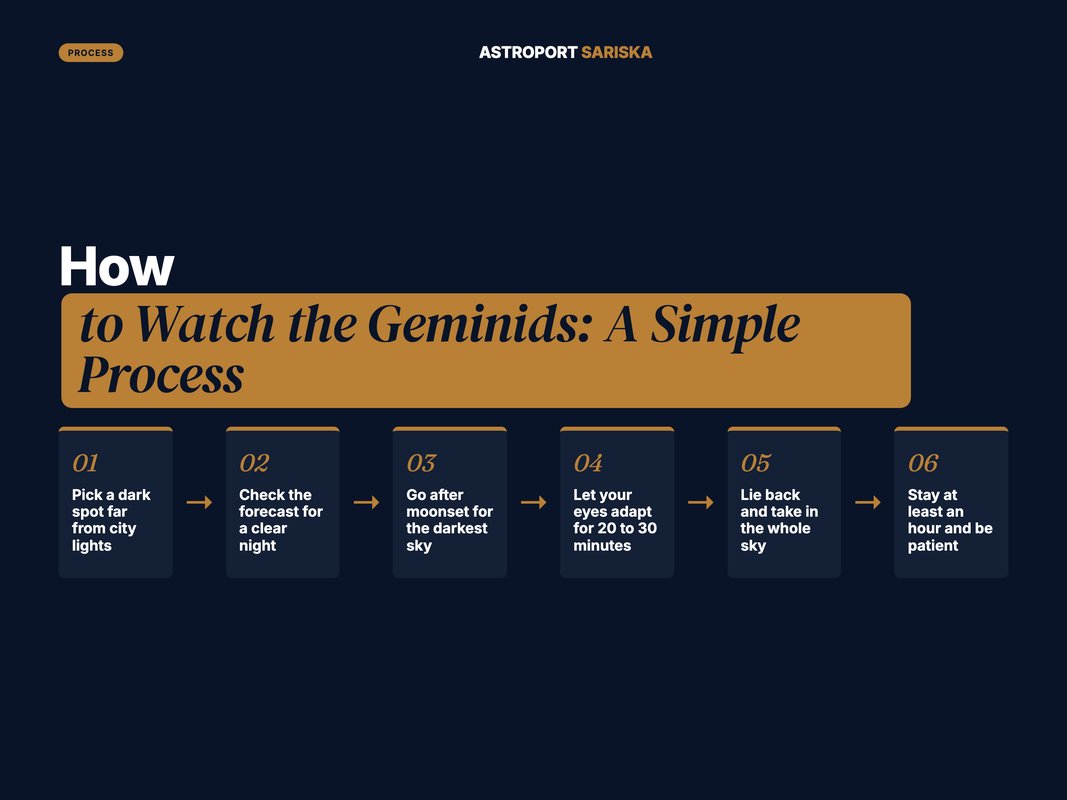
Pick a dark spot. First, get far from city lights. The darker the sky, the more you see. Indeed, this step matters most of all.
-
Check the forecast. Also, you want a clear night. Even thin cloud can hide the show. So pick the clearest sky near the peak.
-
Go after moonset. In 2026, the Moon sets early. So wait until it is down for the darkest sky.
-
Let your eyes adapt. First, give them 20 to 30 minutes in the dark. Meanwhile, avoid your phone screen. Because bright light resets your night vision (Source: NASA, 2026 — How to Find Good Places to Stargaze).
-
Lie back and look up. Then take in as much sky as you can. Still, do not stare at one spot. Meteors flash anywhere.
-
Stay a while. So give it at least an hour. Meteors come in bursts, then pauses. Still, patience pays off.
So that is the whole method. Also, warm clothes and a reclining chair help. After all, December nights get cold.
Q: Do I really not need a telescope?
A: Correct. Because a telescope shows a tiny patch of sky, it works against you. Meanwhile, meteors cross the whole sky fast. So your naked eyes are the right tool. Indeed, they take in the full view.
City vs Dark Sky: Why Location Decides Everything
Your spot matters more than anything else. In fact, the same shower looks wildly different from two places.
From a bright city, you may see only the brightest stars. Meanwhile, the faint ones drown in the glow. So most meteors vanish into that haze (Source: Sky & Telescope, 2026 — Bortle Dark-Sky Scale).
But from a true dark site, the sky comes alive. Then faint stars return. Also, the Milky Way appears. So meteors that the city erased now flash clearly.
For example, the table below shows the gap.
| Factor | Bright city sky | Dark Aravalli sky |
|---|---|---|
| Stars visible | Only the brightest few | Thousands on a clear night |
| Milky Way | Hidden by glow | Clear, bright band |
| Geminid meteors per hour | A handful at best | Up to 120 at peak |
| Faint meteors | Mostly lost | Easy to spot |
So the math is simple. A darker sky means more meteors. Therefore, astronomers say to get at least 20 to 30 miles past the city edge (Source: Sky & Telescope, 2026 — Bortle Dark-Sky Scale).
So that is why a planned trip beats a rooftop. Still, the drive is worth it. Indeed, the difference is night and day, literally.
Q: How much does a dark sky really change the count?
A: Quite a lot, in truth. So a city rooftop might show you a few meteors an hour. Meanwhile, a dark site can show ten times more, or even more than that. Therefore, location is the biggest lever you control.
Geminids vs Perseids: How They Compare
You may know the Perseids of August. Certainly they get more press. But on raw numbers, the Geminids win.
The Geminids peak at about 120 to 150 meteors per hour. Meanwhile, the Perseids peak near 100 (Source: American Meteor Society, 2026 — Meteor Shower Calendar).
So why are the Perseids more famous? Comfort. They fall in warm August weather. So people are already outside.
But the Geminids fall in cold December. So that keeps casual viewers indoors. Their loss. Still, the show is the better one.
There is one more edge. Notably, the Geminid radiant rises early. So you can watch in the evening. But the Perseids ask you to wait past midnight.
So the Geminids give more meteors and an earlier start. Still, you just need warm clothes and a dark sky. Plus, for 2026, with the Moon gone, the case is even stronger.
Q: Are the Geminids better than the Perseids?
A: On raw meteor counts, yes. Indeed, they are denser and start earlier in the night. Still, the Perseids win only on warm weather. But for a real sky show, the Geminids are hard to beat.
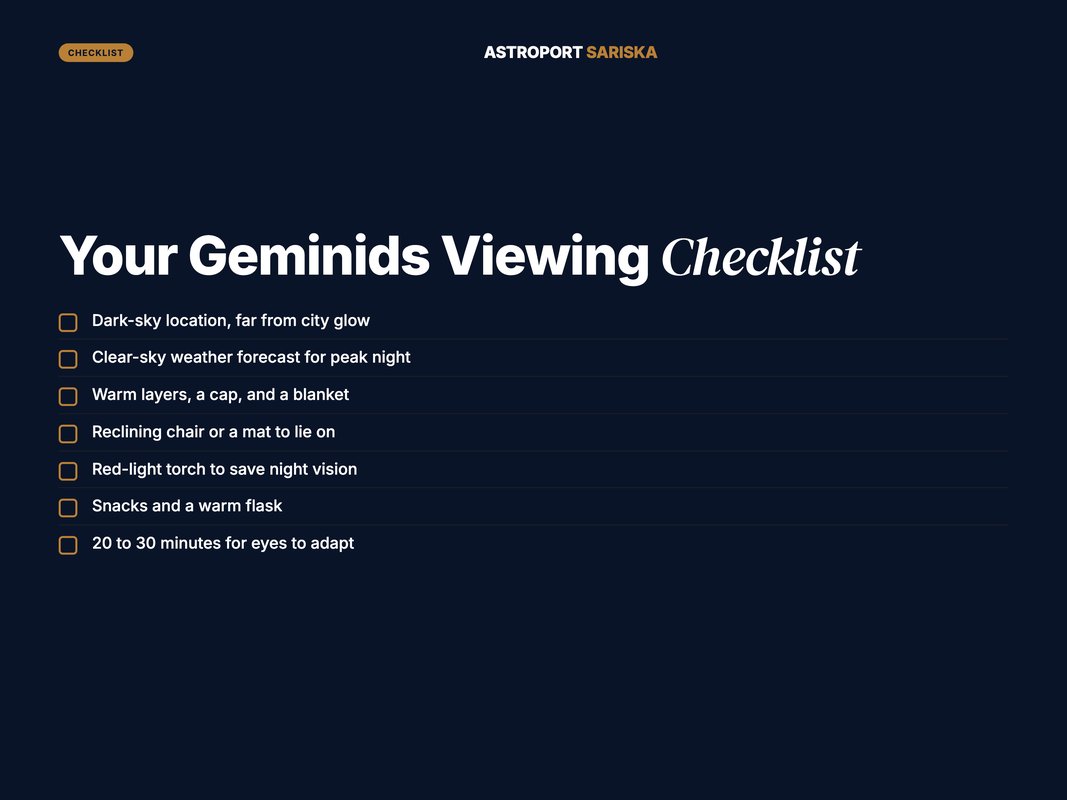
Your Geminids Viewing Checklist
Pack smart and the night runs smoothly. So tick these off before you go.
- A dark-sky location, far from city glow
- A clear-sky weather forecast for peak night
- Warm layers, a cap, and a blanket
- A reclining chair or a mat to lie on
- A red-light torch to save your night vision
- Snacks and a warm flask for the long wait
- 20 to 30 minutes set aside for your eyes to adapt
Also, keep your phone tucked away. Its screen wrecks your dark vision in a flash. So a red light is far kinder to your eyes.
Q: What is the one thing people forget to pack?
A: Warmth. Because December nights in north India get cold fast, lying still chills you. So bring more layers than you think you need. Also, a flask of something hot helps.
Why Astroport Sariska
You want dark skies for the Geminids. So Astroport Sariska gives you exactly that.
It is India’s first astronomy resort. Specifically, it sits in the Aravalli hills, near the Sariska Tiger Reserve. Also, the drive is about 4 to 5 hours from Delhi NCR.
The skies here are genuinely dark. So guests can see more than 4,000 stars on a clear night. Meanwhile, from inside Delhi, you might count just 20.
So that gap is the whole point. Indeed, a dark sky is what turns a few meteors into a real show. So Sariska delivers that for you.
Also, you do not watch alone. Resident astronomers run the sessions. So they guide you with professional telescopes and constellation tours. Indeed, they know how to read the night.
But there is more to the stay than the sky. For example, days bring wildlife safaris in Sariska. Also, there is an organic farm, farm-to-table meals, and a spa. Meanwhile, nights bring campfires and yoga under the stars.
Plus, the whole resort runs on solar power. So it is a calm, grounded base for a December sky trip.
So for the 2026 Geminids, the setting is ideal. Dark skies, expert hosts, and a warm bed after the show. Finally, plan your stay around the peak night.
Conclusion
The Geminids are the year’s best meteor shower. So in 2026, the timing is excellent. Specifically, the peak falls on December 13 into December 14. Also, the Moon stays out of the way.
So you need no gear. Just your eyes, a little patience, and a dark sky. Indeed, that last part is the key.
So a city rooftop will let you down. But a true dark site changes everything. Then the faint meteors return. Also, the sky fills up.
Meanwhile, Astroport Sariska gives you that dark sky, plus expert hosts and a warm place to rest. So it sits about 4 to 5 hours from Delhi NCR.
So pick your night. Then pack warm. Finally, look up. Plan your Geminids trip and catch the show under real stars.
FAQ
Q: When do the Geminids peak in India in 2026?
A: The peak runs through the night of December 13 into December 14, 2026. The richest hours fall after midnight, with the radiant highest around 2 a.m. local time. You can start watching by mid-evening on December 13.