
A great sky event in 2026 is half luck, half timing. Still, you can fix the timing part. Plan your sky event 2026 trip around the dates that matter.
So the best dates for a stargazing trip in 2026 in India are not random. Instead, they follow the Moon, the meteor showers, and the planets. Get those dates right, and the sky does the rest.
Most people plan backwards. First, they pick a free weekend. Then they hope something cool is up there. But it rarely is.
This guide flips that. So you pick the event first. Then you build the trip around it.
Next, we will walk through the simple planning logic. Pick the event. Check its date. Dodge the full moon. Also aim for a new moon. Add a buffer night for clouds. Finally, book early.
Then you get a full 2026 sky-event calendar. Meteor peaks, new moons, planet nights, and the lunar eclipse all sit in one table. For the wider picture, see our astronomy travel guide for 2026. So let us time it right.
Start With the Event, Not the Weekend
Here is the core idea. Big sky nights are fixed in advance.
For example, a meteor shower peaks on a set date. A planet sits at its brightest on a set date. Likewise, the Moon goes dark on a set date. So none of this moves.
Instead, flip your planning. First, don’t ask “which weekend am I free?” Then ask “what is happening in the sky?”
Next, pick one target event. Maybe the Perseids in August, or Saturn in October. Or it could be the Milky Way core on a summer night.
So lock the date. Then request leave around it. Finally, book the stay.
This one switch changes everything. Because you stop hoping and start aiming.
It also makes the trip feel special. You are not just “going away.” Instead, you are going to see something. So that story sticks with people.
One target per trip is plenty. Still, chasing three events in one weekend just stresses you out. So pick the best one. Then build the whole night around it.
Q: What if I can only travel on fixed weekends?
A: Then match the nearest new-moon weekend to your dates. The calendar below lists them. Even without a meteor peak, a dark new-moon sky is a stunning sight. The Milky Way and thousands of stars are always worth the trip.
Rule One: Dodge the Full Moon, Chase the New Moon
This is the most important rule. Indeed, the Moon is the sky’s biggest spoiler.
A full moon acts like a giant floodlight. So it washes out faint stars. Also, it hides all but the brightest meteors.
For example, look at January 2026. The Quadrantids peak around January 3 to 4. But a bright supermoon shares that night. As a result, most meteors vanish in the glare (Source: American Meteor Society, 2025 — Quadrantids 2026).
Now flip it. A new moon means no moonlight at all. So the sky goes deep black. Then faint stars pop. Meteor counts soar.
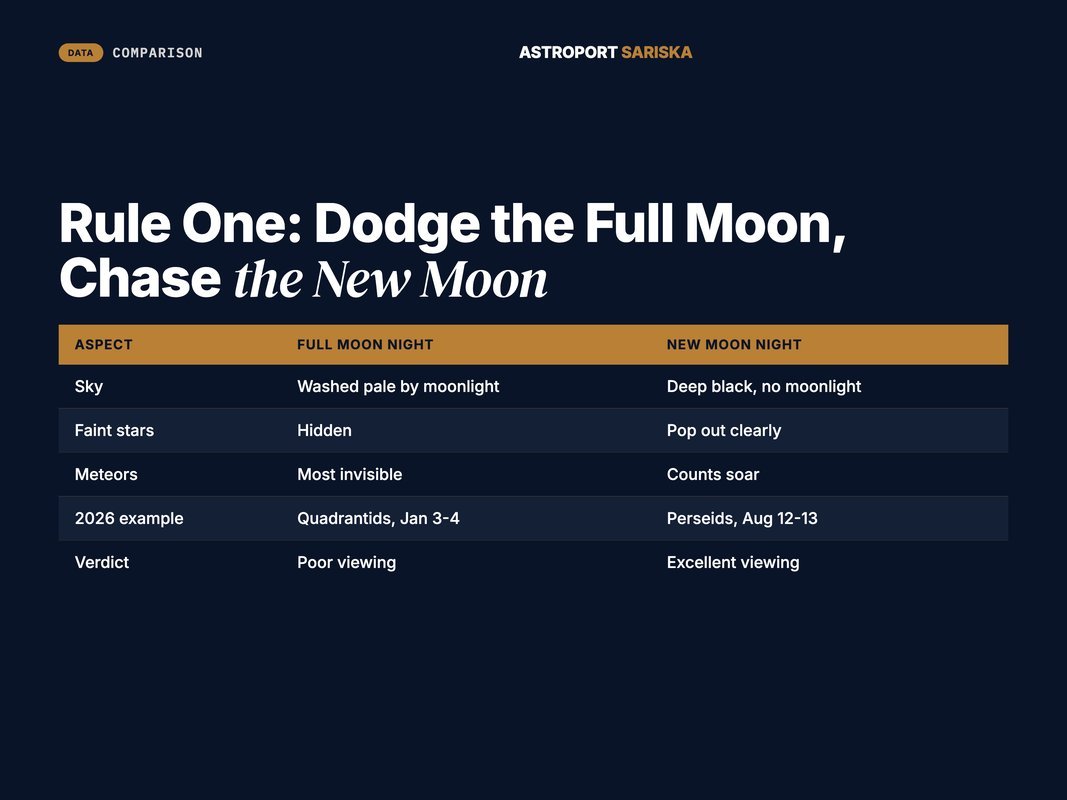
That is why timing beats luck. So aim your trip at the new moon, or the days right around it.
New moons fall about once a month. In 2026, for instance, they include June 14, July 14, and August 12 (Source: EarthSky, 2026 — Supermoons 2026). Indeed, the August new moon is the gift of the year. More on that soon.
Still, a few days either side of a new moon works well. The Moon is just a thin sliver then. So it sets early and leaves the sky dark.
So the rule is simple. Full moon? Then skip it. New moon? Go.
Q: Do I need the exact night of the new moon?
A: No. A window of three to four days on either side is fine. The Moon stays thin and faint then. What you really want to avoid is the full moon, which sits up all night and drowns the stars.
Rule Two: Build In a Buffer Night for Clouds
Even perfect dates can be ruined by clouds. So plan for them.
The fix is easy. So book two nights, not one. Then the second night is your insurance.
If night one is cloudy, you still have night two. Because most weather systems shift within a day, a clear gap often opens up.
This matters most for one-off events. After all, a meteor peak only happens on its date. Miss the peak night to clouds, and the next peak is a year away.
So a two-night stay softens that risk a lot. Also, you double your chance of one clear sky.
There is a bonus, too. For example, a second night lets your eyes adapt fully. Real dark-sky vision takes time to build. So two nights means you actually relax into it.
Next, check the weather a few days out. Apps and forecasts get accurate close to the date. But book the buffer night long before that.
Astroport Sariska sits in a dry Aravalli pocket. So clear nights are common here, far from city haze. Still, a buffer night is smart planning for any sky trip.
Q: How many nights should I book for a meteor shower?
A: Two is the sweet spot. The peak night is your main shot. The second night is backup for clouds, and it doubles your viewing time. For a calm, no-pressure trip, two nights beats one every time.
Rule Three: Book Early, Especially Near a New Moon
Good dark-sky dates are popular. Indeed, many people now plan trips this way.
New-moon weekends near a meteor peak are the busiest of all. So they book out fast. Move early.
A simple target works. So lock your stay four to six weeks before the event. For the biggest nights, even earlier is wise.
Why so far ahead? There are three reasons. First, you get a room. Then you secure the buffer night. Finally, you land the dates you want, not the leftovers.
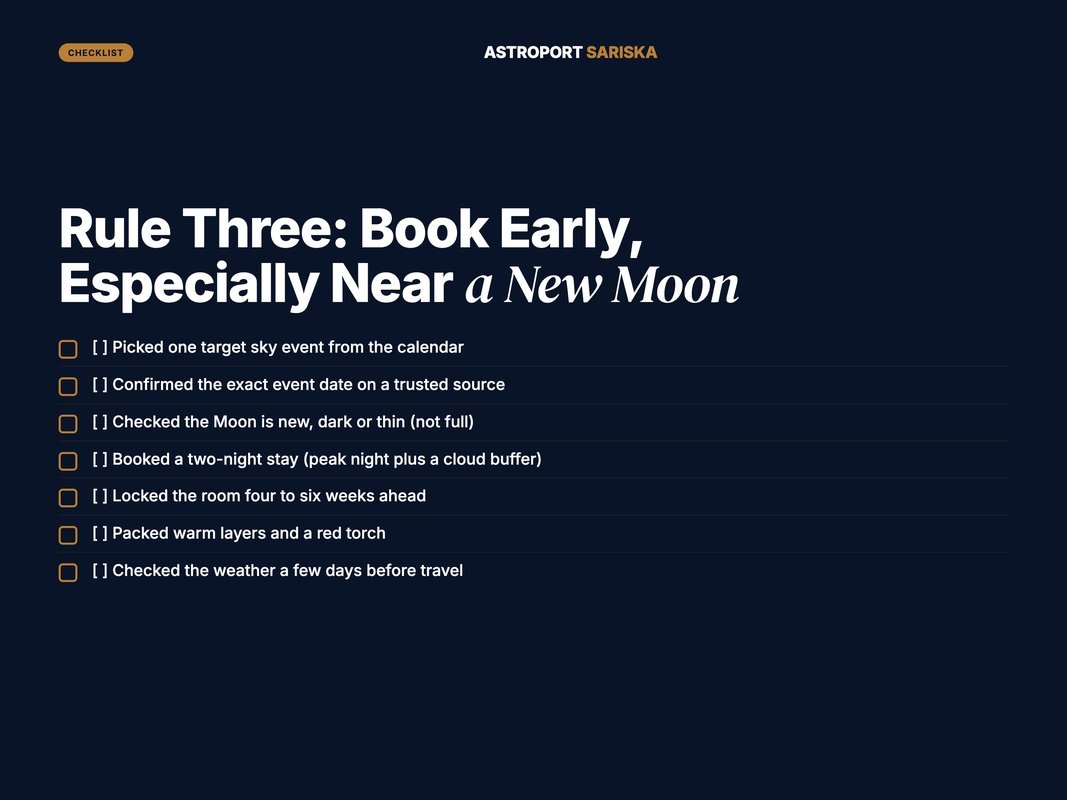
Early booking also gives you time to prep. So you can pack the right gear. Next, read up on the event. Then rest before a late night under the stars.
There is a quiet money point, too. For instance, last-minute trips often cost more and offer less. So planning ahead just lands you a better stay.
So treat the sky calendar like a concert schedule. After all, the best shows sell out. Book your seat early.
Q: How far in advance do new-moon weekends fill up?
A: For headline events like the Perseids, popular dark-sky stays can fill weeks ahead. Aim to book four to six weeks out, or more for August. The earlier you act, the better your dates and your buffer night.
The 2026 Sky-Event Calendar (Verified)
Here is your planning master list. Indeed, every date below is verified.
So use it to pick a target. Also note the Moon column. A “new” or “dark” Moon means great viewing. But a “full” Moon means trouble.
The two star nights are the Perseids in August and the Geminids in December. Because both fall on dark skies, both are perfect trip targets. For a deeper look, see our 2026 meteor shower dates guide and the dedicated Geminids 2026 guide.

The Full 2026 Date Table
| Sky Event | 2026 Date | What You Need | Moon |
|---|---|---|---|
| Quadrantids meteor peak | Jan 3–4 | Open sky, very early hours | Full (supermoon) — poor |
| Jupiter at opposition | Jan 10 | Telescope or binoculars | Any — bright all night |
| Total lunar eclipse | Mar 3 | Just your eyes, east view | Full — but that’s the event |
| Lyrids meteor peak | Apr 21–22 | Open sky, after midnight | Thin — good |
| Eta Aquariids peak | May 5–6 | Low south-east sky, pre-dawn | Gibbous — fair |
| Milky Way core (summer) | Jun–Aug nights | Dark sky, no Moon | Best near new moon |
| Perseids meteor peak | Aug 12–13 | Open sky, late night | New moon — excellent |
| Saturn at opposition | Oct 4 | Telescope for the rings | Any — bright all night |
| Uranus at opposition | Nov 25 | Telescope, very dark sky | Near full — fair |
| Geminids meteor peak | Dec 13–14 | Open sky, from mid-evening | Dark — excellent |
Calendar Sources and Notes
Sources: meteor peaks and Moon notes from EarthSky and the American Meteor Society (Source: EarthSky, 2026 — Perseids guide) and (Source: EarthSky, 2026 — Geminids guide). Planet oppositions from in-the-sky.org (Source: in-the-sky.org, 2026 — Saturn at opposition) and (Source: in-the-sky.org, 2026 — Jupiter at opposition). Lunar eclipse from timeanddate (Source: timeanddate.com, 2026 — Eclipses worldwide 2026).
Q: Which single 2026 event is the easiest win for a first trip?
A: The Perseids on August 12 to 13. They peak on a new moon, so the sky is dark. Rates can hit 90 meteors an hour. Warm nights and high meteor counts make it the most forgiving event of the year.
How to Time Your Sky Event 2026 Trip, Step by Step
Let us turn the rules into a clean process. So follow these six steps in order.

The Six-Step Checklist
-
Pick one target event. First, use the calendar above. So choose a meteor peak, a planet night, or a dark Milky Way weekend. One target is enough.
-
Check the exact date. Next, confirm it on a trusted source. Because meteor peaks shift by a night sometimes, double-check. The calendar links above are a good start.
-
Check the Moon. So look at the Moon column. Aim for “new,” “dark,” or “thin.” But if your event clashes with a full moon, like the Quadrantids, pick a different target.
-
Block a two-night stay. Then set the peak night as night one. Also add night two as your cloud buffer. So this doubles your sky time.
-
Book four to six weeks early. So lock the room before the dates fill. The big nights, like August, go first.
-
Prep and travel light. Finally, pack warm layers and a red torch. Then rest before the late night. Leave the laptop at home.
That is the whole system. So pick, check date, check Moon, book two nights, book early, prep.
It works for any event in any year. So the 2026 calendar just gives you the dates to plug in.
Q: Do I need to track all of this myself?
A: Not at all. At a dedicated dark-sky resort, resident astronomers track the sky for you. They know the peak times and the best viewing spots. You just pick your dates and turn up.
A Quick Note on Planets and the Milky Way
Meteors get the headlines. But planets and the Milky Way are easier wins. So they are up for weeks, not one night.
Planets at Opposition
Saturn reaches opposition on October 4, 2026. Indeed, that is its brightest, closest night of the year (Source: in-the-sky.org, 2026 — Saturn at opposition). Through a telescope, the rings are unforgettable. Also, Saturn stays well-placed for weeks around that date.
Jupiter does the same on January 10, 2026 (Source: in-the-sky.org, 2026 — Jupiter at opposition). So its cloud bands and four bright moons are a telescope treat.
The Milky Way Core
The Milky Way core is the other slow target. Its bright season runs from about February to October. So June, July and August are the peak months (Source: Capture the Atlas, 2026 — Best time to see the Milky Way).
This is good news for planning. Because you don’t need one exact night for these, the window is generous. So you just need a dark sky and a new moon.
Then pair them up. So book a new-moon summer weekend. You get the Milky Way overhead and a planet in the telescope. Two events, one trip.
Q: Are planets easier to plan around than meteors?
A: Yes, much easier. A planet sits bright for weeks near its opposition date. You don’t have to hit one exact night. Just pick a clear evening in that window and bring a telescope.
Quick Facts: Your 2026 Sky-Trip Cheat Sheet
- Perseids peak on the nights of August 12–13, 2026, on a new moon, with up to 90 meteors an hour under dark skies (Source: EarthSky, 2026 — Perseids guide).
- Geminids peak on December 13–14, 2026, moon-free, with up to 120 meteors an hour (Source: EarthSky, 2026 — Geminids guide).
- Saturn is at opposition on October 4, 2026, its best night for the rings (Source: in-the-sky.org, 2026 — Saturn at opposition).
- A total lunar eclipse falls on March 3, 2026, with much of India seeing the late stages near moonrise (Source: timeanddate.com, 2026 — Eclipses worldwide 2026).
- Astroport Sariska’s dark sky shows 4,000+ stars on a clear night, against about 20 from inside Delhi.
Why Astroport Sariska
Picking the date is step one. Then picking the place is step two. So they go together.
Astroport Sariska is India’s first purpose-built astronomy resort. So it sits in a dark-sky pocket of the Aravallis. The location is Village Roopwaas, near Sariska Tiger Reserve Gate No. 2, in Alwar, Rajasthan.
The drive is the easy part. Indeed, it is about 4 to 5 hours from Delhi NCR, roughly 200 km. So that makes a two-night sky weekend simple to plan.
The dark sky does the heavy lifting. So on a clear night, guests see more than 4,000 stars. But from inside Delhi, you might see 20. The difference is night and day.
You also don’t watch alone. For example, resident astronomers run telescope sessions and constellation tours. Also, they know each event’s peak time and the best spots. So your timing is handled for you.
There is more than the sky, too. So the resort runs Sariska safaris, an organic farm-to-table kitchen, yoga under the stars, and the Sparsh Spa. The whole place runs on solar power.
So here is the simple plan. First, pick your 2026 event from the calendar. Next, choose a clear-sky weekend near a new moon. Then book your stay and let the team handle the rest.
Conclusion
A perfect sky night is not luck. Instead, it is a plan.
So start with the event, not the weekend. First, pick your target from the 2026 calendar. Then check its date. Next, dodge the full moon and aim for a new moon. Also add a buffer night for clouds. Finally, book early.
So that simple order changes the whole trip. Because you stop hoping and start aiming, the sky rewards you for it.
The headline nights are easy to remember. So note the Perseids on August 12 to 13. Then the Geminids on December 13 to 14. Saturn is at its best in early October.
Now you have the dates. So Astroport Sariska gives you the dark sky to use them in, just 4 to 5 hours from Delhi NCR.
Pick your night. Then plan your trip. Meanwhile, we will keep the stars ready. So book your clear-sky weekend with us and catch your event in 2026.
FAQ
Timing and the Moon
Q: When is the best time to plan a stargazing trip in 2026?
A: Aim for a weekend near a new moon. New moons fall on dates like June 14, July 14 and August 12, 2026. The sky is darkest then. Big meteor nights are August 12 to 13 and December 13 to 14.
Q: Why should I avoid the full moon for stargazing?
A: A full moon floods the sky with light. It hides faint stars and most meteors. The Quadrantids in January 2026 clash with a bright supermoon, so few meteors show. A new moon gives you a black, star-rich sky instead.
Picking Events and Booking
Q: What are the best meteor showers to plan a 2026 trip around?
A: The Perseids peak on the nights of August 12 to 13, with a new moon and up to 90 meteors an hour. The Geminids peak on December 13 to 14 with dark skies and up to 120 an hour. Both are great trip targets.
Q: How far ahead should I book a stargazing trip?
A: Book at least four to six weeks early for a big event. New-moon weekends near a meteor peak fill fast. Booking ahead also lets you add a buffer night, in case the first night is cloudy.
Eclipses, the Milky Way and Where to Go
Q: Is there a major eclipse visible from India in 2026?
A: Yes. A total lunar eclipse falls on March 3, 2026. Much of India sees the late stages near moonrise. Cities like Delhi catch the final part after the Moon rises in the early evening.
Q: When can I see the Milky Way core in 2026?
A: The bright core season runs from about February to October. June, July and August are the peak months. Pick a new-moon weekend in that window for the best view of the galaxy’s heart.
Q: Where can I go stargazing near Delhi NCR for these events?
A: Astroport Sariska sits about 4 to 5 hours from Delhi NCR. It is a dark-sky resort in the Aravallis with resident astronomers and telescopes. You can book a clear-sky weekend near a new moon and watch the event in comfort.