
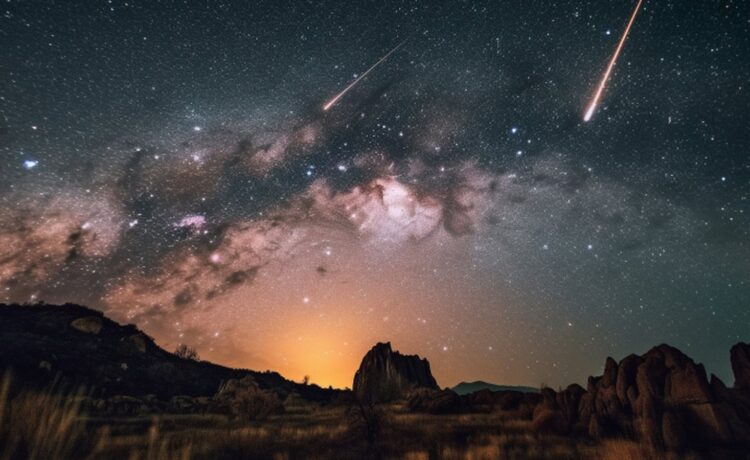
Every August, the sky throws shooting stars by the dozen. So the Perseids are the summer’s big meteor shower. In 2026, the Perseids put on a bright, fast, crowd-pleasing show.
In 2026, the timing is special. The Perseids India 2026 peak falls on the night of August 12 into August 13. Also, the Moon is new, so it stays out of the way. As a result, this is one of the best Perseid years in ages.
Still, there is just one snag. Mid-August is monsoon season here. So clouds can hide the whole show.
This guide is an honest take on that problem. First, you will learn what the Perseids are. Then you will get the exact peak night and moon phase. Next, the guide shows why the monsoon hurts, and where in India still works. Plus you will learn how to watch with just your eyes. Let us begin.
What Are the Perseids?
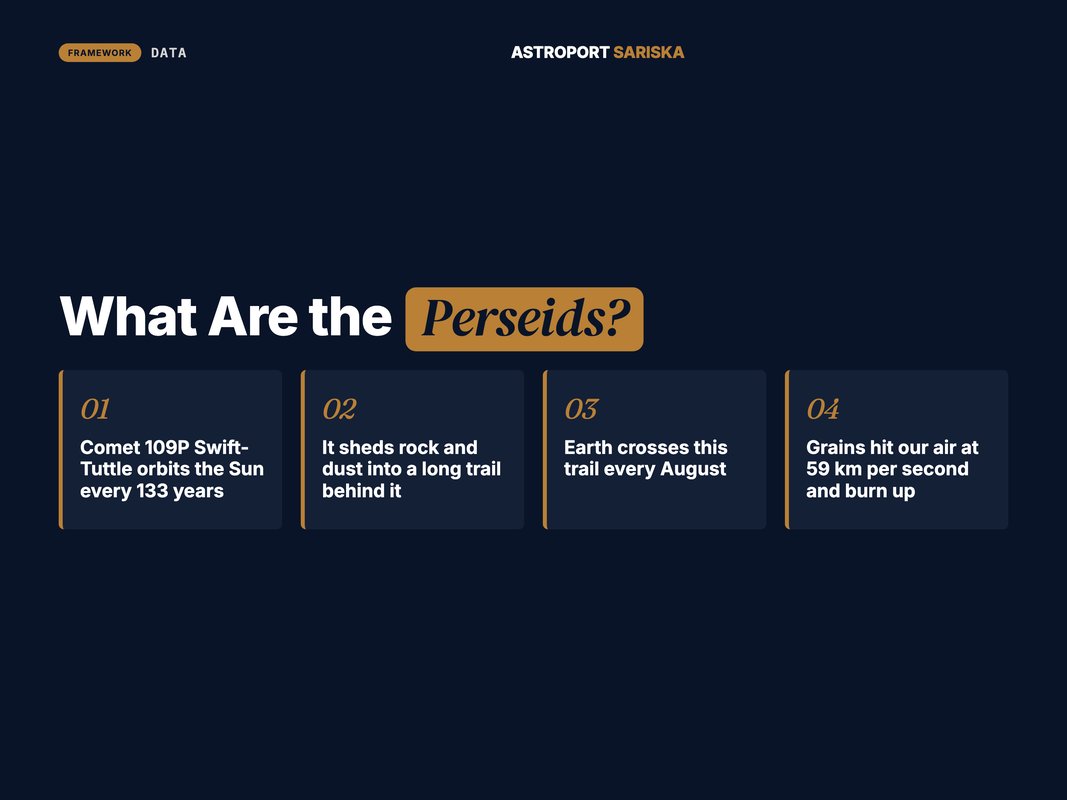
The Perseids are a meteor shower. So they show up each year in August. Also, they are one of the most loved showers we get.
In fact, they come from a comet. Its name is 109P/Swift-Tuttle. The comet takes about 133 years to circle the Sun (Source: NASA, 2026 — 109P/Swift-Tuttle).
That comet leaves a trail of dust behind it. The bits are tiny, often smaller than a grain of sand. Then they drift in a long stream through space.
Each August, Earth plows through that stream. So the grains hit our air at about 59 km per second (Source: NASA, 2026 — Perseids). Then they burn up in a quick flash. Finally, we see them as shooting stars.
The meteors seem to fan out from one point. That point sits in the constellation Perseus. So that is how the shower got its name.
Still, you do not need to find Perseus. The meteors streak right across the whole sky. Also, the Perseids are famous for fireballs, which are big, bright bursts of light (Source: NASA, 2026 — Perseids).
Q: Why are the Perseids so popular?
A: They fall in warm August weather, so people are happy to sit out. Bright and fast, they catch the eye. Better still, they throw lots of fireballs. That mix makes them a summer favourite.
The Perseids 2026 Peak: When to Look Up
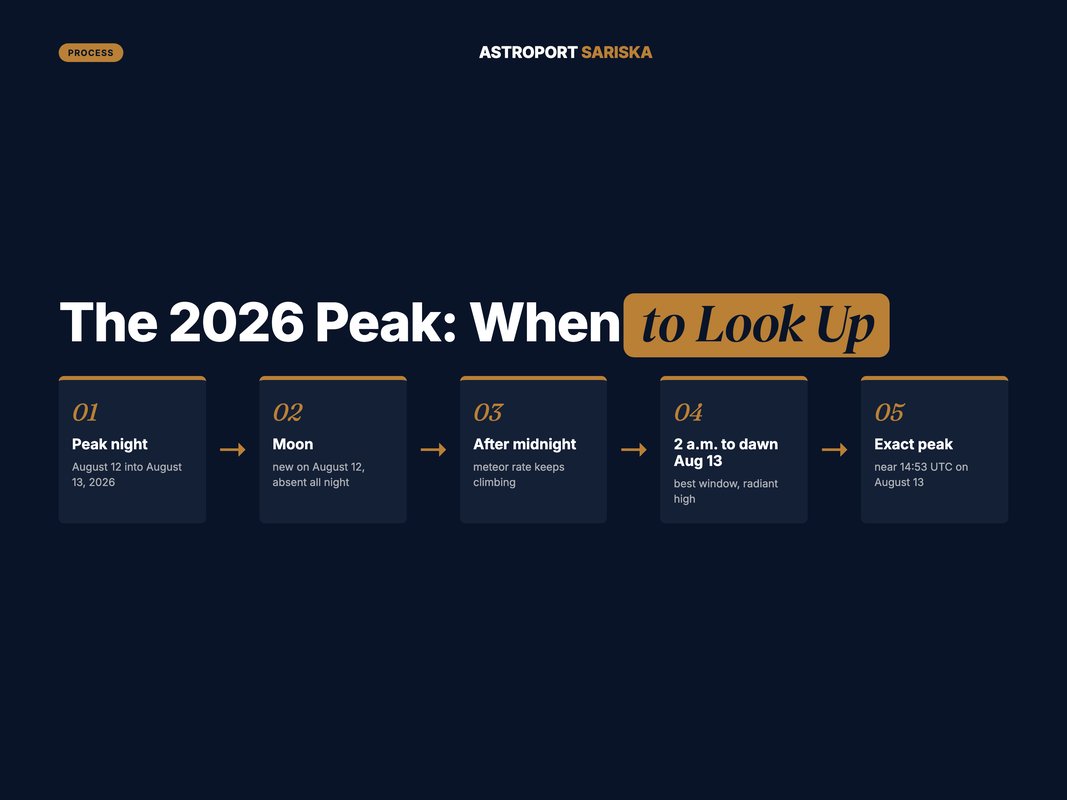
Mark your calendar now. So the Perseids peak on the night of August 12 into August 13, 2026.
The shower runs much longer than one night. Activity builds from mid-July. Then it fades by late August (Source: American Meteor Society, 2026 — Meteor Shower Calendar).
But the peak night is the one to plan around. The exact peak falls near 14:53 UTC on August 13 (Source: EarthSky, 2026 — Perseid meteor shower). So for India, the small hours of the 13th are prime.
The rate climbs hour by hour after midnight. Still, it is usually strongest from about 2 a.m. to dawn. That is when the radiant rides high in the sky.
Now for the best part of 2026. The Moon is new on August 12 (Source: American Meteor Society, 2026 — Meteor Shower Calendar). So it is absent through the whole peak night.
In short, a dark sky means more meteors. Bright moonlight washes out the faint ones. But in 2026, you skip that problem entirely.
So a strong shower and a moonless sky line up. Cloud is the only thing that can spoil it now.
Q: What is the single best hour to watch in 2026?
A: Aim for the small hours, from about 2 a.m. to dawn on August 13. The radiant sits high then. Plus the Moon is gone all night. Skies are at their darkest and richest.
The Monsoon Problem: An Honest Take
Now for the hard truth. August is peak monsoon across much of India.
That is great for farms. Still, it is rough for stargazers. Thick cloud can hide the whole sky for nights on end.
By mid-August, the southwest monsoon covers most of the country. Meanwhile, the west coast and the Western Ghats get drenched. The northeast and the hills stay grey and wet too.
A meteor shower needs a clear sky to shine. Even thin haze can dim the show. So heavy cloud erases it completely.
So yes, the Perseids monsoon India clash is real. In many cities, August 12 to 13 may be a washout. Then you could sit out all night and see nothing.
But the rain is not the same everywhere. India is huge. So some regions get far less August cloud than others.
That is the key to catching the 2026 Perseids. Instead of fighting the monsoon, you go where it is weakest.
The drier zones of the northwest are your friend here. We will look at exactly where next.
Q: Is it pointless to plan for the Perseids during the monsoon?
A: Not at all. It just means location matters more than usual. Most of India will be cloudy in mid-August. But the drier northwest, like semi-arid Rajasthan, gives you a real shot at a clear night.
Where in India Still Works
So where do you go? Basically, you want a spot that is both dark and dry in August.
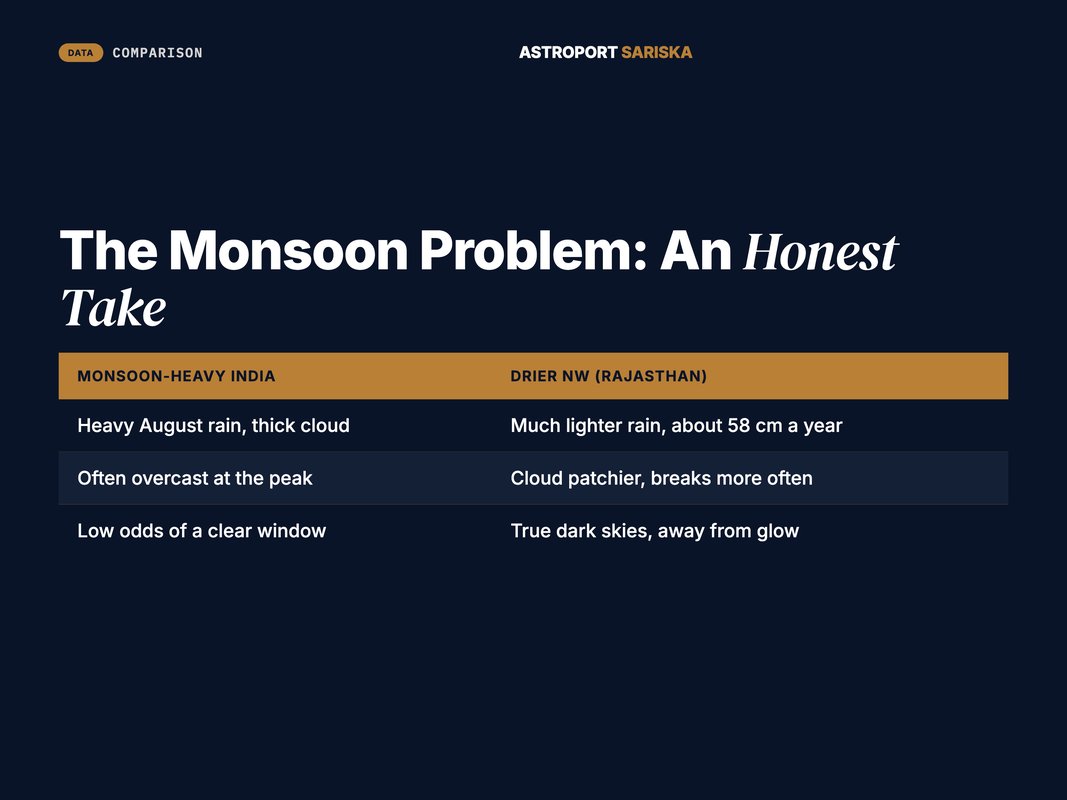
That points to the northwest. Rajasthan is mostly arid to semi-arid. So it gets far less rain than the coast or the hills.
In fact, the whole state averages only about 58 cm of rain a year (Source: RajRAS, 2026 — Climatic Characteristics of Rajasthan). By contrast, the Western Ghats can get many times that. So the gap in August is stark.
The Aravalli hills near Sariska sit in this drier belt. Alwar district has a subtropical, semi-arid climate. Also, monsoon cloud here is lighter and patchier than in most of India.
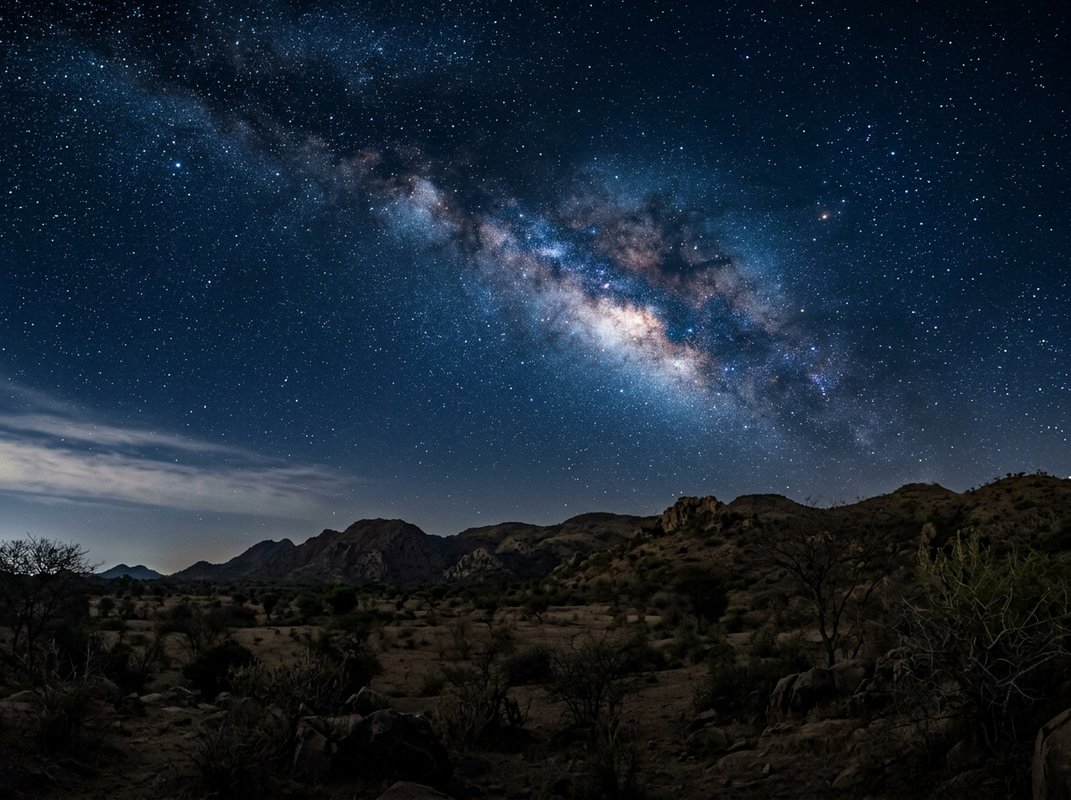
That does not mean a clear night is promised. The monsoon still reaches Rajasthan. But your odds of a break in the cloud are simply much better here.
Still, there is a second win too. This region holds true dark skies. Away from city glow, the stars pour out. So a meteor shower needs that darkness to look its best.
So the recipe is clear. First, pick a dark site in a drier zone. Next, watch the forecast. Then pounce on a clear window near the peak.
Q: Why does semi-arid Rajasthan beat the rest of India for the Perseids?
A: Two reasons. It is much drier in August, so cloud is lighter and breaks more often. And the Aravalli sites are genuinely dark. Dry air plus dark skies is the combination a meteor shower needs.
How to Watch the Perseids: A Simple Process
You need no gear. No telescope. No app. Just your eyes and a little patience. So follow these steps.
The six steps
-
Pick a dark, dry spot. Get far from city lights and heavy cloud. The drier and darker the sky, the more you see. Because of that, this step matters most of all.
-
Watch the forecast. In monsoon season, this is vital. Also, track the cloud cover near the peak. Then pounce on the clearest night you can find.
-
Time it right. The best window is about 2 a.m. to dawn on August 13. The radiant rides high then (Source: NASA, 2026 — Perseids).
-
Let your eyes adapt. Give them about 30 minutes in the dark. Also, avoid your phone screen. Bright light resets your night vision (Source: NASA, 2026 — Perseids).
-
Lie back and look up. Take in as much sky as you can. Still, do not stare at one spot. Meteors flash anywhere.
-
Stay a while. Give it at least an hour. Meteors come in bursts, then pauses. So patience pays off.
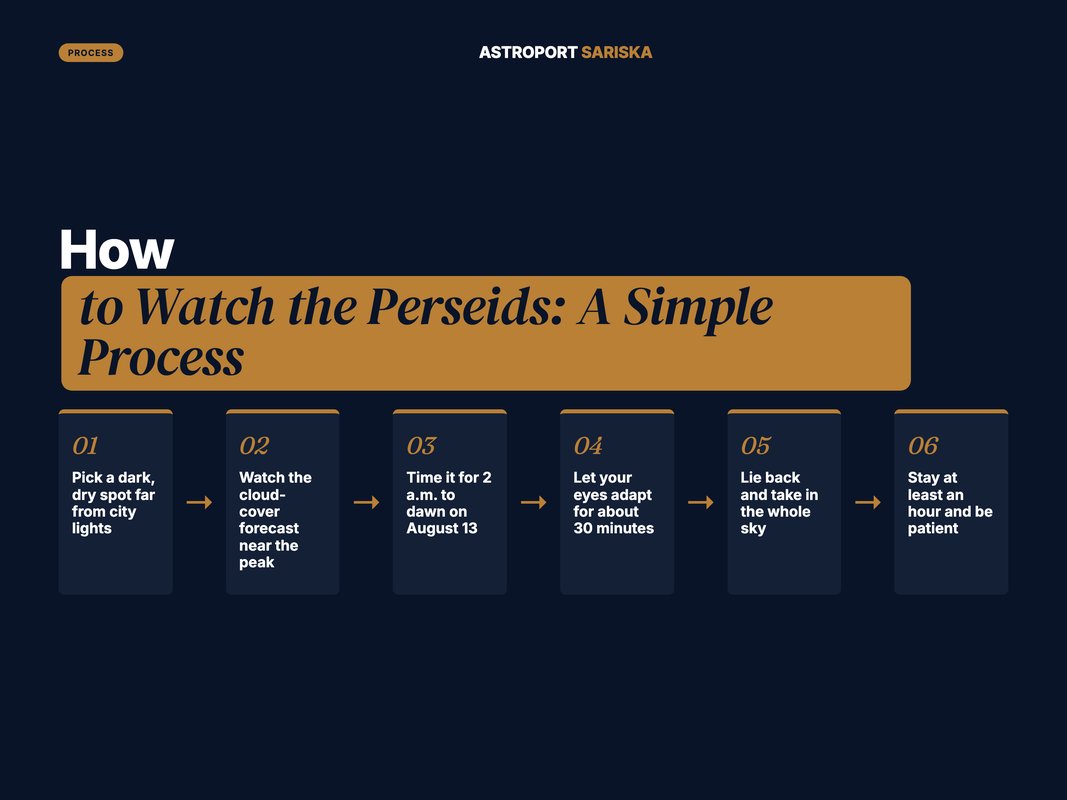
That is the whole method. Also, a mat and a light layer help, since August nights can be muggy. Bug spray is smart too.
Q: Do I really not need a telescope?
A: Correct. A telescope shows a tiny patch of sky. Meteors cross the whole sky in a flash. Your naked eyes are the right tool. They take in the full view.
Quick Facts: Perseids 2026
- Peak night: August 12 into August 13, 2026 (Source: EarthSky, 2026 — Perseid meteor shower)
- Peak rate: about 100 meteors per hour under perfect skies (Source: American Meteor Society, 2026 — Meteor Shower Calendar)
- Parent comet: 109P/Swift-Tuttle, on a 133-year orbit (Source: NASA, 2026 — 109P/Swift-Tuttle)
- Active period: about mid-July to late August (Source: IMO, 2026 — Meteor Shower Calendar)
- 2026 Moon: new on August 12, so dark skies all night (Source: American Meteor Society, 2026 — Meteor Shower Calendar)
Perseids vs Geminids: How They Compare
You may know the Geminids of December. They are the other big shower of the year. So the two make a neat pair.
For example, the Perseids peak near 100 meteors per hour. The Geminids peak higher, at about 120 to 150 (Source: EarthSky, 2026 — Geminid meteor shower). So on raw numbers, the Geminids win.
So why do many people prefer the Perseids? Comfort. They fall in warm August weather. So no one is shivering.
Meanwhile, the Geminids fall in cold December. The sky is often clearer then, with the monsoon long gone. But the cold keeps casual viewers indoors.
The table below sums up the trade-off.
| Factor | Perseids (August) | Geminids (December) |
|---|---|---|
| Peak rate | About 100 per hour | About 120 to 150 per hour |
| Parent body | Comet Swift-Tuttle | Asteroid 3200 Phaethon |
| Weather | Warm but cloudy monsoon | Cold but often clear |
| Main risk | Cloud cover | The cold |
So each shower has a catch. The Perseids fight cloud. Meanwhile, the Geminids fight the cold. But for the 2026 Perseids, a drier site is how you beat the catch.
Q: Are the Perseids or the Geminids better in India?
A: It depends on the year. The Geminids give more meteors and clearer December skies. The Perseids are warmer but face monsoon cloud. In 2026, the new moon makes the Perseids well worth chasing from a dry, dark site.
Your Perseids Viewing Checklist
Pack smart and the night runs smoothly. So tick these off before you go.
- A dark, dry location away from city glow
- Your close eye on the cloud-cover forecast
- One mat or reclining chair to lie on
- A light layer for muggy late nights
- Some red-light torch to save your night vision
- Bug spray and a flask of something warm
- About 30 minutes set aside for your eyes to adapt
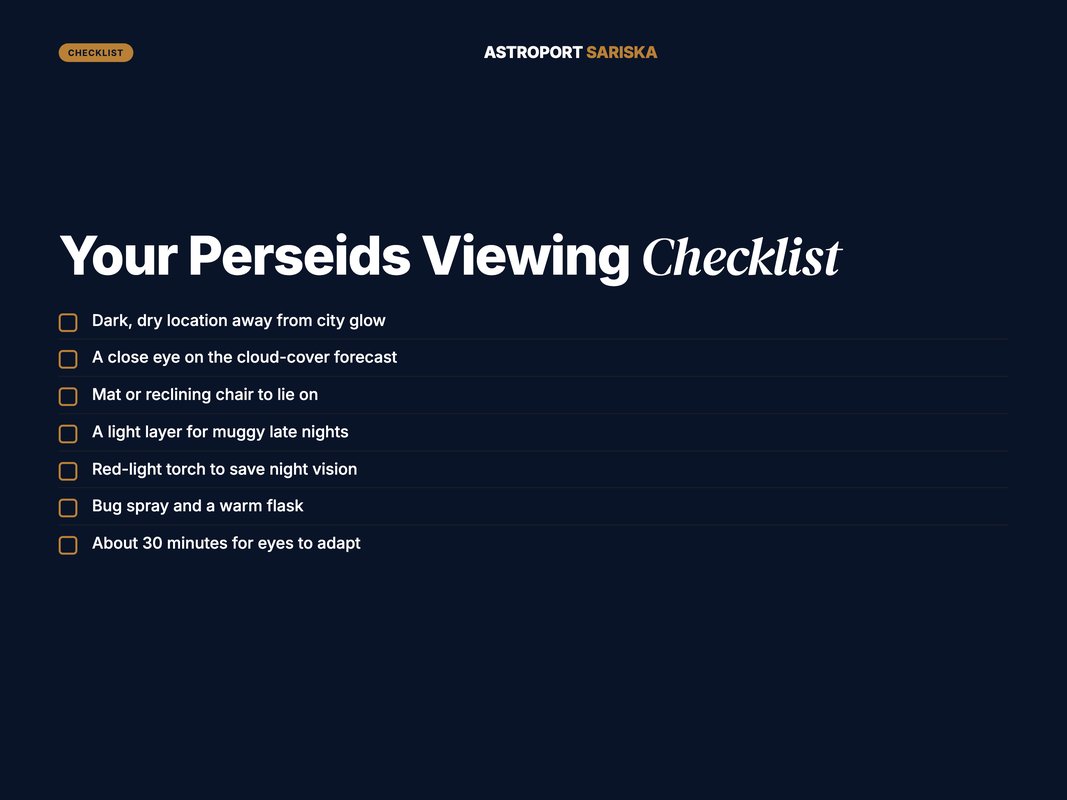
So keep your phone tucked away. Its screen wrecks your dark vision in a flash. Instead, a red light is far kinder to your eyes.
Q: What is the one thing people forget for the Perseids?
A: The forecast. In monsoon season, a clear sky is not a given. Check the cloud cover for a few nights around the peak. Then move fast when a clear window opens.
Why Astroport Sariska
You want dark, dry skies for the Perseids 2026. So Astroport Sariska gives you a strong shot at exactly that.
It is India’s first astronomy resort. It sits in the Aravalli hills, near the Sariska Tiger Reserve. So the drive is about 4 to 5 hours from Delhi NCR.
The setting is semi-arid. Also, August cloud here is lighter than on the coast or in the hills. So that gives your meteor night a real fighting chance.
Plus the skies are genuinely dark. Guests can see more than 4,000 stars on a clear night. But from inside Delhi, you might count just 20.
In short, that gap is the whole point. A dark sky is what turns a few meteors into a real show. So Sariska is built to deliver it.
Also, you do not watch alone. Resident astronomers run the sessions. They guide you with professional telescopes and constellation tours. So they know how to read the night.
Still, there is more to the stay than the sky. Days bring wildlife safaris in Sariska. Then there is an organic farm, farm-to-table meals, and a spa. Nights bring campfires and yoga under the stars. Plus the whole resort runs on solar power.
So for the 2026 Perseids, the setting is ideal. Dry skies, expert hosts, and a calm base after the show. Plan your stay around the peak night.
Conclusion
The Perseids are the summer’s best meteor shower. For the Perseids 2026, the timing is excellent. The peak falls on August 12 into August 13. Also, the Moon is new and stays away.
Still, there is one catch. Mid-August is monsoon season. So cloud, not moonlight, is the real risk this year.
But the rain is not the same everywhere. The drier northwest gives you a real shot. So a dark, semi-arid site is the smart move.
Meanwhile, Astroport Sariska offers that mix. Lighter August cloud, true dark skies, expert hosts, and a calm place to rest. So it sits about 4 to 5 hours from Delhi NCR.
So pick your night. Then watch the forecast. Look up. Plan your Perseids trip and chase the show under real stars.
FAQ
Timing and visibility
Q: When do the Perseids peak in India in 2026?
A: The Perseids peak on the night of August 12 into August 13, 2026. The richest hours fall after midnight, with the best window from about 2 a.m. to dawn. In 2026 the Moon is new, so the sky stays dark all night.
Rates and the Moon
Q: How many Perseid meteors can I see per hour?
A: The peak rate is about 100 meteors per hour under perfect dark skies. Under the moonless 2026 sky, dark-site watchers often report around 90 per hour. From a bright, cloudy city you may see only a handful.
Where and how to watch
Q: Where is the best place to watch the Perseids near Delhi?
A: Head for a dark, drier site away from city glow and heavy monsoon cloud. Astroport Sariska in the Aravallis sits about 4 to 5 hours from Delhi NCR. The semi-arid setting sees lighter August cloud than most of India.