
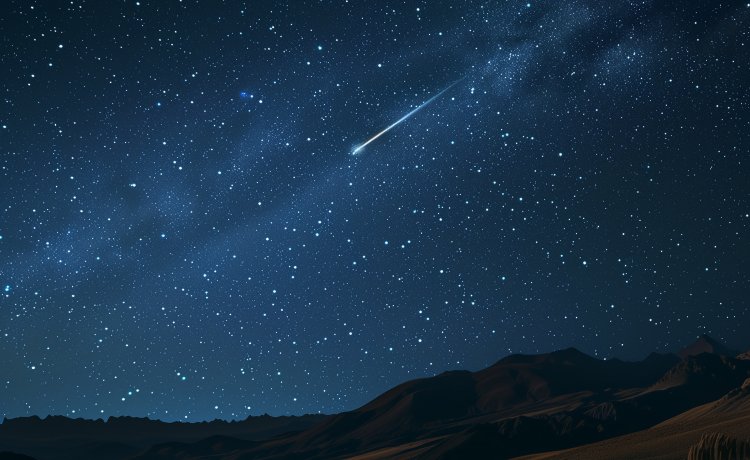
Step outside on a clear night at Sariska. Then look up. The sky is not empty. In fact, it is crowded.
So what can you see in the night sky at Sariska? More than you think. In fact, the dark Aravalli sky here shows thousands of stars, the Milky Way, planets, and far-off galaxies. Most of us never see this from home.
So this is an honest inventory. No hype. Just what is really up there, and how to catch it.
First, we will go in three layers. So we start with your own eyes. Then a pair of binoculars. Then a telescope. Also, we cover the seasons, the Moon, and how to plan your night. So let us look up.
Why the Sariska Sky Shows So Much More
City skies are washed out. Streetlights drown the stars. So you might see twenty on a good night.
But Sariska is different. It sits deep in the Aravalli hills. So the nearest big glow is far away.
Astronomers rate sky darkness on the Bortle scale. So it runs from 1 to 9. A bright city is an 8 or a 9. Meanwhile, a true dark site is a 1 or 2 (Source: Sky & Telescope — The Bortle Dark-Sky Scale).
But why does this matter so much? Because darker skies reveal fainter stars. Under a truly dark sky the eye can reach near magnitude 7.6 to 8.0 with effort (Source: Wikipedia, Limiting magnitude — Limiting magnitude). In a bright suburb, though, the limit drops to about magnitude 4.
So that gap is huge. In fact, it is the difference between a few hundred stars and thousands.
Here, the Milky Way is the clearest proof. Light pollution hides it from about 80% of people in North America (Source: NPR / New World Atlas — Light Pollution Hides Milky Way). At Sariska, though, it is just there.
Q: Is the Sariska sky really that much darker than Delhi?
A: Yes. A city sits high on the Bortle scale, washed out by light. Sariska sits far from that glow. The result is fainter stars and a visible Milky Way.
The Naked-Eye Sky: What Your Own Eyes Catch
So start with no gear at all. Just step out and let your eyes adjust. Then give it twenty minutes.
The first thing you notice is the sheer count. On a clear, moonless night you can take in thousands of stars. In fact, under ideal skies the naked eye can reach about 9,000 stars across the whole sky (Source: Sky & Telescope — The Bortle Dark-Sky Scale). From inside a big city, though, that can fall below 100.
Next, the Milky Way. It runs across the sky as a soft, glowing band. Also, it is best in the late summer and autumn months.
Then the constellations. Orion in winter. Meanwhile, Scorpius and Sagittarius rule the summer. The Big Dipper points the way north. So these shapes are your map.
Planets are easy too. They shine steadily and do not twinkle. So Jupiter and Venus are very bright. Saturn glows soft and golden. Mars, meanwhile, looks orange-red.
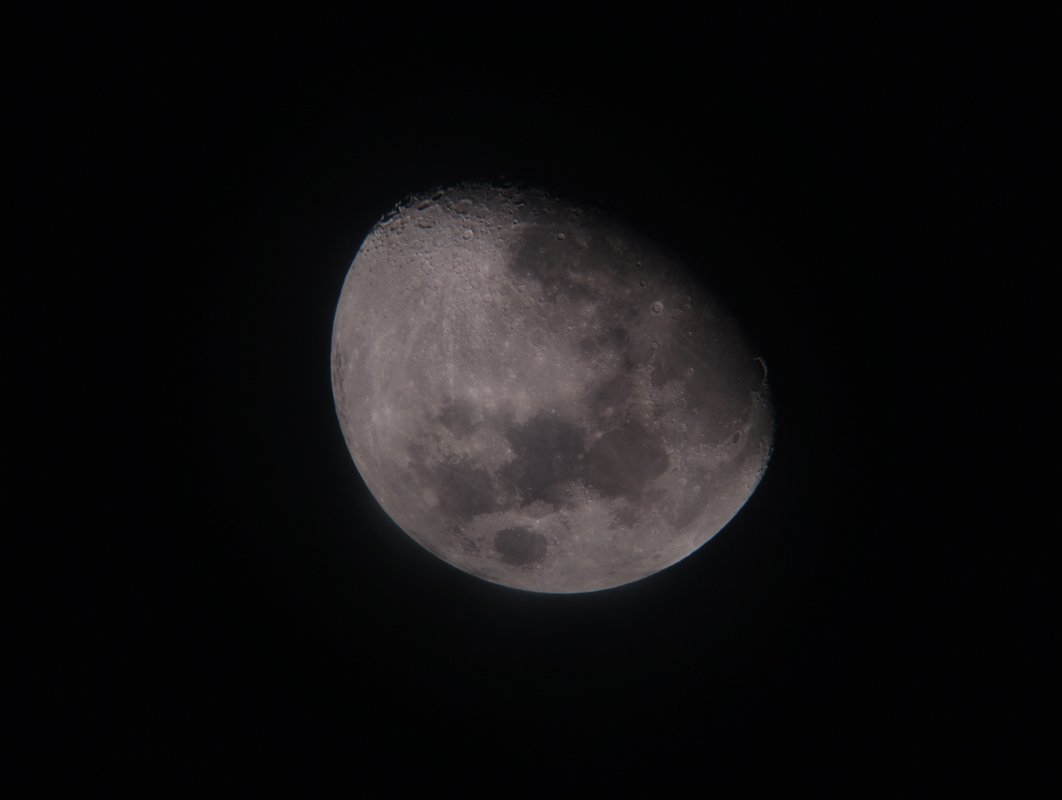
Then there is the Moon, its own show. Its phase changes the whole sky. A full Moon is lovely but washes out faint stars.
Watch a while and you may catch a meteor. Just a quick streak. Then a small gasp.
Satellites cross too. The International Space Station is the brightest of them. In fact, it ranks brightest in our sky after the Sun and Moon (Source: BBC Science Focus — How to spot the ISS). So look for a steady white dot, moving fast. It crosses in under six minutes.
Q: Do I need any equipment to enjoy the night sky here?
A: Not at all. The naked-eye sky is the main event. Thousands of stars, the Milky Way, planets, and meteors are all free. Gear only adds extra.
With Binoculars: A Whole New Layer Opens Up
Now lift a simple pair of binoculars. A basic 10×50 pair works great. Plus, they are easy to point and need no setup.
So this small step changes everything. Stars that looked like single dots split into pairs. Then fuzzy patches turn into clusters.
The Pleiades is a favourite. To the eye it is a tiny knot of stars. But in binoculars it bursts into dozens of bright blue points.
Then there is the Orion Nebula, a winter gem. It sits just below Orion’s Belt. In fact, it glows at about magnitude 4 and shows to the eye as a fuzzy star (Source: NASA Science — Messier 42, the Orion Nebula). So binoculars reveal its soft, misty glow.
Then there is Andromeda. This is the showstopper. In fact, the Andromeda Galaxy, M31, is the most distant thing you can see with the unaided eye (Source: EarthSky — The Andromeda Galaxy). Also, it is best in August and September. In binoculars it is a clear oval smudge of light. So remember, that light left the galaxy over two million years ago.
Binoculars also pull in Jupiter’s moons. In fact, even a modest pair reveals the four Galilean moons as tiny specks beside the planet (Source: Astronomy.com — The Galilean moons of Jupiter). So Galileo saw the same view in 1610.
The Moon is stunning here too. So craters and dark plains pop into relief along the day-night line.
Q: What is the single best thing to find with binoculars at Sariska?
A: The Andromeda Galaxy. It is the most distant object the eye can reach, and binoculars make its oval glow clear. Look for it on a moonless autumn night.
Through Astroport’s Telescopes: The Close-Up Views
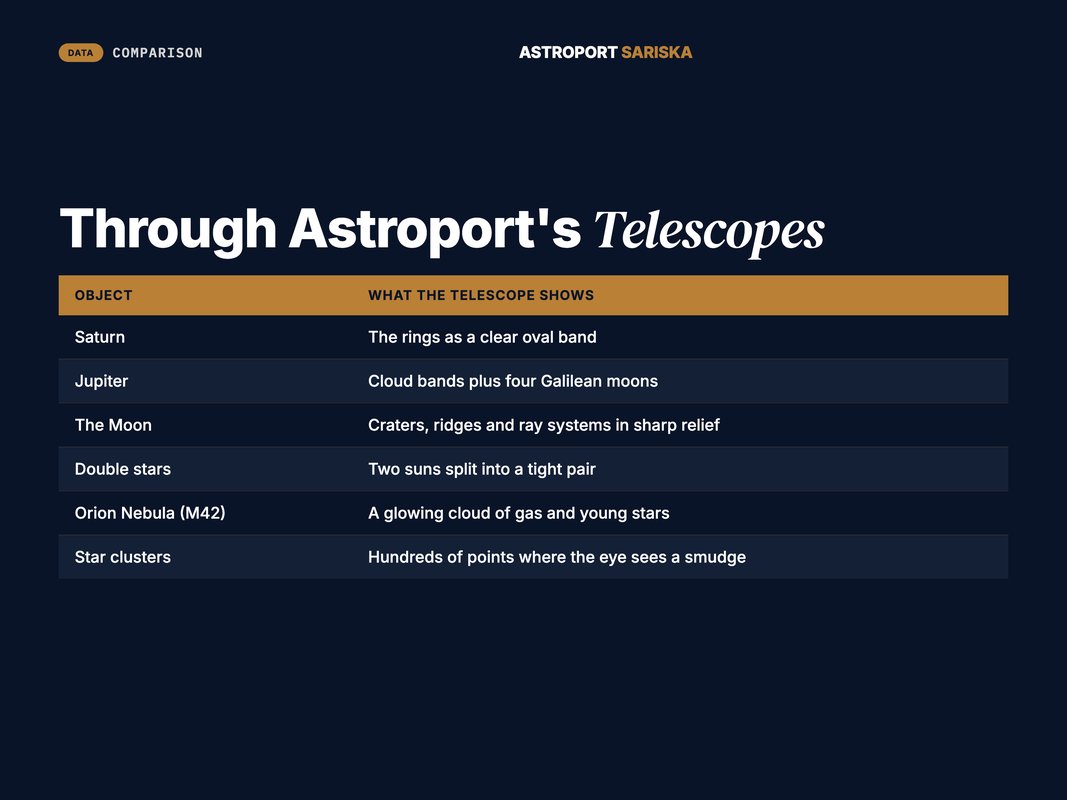
So this is where Sariska earns its name. Our resident astronomers run telescope sessions each clear night. So they find the targets for you and explain what you see.
Saturn is the crowd favourite. Through a telescope its rings snap into view as a real, tilted ring. In fact, at around 25x magnification the ring shows as a ring, not a blob (Source: Sky & Telescope — Viewing Saturn). So people often go quiet, then laugh out loud.
Jupiter is next. Here you can see its cloud bands as stripes. Plus, its four bright moons sit in a neat line, shifting from night to night.
The Moon is jaw-dropping at this scale. Craters, mountains, and long shadows fill the view. So it looks close enough to touch.
Double stars are a quiet treat. Many “single” stars split into two. Some, in fact, glow in different colours, like gold and blue.
Then come the deep-sky targets. Star clusters sparkle like spilled sugar. Meanwhile, nebulae glow as soft clouds where new stars form. So the Orion Nebula is a full winter showpiece in a scope.
What you see shifts with the season and the Moon. So a new-moon night is darkest and best for faint things. As a result, our astronomers plan each session around the sky on offer.
Q: What is the most popular telescope view at Astroport?
A: Saturn and its rings, every time. The rings look unreal the first time you see them live. Jupiter’s bands and moons run a close second.
A Quick Guide: What to See, and How
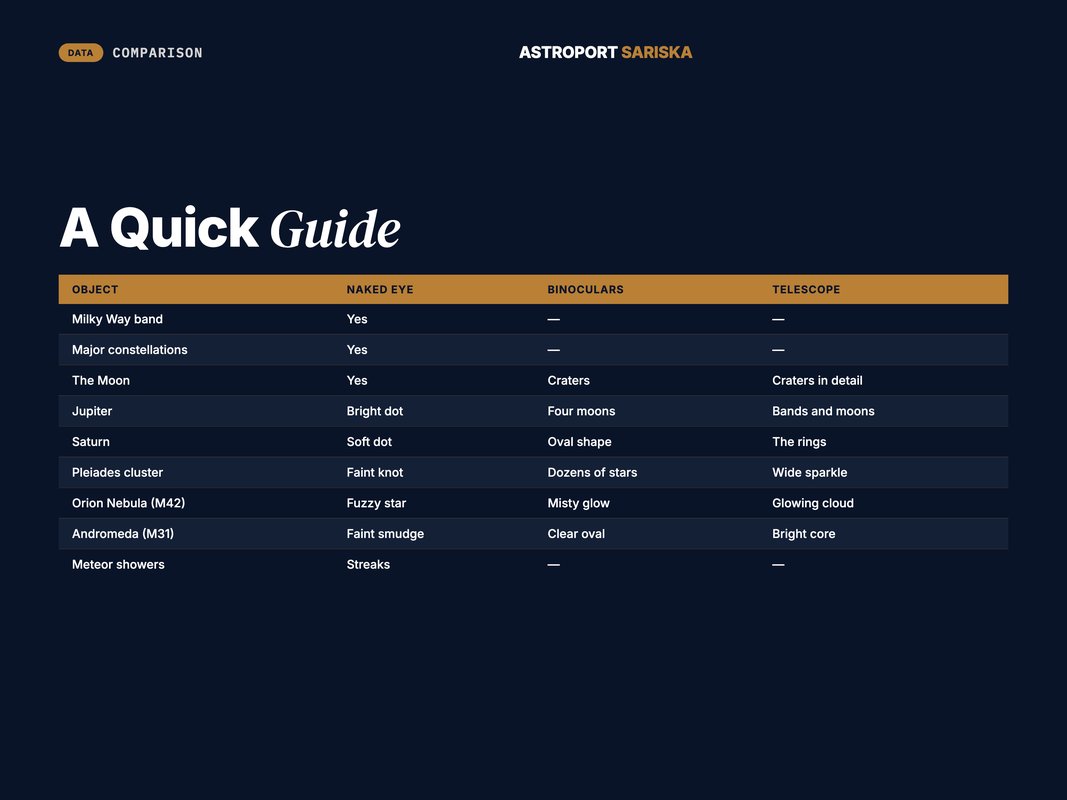
So here is a simple cheat sheet. It maps each object to the best way to view it. Also, it lists the best season to try.
| Object | Naked eye | Binoculars | Telescope | Best season |
|---|---|---|---|---|
| Milky Way band | Yes | — | — | Summer to autumn |
| Major constellations | Yes | — | — | All year |
| The Moon | Yes | Craters | Craters in detail | All year |
| Jupiter | Bright dot | Four moons | Bands and moons | Varies |
| Saturn | Soft dot | Oval shape | The rings | Varies |
| Pleiades cluster | Faint knot | Dozens of stars | Wide sparkle | Autumn to winter |
| Orion Nebula (M42) | Fuzzy star | Misty glow | Glowing cloud | Winter |
| Andromeda Galaxy (M31) | Faint smudge | Clear oval | Bright core | Autumn |
| Meteor showers | Streaks | — | — | Aug and Dec peaks |
So read it left to right. Then each step adds detail. Still, even the naked-eye column alone is a full night.
Q: Can I see all of these on one visit?
A: Many of them, yes, but not every single one. The sky changes by season and Moon phase. Our astronomers help you target what is best on your night.
Meteors and the Seasons: Timing Your Visit
So the sky is not the same all year. Each season brings new sights. Still, timing helps you catch the best ones.
Late summer and autumn are golden for the Milky Way. Also, they are peak time for Andromeda. Then the galaxy rides high and easy to find.
Winter, meanwhile, is crisp and steady. Orion rules the sky. So the Orion Nebula is at its best. Plus, cold, dry air often means sharper views.
Meteor showers are a special treat. For example, the Perseids peak around 12 to 13 August. Under a dark sky you can see 60 to 100 an hour (Source: Natural History Museum — Meteor showers).
Then the Geminids peak in mid-December. They can bring up to 150 meteors an hour at their best (Source: Natural History Museum — Meteor showers). So both are well worth a winter or summer trip.
But the Moon matters most of all. A bright Moon hides faint things. So for the darkest sky, plan around a new moon.
Q: When should I visit for the best stargazing?
A: Pick a clear, new-moon night for the darkest sky. Time it near a meteor peak in August or December for extra drama. Our team can help you plan the date.
A Simple Way to Get the Most From Your Night
You do not need to be an expert. Still, a little planning goes a long way. So follow these steps for a great night.
- Pick your date. Aim for a clear sky near a new moon.
- Let your eyes adjust. Sit in the dark for twenty minutes. No phone screens.
- Use red light only. It keeps your night vision sharp.
- Start big. Find the Milky Way and the bright planets first.
- Add binoculars. Sweep the Pleiades, Andromeda, and Jupiter’s moons.
- Join a telescope session. Let the astronomer find Saturn and the rest.
- Just sit and look. Some of the best moments are simply quiet.
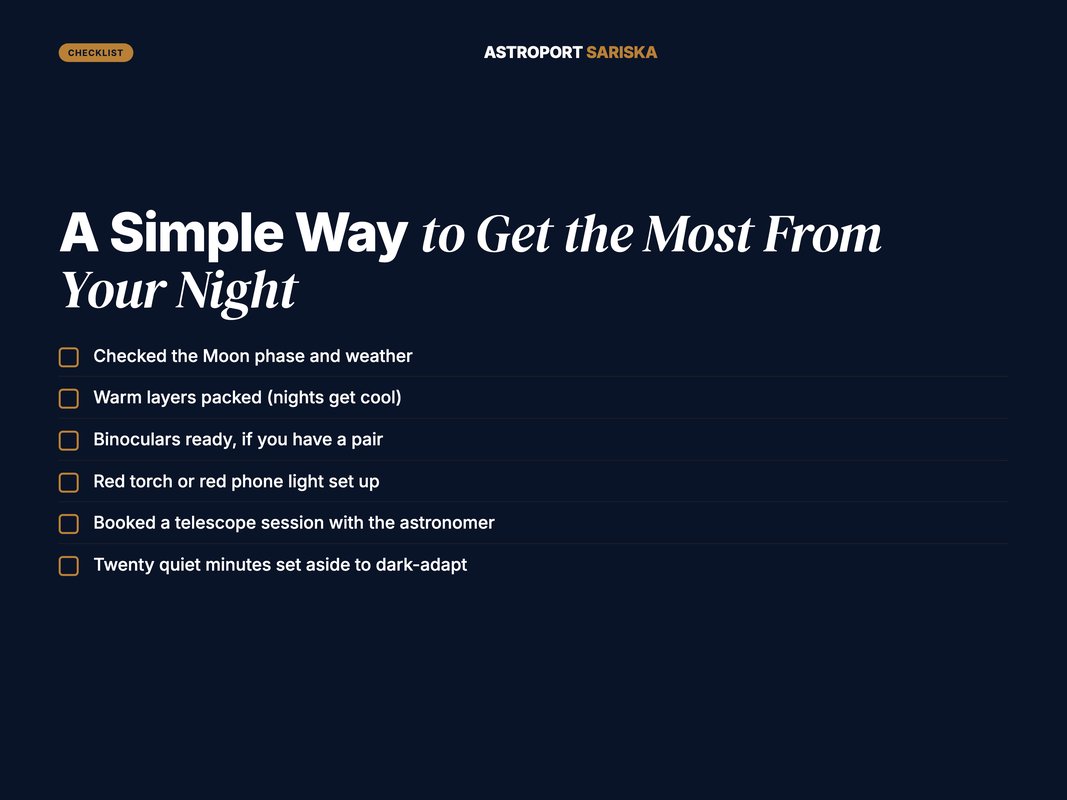
Run through this checklist before you head out:
- Checked the Moon phase and weather
- Warm layers packed (nights get cool)
- Binoculars ready, if you have a pair
- Red torch or red phone light set up
- Booked a telescope session with the resident astronomer
- Twenty quiet minutes set aside to dark-adapt
Q: What is the one tip that helps the most?
A: Let your eyes adapt to the dark, and avoid white light. After twenty minutes you will see far more stars. It costs nothing and changes the whole night.
Why Astroport Sariska
Astroport Sariska is India’s first astronomy resort. So it is built for the night sky. Also, it sits in the Aravalli hills, near Sariska Tiger Reserve Gate No. 2.
Plus, the drive is easy. It is about 4 to 5 hours from Delhi NCR. So that is roughly 200 km from the city glow.
Here, the dark sky is the headline act. So guests see thousands of stars on a clear night, against barely twenty from inside Delhi. Also, the whole resort runs on solar power.
The stargazing is guided, not guesswork. So resident astronomers lead telescope sessions each clear night. Also, they run constellation tours and solar viewing by day. Plus, you can try a telescope-making workshop or an astrophotography class.
But there is more than the sky. By day, head out on a Sariska tiger-reserve safari. Watch for tigers, leopards, deer, and over 200 bird species. Then unwind at the Sparsh Spa, or eat fresh from the organic farm.
So the night ends warm. Sit by a campfire under the stars. Then sleep, and do it all again tomorrow.
Want to see it for yourself? So plan a stay and let the Aravalli sky do the rest.
Conclusion
So, what can you see in the night sky at Sariska? A great deal more than you can from any city.
So with your own eyes: thousands of stars, the Milky Way, planets, and meteors. With binoculars: the Pleiades, Andromeda, and Jupiter’s moons. Through a telescope: Saturn’s rings, lunar craters, and glowing nebulae.
Also, the sky shifts with each season and Moon phase. So that is part of the charm. Every visit, then, looks a little different.
You do not need to be an expert. You just need a dark sky and a little time. So Sariska gives you both.
Ready to look up? So plan your stay at Astroport Sariska and meet the real night sky.
FAQ
Q: What can you actually see in the night sky at Sariska? A: On a clear night you see the Milky Way, thousands of stars, constellations, and bright planets. Binoculars add the Pleiades, Andromeda, and Jupiter’s moons. A telescope brings Saturn’s rings, lunar craters, and deep-sky nebulae.
Q: How many stars can you see at Sariska? A: On a clear, moonless night you can see thousands of stars from the dark Aravalli sky. From inside a big city like Delhi, light pollution can cut that to under 100.
Q: Can you see the Milky Way at Sariska? A: Yes. On a clear, moonless night it shows as a soft glowing band. Most city dwellers never see it, as light pollution hides it from about 80% of North Americans.
Q: Do you need a telescope to enjoy the night sky at Sariska? A: No. The naked-eye sky is the main event, with thousands of stars, planets, and the Milky Way. Binoculars and our telescopes add more, but they are a bonus.
Q: What is the best season for stargazing at Sariska? A: Every season offers something. Late summer and autumn favour the Milky Way and Andromeda. Winter brings the Orion Nebula and steady skies. Plan around a new moon.
Q: Can you see meteor showers and the ISS from Sariska? A: Yes. The Perseids in August and the Geminids in December bring dozens of meteors an hour. The Space Station also passes over as a bright, fast dot at dawn or dusk.
Q: Why is the night sky so much darker at Sariska than in the city? A: Sariska sits in the Aravalli hills, far from city glow. On the Bortle scale a city rates 8 or 9, while a rural site rates much lower. Darker skies mean fainter stars become visible.