
You know the Sunday-evening feeling. You have just driven six hours, seen four places, and photographed all of them. Still, you cannot remember a single quiet moment.
That gap is what slow travel tries to close. So the slow travel India meaning is not complicated. It means fewer places, longer stays, and more attention to the one place you chose.
This piece explains it plainly. First, you will get the definition. Then you will see why it is spreading in India right now. Also, you will get a two-night shape you can copy. Finally, you will learn how to travel slowly without taking extra leave.
What Slow Travel Actually Means
Slow travel is a pace, not a price bracket. So it is not about luxury, and it is not about roughing it either.
The idea borrows from the slow food movement. There, the argument was that faster eating made food worse. Here, the argument is that faster travel makes travel thinner.
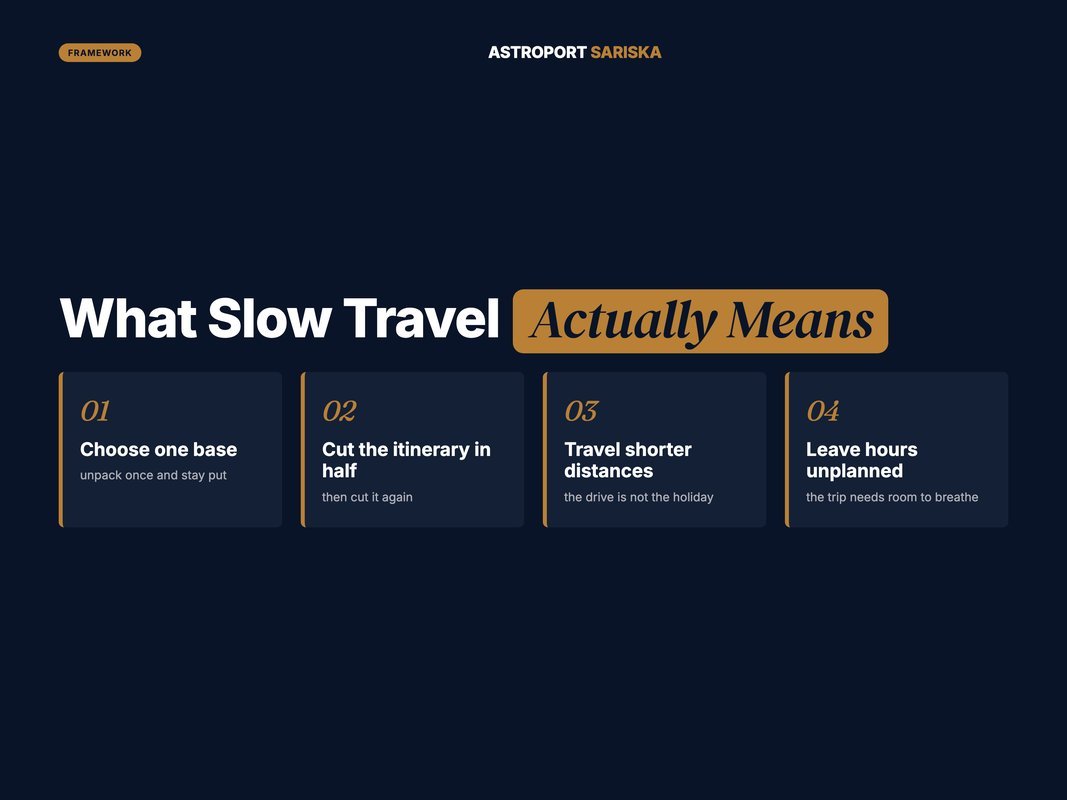
In practice, it comes down to four habits.
- Choose one base. You unpack once and stay put.
- Cut the itinerary in half. Then cut it again.
- Travel shorter distances. Because the drive is not the holiday.
- Leave hours unplanned. So the trip has room to breathe.
None of that requires more money. Instead, it requires giving up the instinct to maximise.
Most of us are trained to maximise. You have two days, so you try to extract four days of sights from them. Then you come home tired and oddly empty.
Slow travel flips the metric. Instead of counting what you saw, you notice what you remember.
Q: Is slow travel just a fancy word for doing nothing?
A: Not quite. You still do things, but you do fewer of them properly. The difference is that a slow trip has space between activities, so each one actually registers.
Why More Indians Are Choosing It Now
Three things changed at once, and they pushed in the same direction.
First, remote and hybrid work spread. So a Thursday-night departure became possible for a lot of people. That quietly made short, close trips more attractive than long ones.
Second, the weekend-getaway market near big cities matured. There are simply more good places within a four-hour drive than there were ten years ago.
Third, people got tired. The pandemic years made crowded, high-tempo travel feel less like a reward.
Then costs shifted too. Fuel and tolls rose, so long chains of driving stopped feeling cheap. Meanwhile a second night at one place started to look like better value than a second destination.
There is also a plainer reason. Traffic got worse. A destination eight hours away is now a two-day commitment before you have done anything.
India’s tourism policy has leaned the same way. The emphasis now falls on responsible, experience-led travel rather than pure footfall (Source: Ministry of Tourism, Government of India, 2026 — Ministry of Tourism).
The Quiet Driver Nobody Mentions
Phones. A packed itinerary leaves no gap, and gaps are when you put the phone down.
So slow trips are often the only ones where people genuinely disconnect. That is not a spiritual claim. It is just what happens when there is nothing scheduled for two hours.
Quick Facts
- Bright planets are visible to the naked eye from dark rural skies (Source: NASA, 2026 — Skywatching). So a slow rural stay needs no equipment.
- Natural darkness is treated as a protected resource, not just scenery (Source: US National Park Service, 2026 — Night Skies). Artificial light disrupts wildlife and sleep.
- Astroport Sariska sits roughly 200 km from Delhi NCR, about four to five hours by road.
- India’s tourism strategy keeps prioritising responsible travel (Source: Ministry of Tourism, Government of India, 2026 — Ministry of Tourism).
Slow Travel vs the Weekend Dash
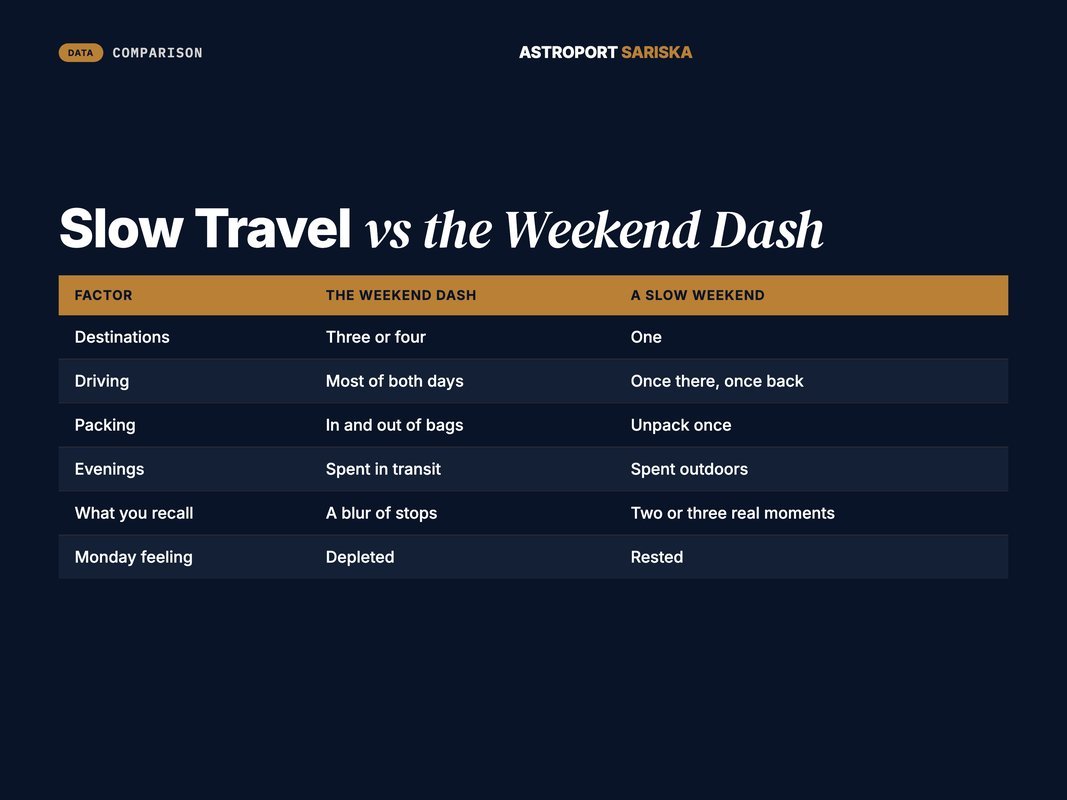
The contrast is easiest to see side by side.
| Factor | The weekend dash | A slow weekend |
|---|---|---|
| Destinations | Three or four | One |
| Driving | Most of both days | Once there, once back |
| Packing | In and out of bags | Unpack once |
| Evenings | Spent in transit | Spent outdoors |
| What you recall | A blur of stops | Two or three real moments |
| Monday feeling | Depleted | Rested |
Look at the driving row. That is where the time actually goes.
A dash spreads four hours of driving across both days. Meanwhile, a slow trip front-loads it and then stops.
So the slow version is not shorter. It just spends its hours differently.
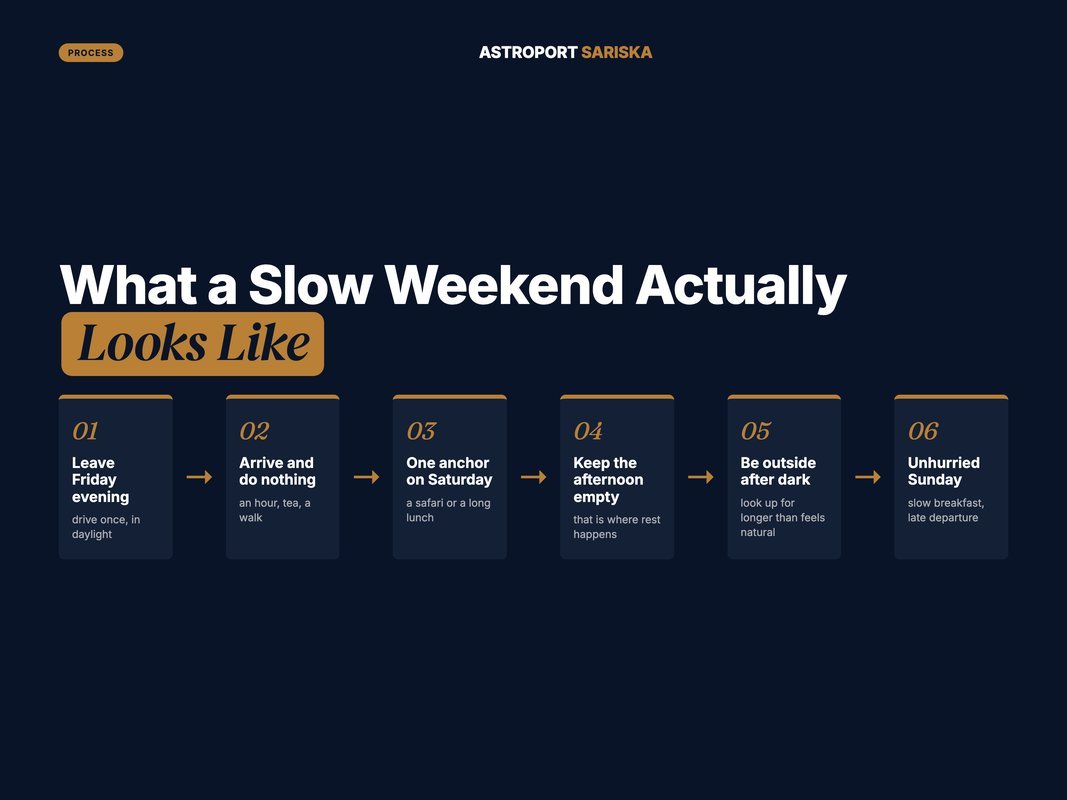
What a Slow Weekend Actually Looks Like
Here is a two-night shape that works near Delhi NCR. Most people adapt it, but the skeleton holds.
- Leave Friday evening or early Saturday. So the drive happens once, in daylight where possible.
- Arrive and do nothing for an hour. Then tea, a walk, no plans.
- Pick one anchor for Saturday. A safari, a farm walk, a long lunch. One, not three.
- Keep the afternoon empty. Because the empty part is where the rest happens.
- Be outside after dark. Then look up, properly, for longer than feels natural.
- Sunday morning stays unhurried. So breakfast is slow and departure is late.
Notice what is missing. There is no second destination, and no day trip.
That single omission is what makes the whole thing work.
How to Travel Slowly Without Extra Leave
This is the practical objection, and it is fair. Most people cannot add days.
Still, you can change the shape of the days you already have.
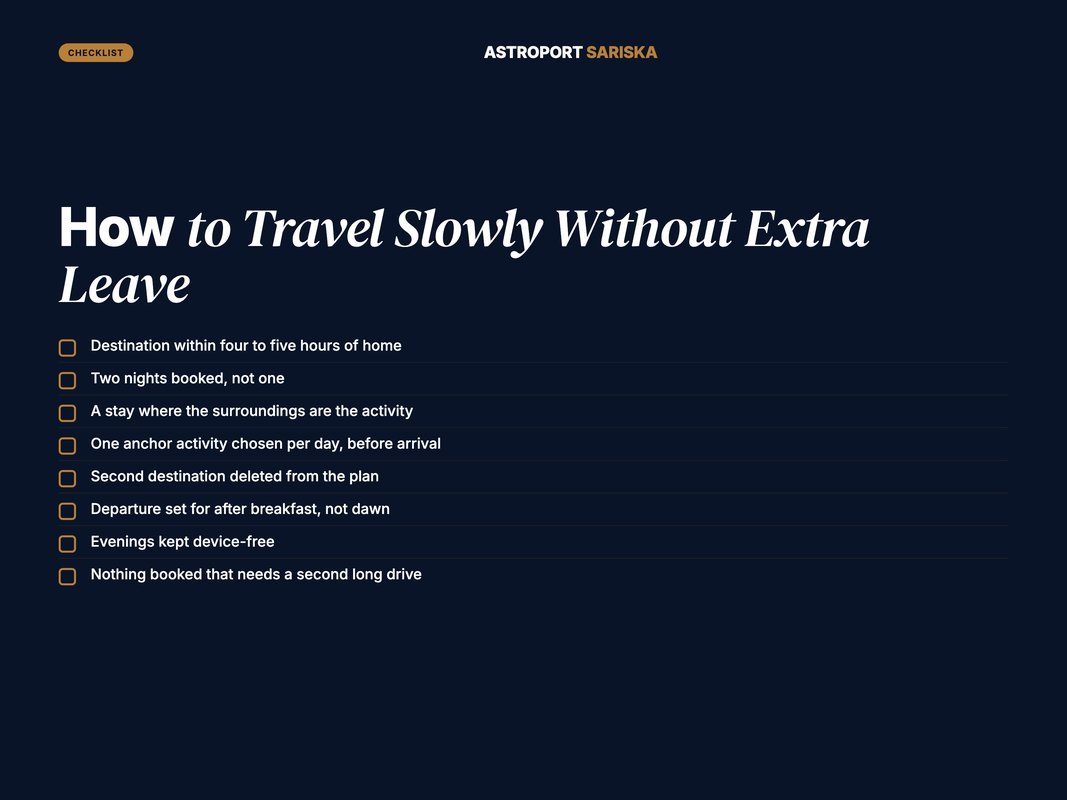
- Pick somewhere within four to five hours, so one drive does not become two.
- Book two nights instead of one, even on the same weekend.
- Choose a stay where the surroundings are the activity.
- Decide your one anchor per day before you arrive.
- Delete the second destination from the plan entirely.
- Leave after breakfast on the last day, not at dawn.
- Keep evenings device-free, because that is where the rest lives.
None of those need more leave. Instead, they need one decision made earlier.
Also, a slower trip tends to lower your impact. Because most travel emissions come from moving rather than staying, cutting the moving does most of the work (Source: Ministry of Environment, Forest and Climate Change, 2026 — MoEFCC).
Where the Sky Fits In
Slow travel needs something to slow down for. Otherwise the empty hours just feel like boredom.
A dark sky is unusually good at this. It rewards patience directly, because your eyes take about half an hour to adapt before faint objects appear.
So stargazing is structurally slow. You cannot rush it, and hurrying produces nothing.
From a genuinely dark rural site, thousands of stars are visible with no equipment at all (Source: NASA, 2026 — Skywatching). From a city, the same sky gives you a handful.
That difference is not about your eyes. It is about where you are standing.
So the sky rewards the exact thing slow travel asks for. You stay in one place, and you wait.
Also, it fills the hours that people worry about. The empty evening stops being empty the moment you look up.
Q: Do I need to know any astronomy for this to be worth it?
A: No. Most people start by simply noticing how much is up there. Knowing the names comes later, and it is optional.
What Slow Travel Is Not
A few misconceptions put people off before they try it. So it helps to clear them early.
It is not budget travel. You can travel slowly in a tent or in a suite. The variable is pace, not spend. So the two are unrelated.
It is not anti-planning either. In fact, slow trips need a firmer decision up front. You have to choose the one place, and then defend that choice against the urge to add a second.
It is also not about being idle. A dawn safari is slow travel. Then so is a long walk, or an evening at a telescope. What makes them slow is the space around them.
Finally, it is not only for long holidays. Two nights is enough. The shape matters more than the length.
Q: Does slow travel mean I will get bored?
A: Sometimes, briefly. That usually passes within a day. Most people find the boredom was just the first hour of not checking anything.
A Simple Test
Here is one way to check whether a plan is actually slow.
Count the number of times you will pack a bag. Once means slow. Three times means you have planned a tour.
Then count your long drives. One each way is the ceiling.
If both numbers are low, the rest tends to follow on its own.
Who It Suits, and Who It Does Not
Slow travel is not for everyone, and that is worth saying plainly.
It suits people who come back from holidays tired. Also, it suits families with small children, because fewer transitions means fewer meltdowns. Then it suits anyone whose week is already fragmented, since the trip becomes the opposite of that.
It suits first-time visitors to a region less well. If you have never seen a place, you may genuinely want the tour. That is a fair choice, and it is not a lesser one.
It also struggles when the group disagrees. One person wanting to maximise will quietly re-plan the trip for everyone. So the conversation is worth having before you book, not in the car.
Start With One Weekend
You do not have to convert permanently. Instead, try the shape once.
Pick a single place within a four-hour drive. Then book two nights and refuse to add anything else.
If Monday feels different, you will know. If it does not, you have lost nothing but a second destination you never really wanted.
Why Astroport Sariska Suits a Slow Trip
Astroport Sariska was built around staying put. It is India’s first purpose-built astronomy resort, set in Village Roopwaas near Sariska Tiger Reserve, in Alwar, Rajasthan.
The drive from Delhi NCR runs about four to five hours. So it sits inside the range where one drive still makes sense.
What makes it work for slow travel is that the reasons to stay are on site. There are resident astronomers and professional telescopes for the evenings. There is an organic farm supplying the kitchen, so meals are a reason to linger rather than a refuelling stop.
The property runs on solar power, and the surrounding dark is real rather than decorative. Sariska itself is next door for a single morning safari, which is the one anchor most guests pick.
There is a spa, yoga under the sky, and campfires. Still, the honest pitch is simpler. There is very little reason to get back in the car, which is exactly the point.
If you are weighing how long to stay, our guide on one night versus two covers the trade-off in detail.
The Short Version
Slow travel is not a philosophy you have to adopt. It is a scheduling decision.
Pick one place. Stay two nights. Drive once, then stop driving. Choose a single anchor each day and protect the empty hours around it.
So the slow travel India meaning comes down to something quite ordinary. You are not trying to see more. You are trying to actually be somewhere.
Then the trip stops being a task you completed. It becomes a weekend you remember.
Ready to try a slower weekend near Delhi NCR? Plan your stay at Astroport Sariska and give yourself two nights instead of one.
FAQ
Getting Started
Q: What is slow travel in simple terms?
A: Slow travel means fewer places and more time in each one. You swap a checklist of sights for a longer stay in one spot. The aim is to notice where you are, rather than to cover ground.
Q: Is slow travel more expensive than a regular trip?
A: Not usually. You spend less on fuel, transfers and constant movement. Costs shift towards the stay itself. Many people find a slower trip works out similar, because the moving is what quietly drains a budget.
Planning It
Q: Can you do slow travel on a two-day weekend?
A: Yes, if you pick one destination and stay put. The rule is simple. One base, no day trips, nothing that needs a second long drive. A short trip becomes slow when you stop moving inside it.
Q: Is slow travel the same as eco-tourism?
A: They overlap but are not identical. Slow travel is about pace and attention. Eco-tourism is about impact. Travelling slowly usually lowers your footprint, because most travel emissions come from movement rather than from staying still.
On the Ground
Q: How far should a slow weekend be from home?
A: Close enough that the drive does not eat the trip. For Delhi NCR, four to five hours is a practical ceiling. Beyond that, a two-night trip turns into travelling with a short break in the middle.
Q: What should you actually do on a slow trip?
A: Less than you think. Pick one anchor activity a day and leave the rest open. Walking, eating slowly, reading and looking at the sky all count. The empty hours are the point, not a gap to fill.