
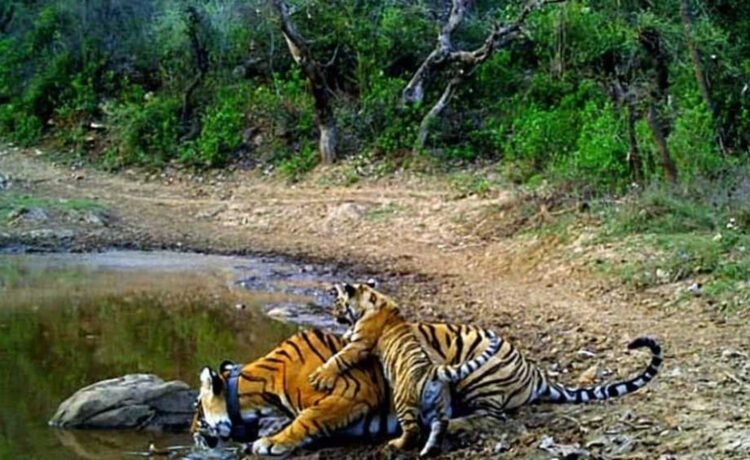
The jeep stops. Nobody says anything.
Fifty metres off, a sambar stag lifts its head and stares straight at you. Then it barks, once, and the whole valley hears it.
That bark is an alarm call. So something is moving out there, and every animal within range now knows it.
This is what Sariska wildlife sightings actually feel like. Less a parade, more a slow reading of signs.
This diary covers what lives here. First, the land itself. Then the tiger story, which is remarkable.
Also, the cats, the deer and the birds. Finally, how to improve your own odds.
Where You Are Standing
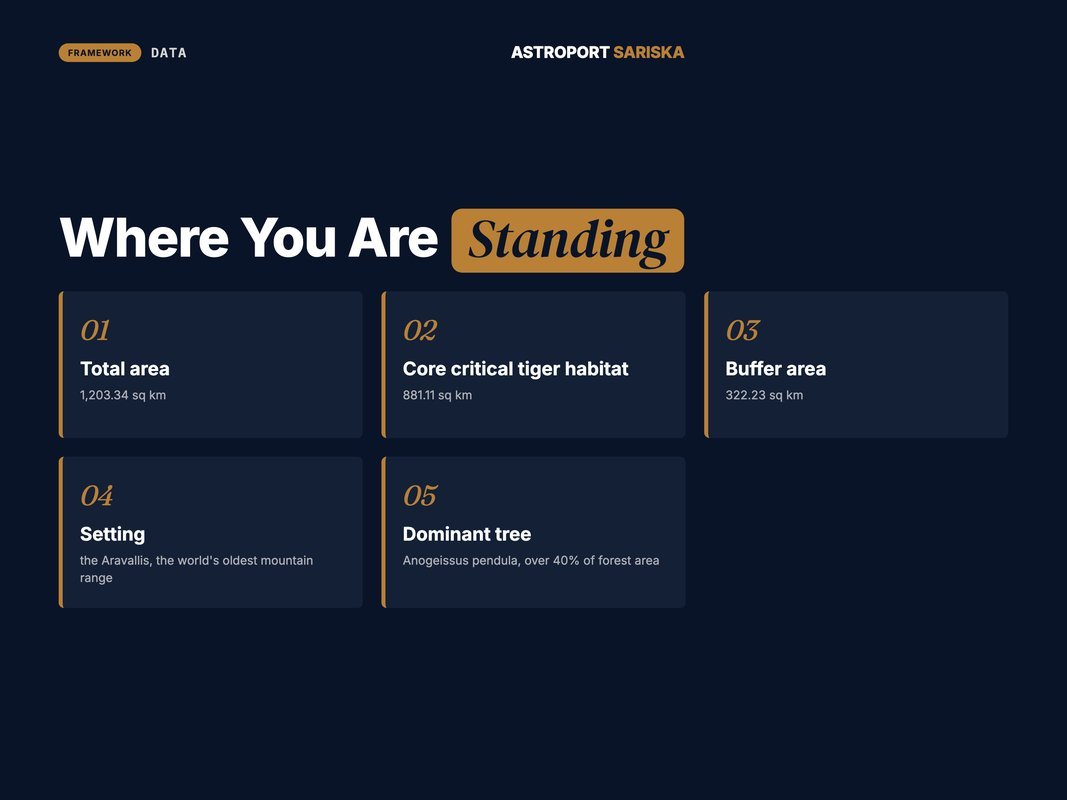
Sariska sits in the Aravallis, which the tiger authority calls the world’s oldest mountain range (Source: National Tiger Conservation Authority, 2026 — Sariska Tiger Reserve brief note).
That age shows. The hills are worn down and rounded, not jagged.
There are no sharp peaks here. Instead, you get long low ridges.
So the views run wide. A jeep can see far across a valley.
Rock breaks up the ground. Because of that, cats keep cover even in open forest.
The reserve is big. It totals 1,203.34 square kilometres in all (Source: National Tiger Conservation Authority, 2026 — Sariska Tiger Reserve brief note).
That splits into 881.11 square kilometres of core critical tiger habitat, plus 322.23 square kilometres of buffer (Source: National Tiger Conservation Authority, 2026 — Sariska Tiger Reserve brief note).
The forest is dry and thorny rather than lush. So one tree dominates, and it is worth knowing by sight.
The dhok tree covers over 40 percent of the forest area (Source: National Tiger Conservation Authority, 2026 — Sariska Tiger Reserve brief note).
Bamboo and khair fill the valleys. Meanwhile, rocky patches carry other hardy species.
This matters for spotting. Because dhok forest is open and leafless for much of the year, visibility is far better than in a wet jungle.
So Sariska rewards patience differently. You are scanning long distances rather than peering into thickets.
Q: Is Sariska greener or drier than other Indian parks?
A: Much drier. Because it is thorn and dry deciduous forest, it looks bare for months. Still, that openness makes animals easier to see once you learn where to look.
The Tiger Story: Lost, Then Brought Back
This is the part that makes Sariska unusual among Indian reserves.
Sariska was once among the country’s most popular tiger reserves, helped by its closeness to the capital (Source: National Tiger Conservation Authority, 2026 — Sariska Tiger Reserve brief note).
Then the tigers vanished. Poaching and other pressures drove them to local extinction (Source: National Tiger Conservation Authority, 2026 — Sariska Tiger Reserve brief note).
So a park named for tigers had none at all.
What happened next was a first. Wild tigers were moved in from Ranthambhore. The plan was drawn up with the tiger authority and the Wildlife Institute of India (Source: National Tiger Conservation Authority, 2026 — Sariska Tiger Reserve brief note).
They call this effort the first of its kind in the world (Source: National Tiger Conservation Authority, 2026 — Sariska Tiger Reserve brief note).
The Translocation Record
Here is the record, animal by animal.
| Code | Date moved | Sex |
|---|---|---|
| ST 1 | 28 June 2008 | Male |
| ST 2 | 4 July 2008 | Female |
| ST 3 | 25 February 2009 | Female |
| ST 4 | 20 July 2010 | Male |
| ST 5 | 28 July 2010 | Female |
| ST 6 | 23 February 2011 | Male |
| ST 7 | August 2012 | Cub |
| ST 8 | August 2012 | Cub |
| ST 9 | 23 January 2013 | Female |
| ST 10 | 24 January 2013 | Female |
(Source: National Tiger Conservation Authority, 2026 — Sariska Tiger Reserve brief note)
Notice ST 7 and ST 8. Because they are listed as cubs, they mark the point where the group began breeding here.
That is the whole goal of a move like this. You want a group that keeps going on its own.
Ten animals is a small base. So each birth still matters a great deal.
Since then, one of the moved tigresses has had cubs of her own (Source: National Tiger Conservation Authority, 2026 — Sariska Tiger Reserve brief note).
So every tiger here traces back to that move. That changes how a sighting feels.
The monitoring is intense. Dedicated teams watch the tigers around the clock, and night patrolling runs daily (Source: National Tiger Conservation Authority, 2026 — Sariska Tiger Reserve brief note).
Q: Does that mean tigers here are tracked and easy to find?
A: Tracked, yes. Easy, no. Because the watching is for safety, not for tourists, sightings still come down to chance. So treat any tiger as a gift.
The Big Cats and Other Carnivores
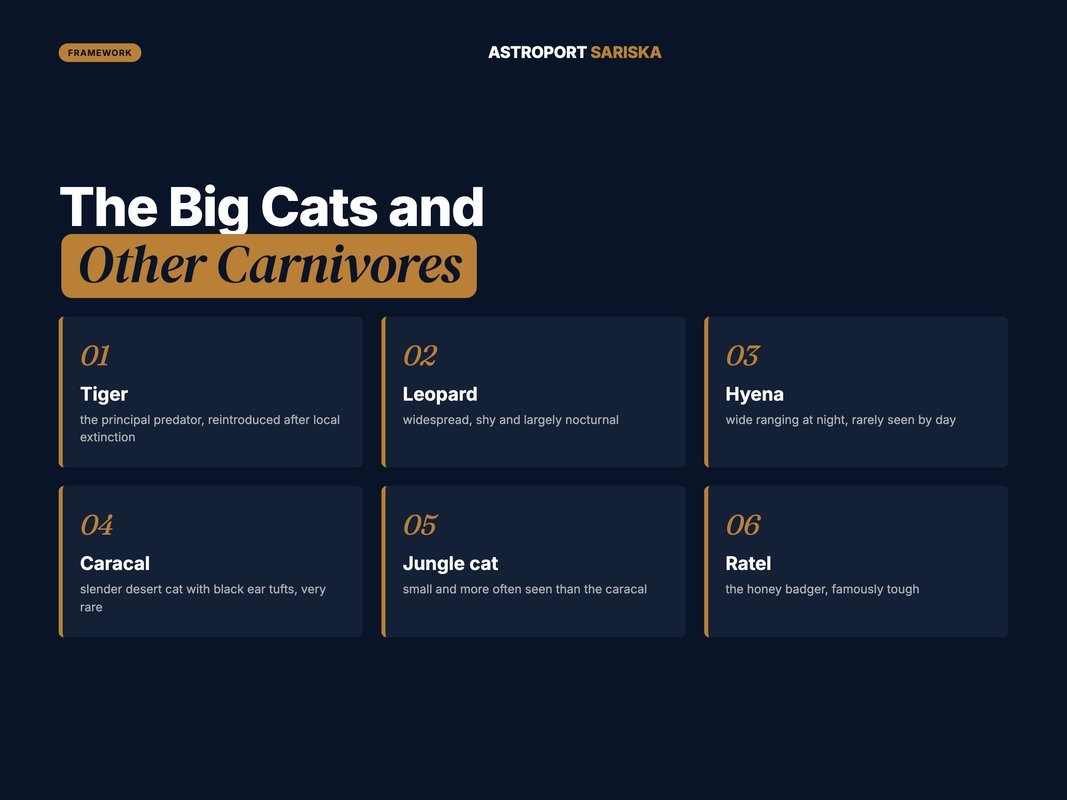
The tiger is the headline predator, but it is not alone.
Leopard and hyena are the other big hunters here (Source: National Tiger Conservation Authority, 2026 — Sariska Tiger Reserve brief note).
Leopards are widespread and adaptable. Still, they are shy and mostly nocturnal, so daytime views are rare.
Hyenas are stranger and rarer to see. Because they range widely at night, most guests only find their tracks.
Then come the small hunters. Caracal, jungle cat and ratel all occur here (Source: National Tiger Conservation Authority, 2026 — Sariska Tiger Reserve brief note).
The caracal is the prize. It is a slender desert cat with long black ear tufts, and very few visitors ever see one.
The ratel, or honey badger, is the toughest animal in the reserve by reputation. So it is worth asking your guide about.
Set your expectations by size. Because big cats are few and roam far, the small hunters are the likelier find.
That is not a downgrade. It is just how the numbers work.
Ask your guide what they saw yesterday. Then you know what is moving this week.
Sightings run in patterns. So last week’s news is often this week’s route.
Q: What are my realistic chances of seeing a tiger?
A: Modest on any single drive. So most visitors do not, and that is normal everywhere. Because two or three drives raise the odds, a longer stay helps more than luck.
The Deer and Antelope You Will Actually See
This is where Sariska delivers reliably.
Nilgai and sambar deer both occur at very high density across the reserve (Source: National Tiger Conservation Authority, 2026 — Sariska Tiger Reserve brief note).
Nilgai is the largest antelope in Asia. You cannot mistake it.
Bulls turn slate-grey with age. Cows stay tawny.
They are big animals, and they know it. So they rarely rush off.
They prefer open ground and often appear near villages (Source: National Tiger Conservation Authority, 2026 — Sariska Tiger Reserve brief note).
Sambar is the big deer here. It is dark, heavy and shaggy. It favours plateaus over woodland and grassland (Source: National Tiger Conservation Authority, 2026 — Sariska Tiger Reserve brief note).
Spotted deer, or chital, move in large herds. They feed on fallen Zizyphus fruit, often alongside common langur (Source: National Tiger Conservation Authority, 2026 — Sariska Tiger Reserve brief note).
That pairing is worth watching for. Because langurs drop fruit from above while deer clean up below, the two feed together deliberately.
The four-horned antelope and wild pig live here too (Source: National Tiger Conservation Authority, 2026 — Sariska Tiger Reserve brief note).
The four-horned antelope is small, shy and scarce. So spotting one counts as a good morning.
A jungle cat crossing a track at dusk is a fine sighting too. So is a mongoose in the dust.
None of those make the highlight reel. Still, they are the ones you actually see.
Keep score of everything, not just the cats. Then a slow drive still ends well.
It is the only antelope with four horns. That fact alone makes it worth a look.
Wild pig turn up almost everywhere. So do langur, in noisy groups.
Common langur is the most common monkey here, followed by the rhesus macaque (Source: National Tiger Conservation Authority, 2026 — Sariska Tiger Reserve brief note).
Both gather in large groups near the temple complexes inside the park (Source: National Tiger Conservation Authority, 2026 — Sariska Tiger Reserve brief note).
Q: Which animal am I most likely to see first?
A: Nilgai, almost certainly. Because they are large, common and use open ground, they often appear within minutes. So they are usually the first stop on any drive.
The Small Mammals Nobody Photographs
Everybody watches the treeline for cats. Meanwhile, the interesting stuff is closer to the wheels.
Sariska holds small Indian civet, palm civet, common mongoose and ruddy mongoose (Source: National Tiger Conservation Authority, 2026 — Sariska Tiger Reserve brief note).
Also present are the rufous-tailed hare, the porcupine and the pangolin (Source: National Tiger Conservation Authority, 2026 — Sariska Tiger Reserve brief note).
The pangolin is the extraordinary one. It is a scaled, ant-eating mammal, and it is one of the most poached animals on earth.
Almost nobody sees one. Still, knowing it is out there changes how you look at the ground.
Porcupine quills turn up on tracks fairly often. So do civet and mongoose prints in soft dust.
Ask your guide to read the tracks. Because a good tracker turns an empty stretch into a story, it is the best value on any drive.
Dust holds prints well here. So the first drive after rain is a poor one for tracks.
Look at the edges of the road. That is where soft dust gathers.
Q: Are night drives possible to see these?
A: Not inside the core, since drives are limited to set zones and times. So dusk drives and tracks are your best route to the nocturnal species.
Birds: 211 Species on the Official List
For many visitors, the birds end up being the highlight.
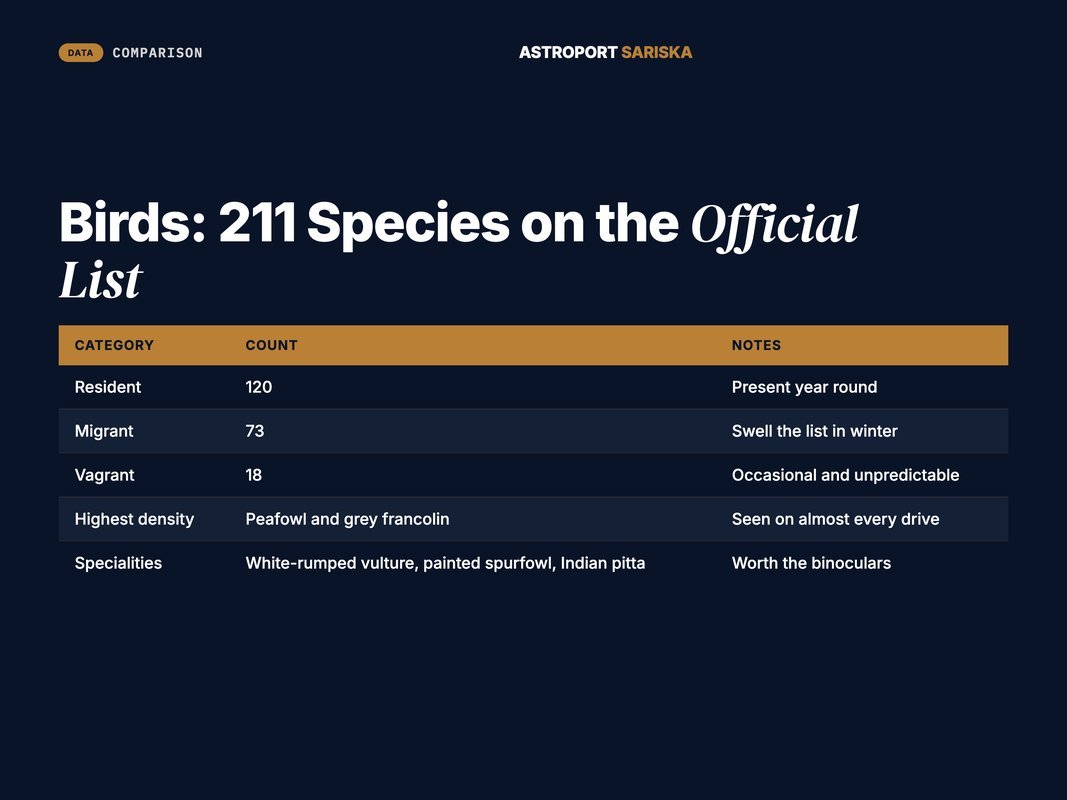
211 bird species have been recorded at Sariska (Source: National Tiger Conservation Authority, 2026 — Sariska Tiger Reserve brief note).
That list breaks down neatly. 120 are resident, 73 are migrants and 18 are rare strays (Source: National Tiger Conservation Authority, 2026 — Sariska Tiger Reserve brief note).
So more than a third of the list arrives from elsewhere. That is why winter is such a strong birding season here.
Two species dominate by sheer numbers. Sariska has a very high density of peafowl and grey francolin (Source: National Tiger Conservation Authority, 2026 — Sariska Tiger Reserve brief note).
Then there are the specialities. White-rumped vulture, painted spurfowl, Aravalli red spurfowl, Indian cuckoo, common sand grouse, Indian pitta and great horned owl all occur (Source: National Tiger Conservation Authority, 2026 — Sariska Tiger Reserve brief note).
The white-rumped vulture deserves a mention. Because vulture numbers across South Asia crashed, seeing one here is significant.
The Indian pitta is the pretty one. It is small, bright and far easier to hear than to see.
It calls at dawn and dusk. So the safari slots line up well with it.
The great horned owl is the other one to ask about. Because owls sit still, a guide who knows a roost can show you one.
So bring binoculars. Even on a tiger drive, the birds keep the quiet stretches interesting.
One pair between two is enough. Then you take turns.
Learn five calls before you go. Because sound comes first in dry forest, your ears do a lot of the work.
The peafowl call is the one you will hear most. It carries a long way.
Q: When is the best season for birds at Sariska?
A: Winter, comfortably. Because 73 of the recorded species are migrants, the list swells in the cool months. So November through February gives you the widest variety.
Water Decides Everything
Here is the single most useful thing to understand about this reserve.
Sariska has no river that runs all year (Source: National Tiger Conservation Authority, 2026 — Sariska Tiger Reserve brief note).
Instead there are ephemeral streams and pools, plus a few natural springs (Source: National Tiger Conservation Authority, 2026 — Sariska Tiger Reserve brief note).
Ephemeral just means temporary. So they run after rain and vanish afterwards.
Most of that water dries up in summer (Source: National Tiger Conservation Authority, 2026 — Sariska Tiger Reserve brief note).
That one fact shapes everything you will see. Because animals must come to the remaining water, the last pools draw them in.
So a waterhole in the dry season is worth more than a hundred kilometres of driving. Good guides know this and plan around it.
Ask to stop rather than push on. Then let the place come to you.
Twenty quiet minutes often beats an hour of driving. Because engines carry, a parked jeep hears more.
The reserve also holds a few fish in those pools. So there is more life in a dry-season stream than it looks.
Birds follow the water too. So a pool draws both prey and hunters.
Sit still there and wait. That is the whole trick.
Q: Does that mean summer is the best time for sightings?
A: For concentration, yes, because animals cluster at water. Still, the heat is punishing for visitors. So most people trade slightly lower odds for a comfortable winter trip.
How to Improve Your Odds
Luck matters. But so does method.
-
Go at first light. First, animals move and drink before the heat builds. So a dawn slot beats a mid-morning one every time.
-
Wear dull colours. Then you stop standing out against dry scrub.
-
Stay quiet and listen. Because sambar and langur give alarm calls when a predator moves, sound finds cats more often than sight does.
-
Watch the waterholes. Also, ask your guide to sit at one rather than keep driving.
-
Scan wide, not close. So use the open dhok forest to your advantage and look far into it.
-
Take more than one drive. Finally, odds stack. Because two or three drives beat one, plan a two-night stay.

Also, drop the tiger fixation. Because the reserve holds far more than one animal, a wider brief makes for a better morning.
Set a small goal instead. Try to name five birds.
Then the drive has a shape. So a blank hour still counts for something.
Keep a list in your phone. By the third drive it reads like a proper diary.
Q: Is a private jeep better than a shared one?
A: Usually, if the budget allows it. Because a smaller group is quieter and can wait longer at a waterhole, you get more control. So the difference shows up on slow days.
Why Astroport Sariska
Wildlife rewards early starts. So where you sleep decides how good your dawn is.
Astroport Sariska is India’s first astronomy resort. It sits at Tehla in the Aravalli hills, beside the Sariska Tiger Reserve in Alwar, Rajasthan.
The drive is about four to five hours from Delhi NCR. So you arrive with the afternoon spare and are ready for a first-light departure.
Jeep safaris run from here with guides. Meanwhile, nature walks, trekking and birdwatching all start on the doorstep.
That last point matters more than people expect. Because so much of the bird list is visible outside the reserve too, a slow morning on the property is productive.
Then the second half of the stay is the sky. Resident astronomers run the sessions with professional telescopes. The site is dark enough for thousands of stars on a clear night.
So you get the same landscape twice, in two completely different states. Deer at dawn, then the Milky Way at midnight.
The property runs fully on solar power, operates as a no-plastic zone, and grows much of its own food on site.
One timing note. Astronomy activities pause each year from 1 June to 15 August during the monsoon. So a winter trip suits both the birds and the stars. Plan your stay for the cool months.
Conclusion
So Sariska is not a tiger lottery. It is a whole dry-forest system that happens to hold tigers.
The scale is real, at 1,203.34 square kilometres across the world’s oldest mountains. Meanwhile, dhok forest covers over 40 percent of it.
The tiger story is the rarest thing here. Because the population was rebuilt from translocated animals after local extinction, every sighting carries that history.
But plan for the rest. Nilgai and sambar are near certainties, and 211 recorded bird species keep the quiet hours full.
Then remember the water. Because nothing here runs year-round, the surviving pools are where the animals go.
Go at dawn. Stay quiet, and take more than one drive. Plan your safari and stargazing trip and see the Aravallis twice over.
FAQ
Q: What animals will I actually see at Sariska?
A: Nilgai and sambar deer are close to certain, since both live here in large numbers. Spotted deer, wild pig, langur and rhesus macaque are also common. Tigers and leopards are possible but never guaranteed on any single drive.
Q: How big is Sariska Tiger Reserve?
A: The reserve totals 1,203.34 square kilometres. That splits into 881.11 square kilometres of core tiger habitat and 322.23 square kilometres of buffer. All of it sits in the Aravalli hills of Alwar district.
Q: Is it true that Sariska lost all its tigers?
A: Yes. Tigers became locally extinct at Sariska due to poaching and other factors. Wild tigers were then moved in from Ranthambhore under a science-led plan. The tiger authority calls it the first such effort in the world.
Q: How many bird species are there at Sariska?
A: 211 bird species have been recorded in Sariska. Of those, 120 are resident, 73 are migrants and 18 are rare strays. Peafowl and grey francolin are especially common.
Q: Are there leopards at Sariska?
A: Yes. Alongside the tiger, the reserve holds leopard and hyena. Smaller hunters include the caracal, jungle cat and ratel. Leopards are widespread but shy, so sightings depend heavily on luck and timing.
Q: What is the best time of day for a Sariska safari?
A: First light. Animals move and drink before the heat builds, then settle into cover for the middle of the day. Late afternoon is the second-best window as temperatures drop again.
Q: Why does water matter so much for spotting wildlife at Sariska?
A: Sariska has no river that runs all year. Water sits in ephemeral streams, pools and a few natural springs, and most of it dries up in summer. That concentrates animals around the remaining water, which makes those spots the best places to wait.