
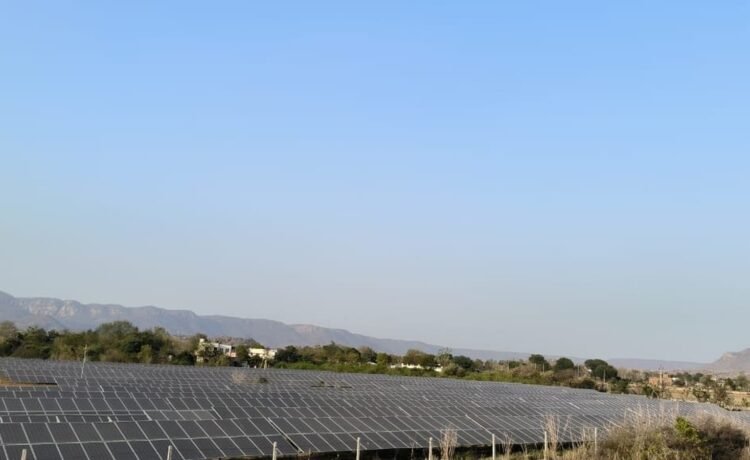
You wake up and something is missing. It takes a minute to work out what.
There is no hum. No generator, no traffic, no compressor cycling behind a wall.
That absence is the honest answer to what a solar powered resort India experience feels like. It is not about the panels. Instead, it is about what the panels remove.
So the pitch is usually wrong. Brochures show the hardware.
But you never look at the hardware. Instead, you notice the quiet.
This piece walks through the reality. First, you will learn what off-grid actually means.
Then you will get the day, hour by hour. Also, you will see what you give up. Finally, you will learn why dark skies and solar power belong together.
What Off-Grid Actually Means
The phrase gets used loosely. So here is the plain version.
Off-grid means the property makes its own power. It is not drawing from the public electricity network.
At Astroport Sariska, that power is entirely solar. Panels charge banks of batteries through the day, and the batteries carry the night.
But power is only one system. A properly off-grid site also handles its own water and waste.
So rainwater is harvested rather than bought in. Organic waste goes to a biogas plant rather than a landfill.
Food follows the same logic. Because the farm is on site, vegetables, fruit, poultry and dairy come from the land around you.
None of that is visible from a cottage window. Still, it changes what the place sounds and smells like.
Also, it changes what leaves. Because waste is handled here, few trucks come and go.
So the road stays empty. Then the dust stays down.
Q: Is off-grid the same as eco-friendly?
A: Related, but not identical. So a place can be off-grid and still wasteful. Because the real test is what the whole system does, look at water, waste and food as well as power.
The First Thing You Notice Is Quiet
Ask returning guests what stayed with them. Very few say the solar panels.
Almost all of them mention the quiet.
Grid-connected hotels hum constantly. Because a diesel generator idles for backup, there is a low drone under everything.
Solar has no moving parts. So the power itself is silent, and the batteries are silent too.
Take that away and you notice what is underneath. Wind through scrub. Birds settling at dusk. Somebody’s footsteps on gravel a hundred metres off.
The second thing people notice is the dark. Because outdoor lighting is kept low and pointed down, the paths are lit but the sky is not.
That takes an evening to adjust to. Then it becomes the point.
Bring a red torch if you have one. Otherwise the staff will hand you one.
Avoid your phone screen outdoors. Because one glance resets your night vision, it is the main thing to watch.
By the second night, most guests stop using torches entirely. So their eyes do the work instead.
Then you start to hear more. Because your eyes give up some ground, your ears take over.
Plus you slow down. So a short walk takes twice as long.
Q: Is it too dark to walk around safely?
A: No, paths are lit properly. Because the light is aimed down at the ground rather than out into the air, you see where you are going without ruining your night vision.
A Day on Solar Power
The rhythm shifts slightly. Here is how a day actually runs.
-
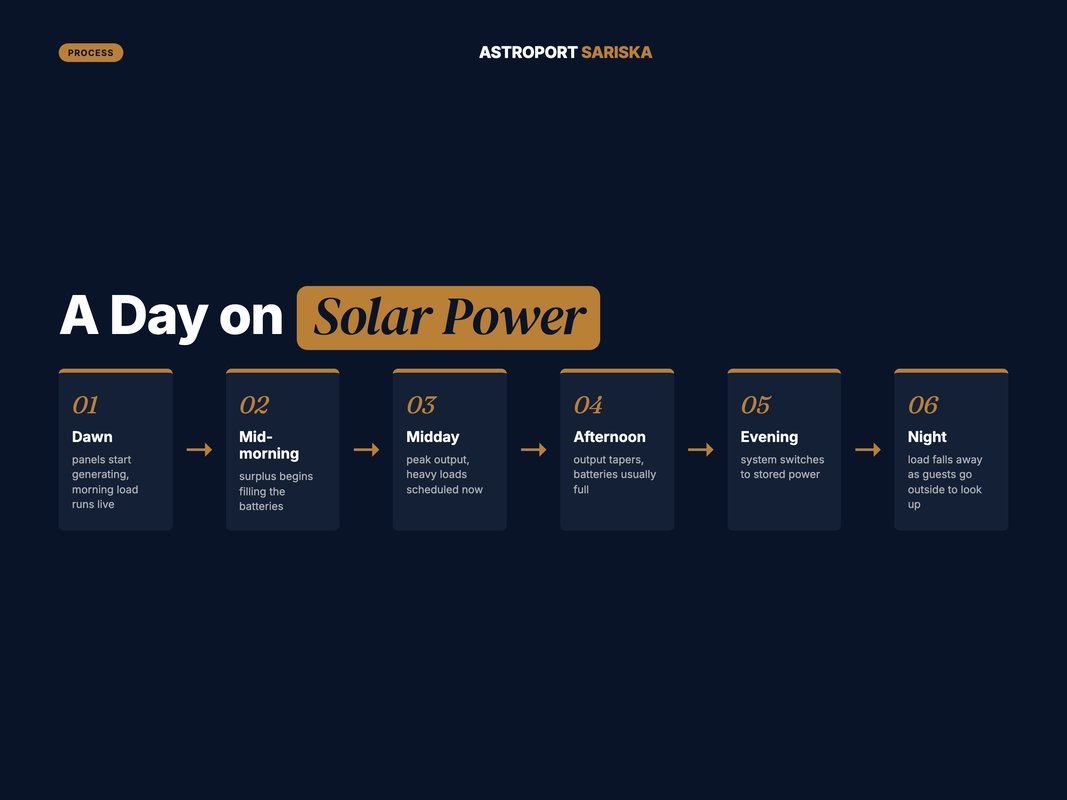
Dawn. First, the panels start generating as soon as the light comes up. So the morning load runs straight off live sunshine.
-
Mid-morning. Then generation climbs past what anyone is using. Because the surplus goes into storage, the batteries fill through the day.
-
Midday. Meanwhile, this is the peak. So heavy loads like laundry and pumping are best scheduled now.
-
Afternoon. Next, output tapers as the sun drops. The batteries are usually full by this point.
-
Evening. So the system switches over to stored power for lighting, fans and the kitchen.
-
Night. Finally, the load falls away as people go outside to look up. Because the biggest evening activity needs no power at all, the draw is small.
Notice step six. So the resort’s headline activity, stargazing, is also its lowest-energy hour.
That is not a coincidence. Because dark skies and low power use want the same thing, the two reinforce each other.
Q: Do I need to change how I use power as a guest?
A: Not really. So you use the room as you would anywhere. Still, a little awareness helps, because you can see exactly where your electricity came from.
What Runs, What Doesn’t, and What You Give Up
This is the question behind the question. So here is a straight answer.
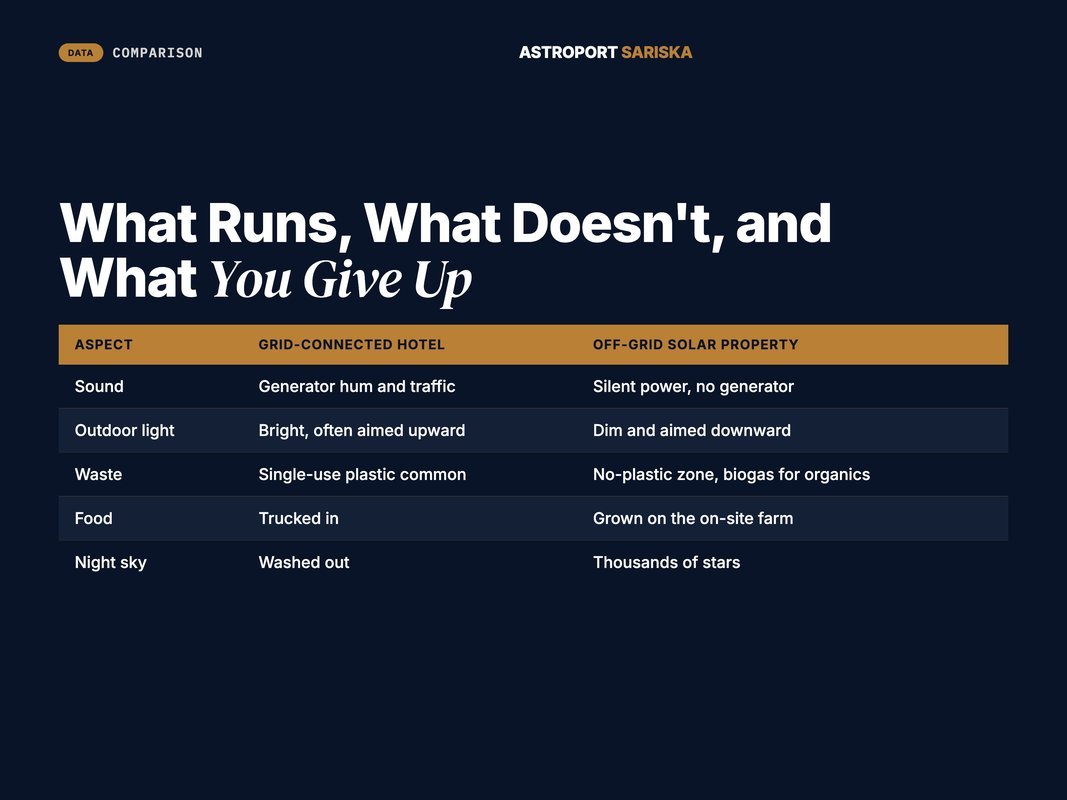
Lights run. Fans run. Hot water runs. Air conditioning runs. The kitchen runs.
You are not roughing it. Because modern solar and storage handle hospitality loads comfortably, the standard of the stay does not drop.
What does change is smaller than people fear.
Connectivity is patchier, because you are deep in the Aravallis rather than in a city. So streaming can be slow.
Most guests count that as a gain rather than a loss. Because the whole point is the sky and the wildlife, an unreliable signal helps.
Outdoor lighting is deliberately dim. Also, single-use plastic is absent, since the property runs as a no-plastic zone.
The menu follows the farm and the season. So you eat what is ready rather than what is listed.
Also, portions arrive when the kitchen is ready. Because nothing sits under a lamp, the timing shifts a little.
Most people prefer it. Still, it is worth knowing before you arrive.
Q: What happens if the weather turns for several days?
A: Storage covers it. Because systems are sized for dull stretches, guests generally notice nothing. So the kitchen and hot water get priority if it ever came to that.
The Systems Behind the Comfort
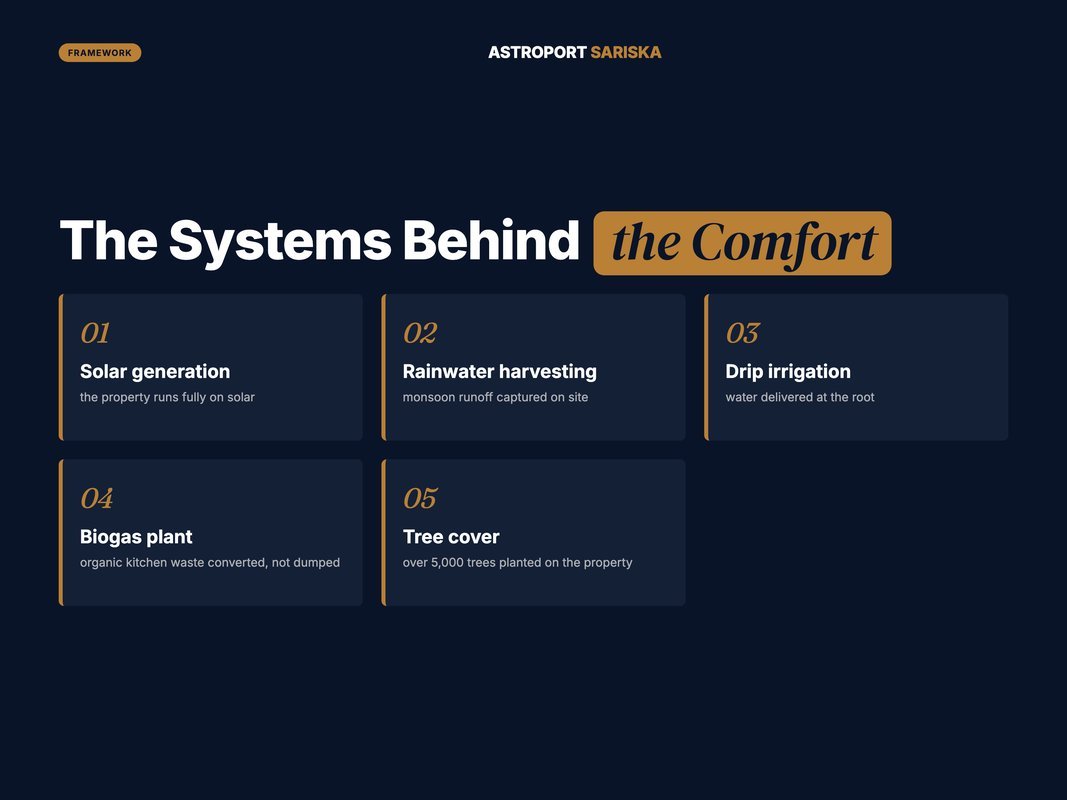
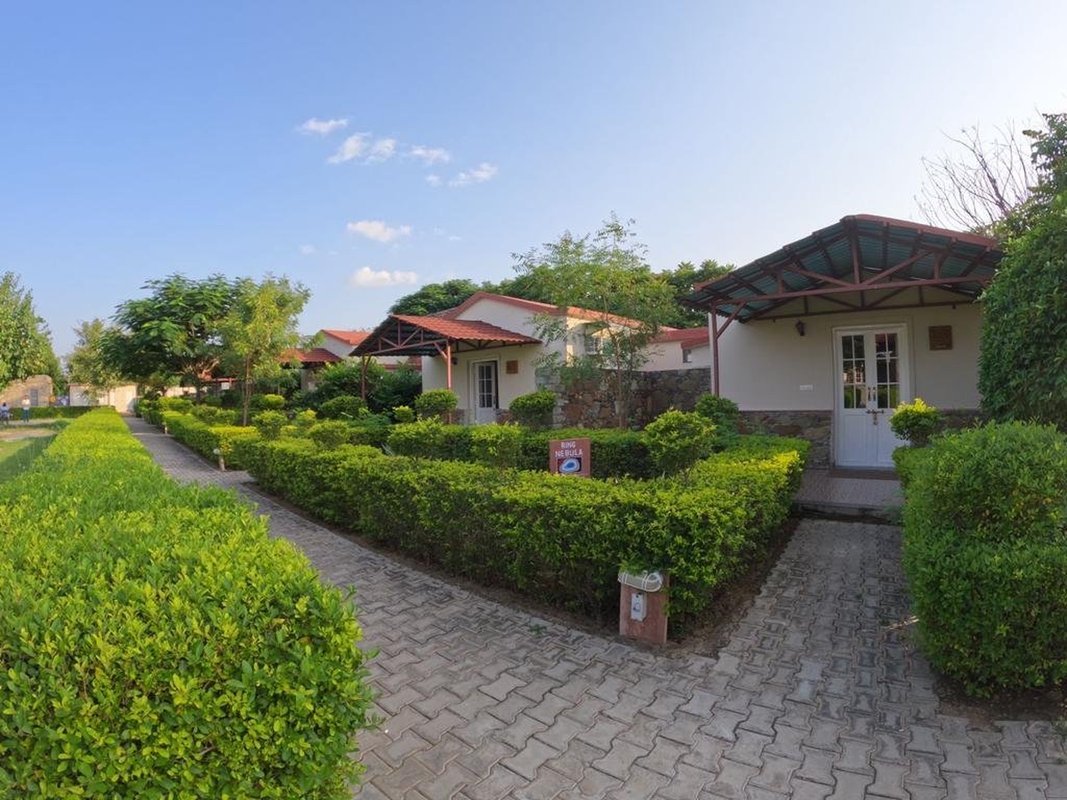
Five things do the work here. None of them are visible from your cottage.
Solar generation. So the property runs fully on solar power, with no grid connection.
Rainwater harvesting. Then structures catch monsoon runoff instead of letting it drain away.
Drip irrigation. So the farm gets water at the root, which cuts waste sharply.
A biogas plant. Because organic kitchen waste is converted rather than dumped, the site gets energy back from it.
Tree cover. Also, over 5,000 trees have been planted here. They shade the ground and hold the soil.
(Source: Astroport Sariska, 2026 — Astroport Sariska)
Together those close most of the loops. So water, waste, food and power largely stay on site.
That is the difference between a solar panel on a roof and a genuinely off-grid property. One is a feature. The other is a design.
So ask about waste, not panels. Because anyone can bolt on a roof array, the loops are the real test.
Then ask where the water goes. That answer tells you most of it.
Q: Which of those five matters most?
A: The biogas plant surprises people. Because food waste is the heaviest and smelliest thing a resort produces, handling it on site removes a lot of truck traffic and landfill.
Why Off-Grid and Dark Skies Go Together
These two things are usually treated separately. In fact, they are the same discipline.
When every unit of power is generated on site, waste becomes visible. So a floodlight pointing at the sky is not just bad for stars. It is a battery you cannot use later.
That changes lighting decisions. Because shielded, downward-facing lights use less power and spill less glare, they win on both counts.
The result is a much darker sky overhead. Meanwhile, the paths are still lit.
This matters more each year. Night skies worldwide have been brightening by about 9.6 percent a year, doubling roughly every eight years (Source: US National Park Service, 2026 — Light Pollution).
And skyglow already hides the Milky Way from more than a third of humanity (Source: Falchi et al., 2016 — World Atlas of Artificial Night Sky Brightness).
So an off-grid site in the Aravallis is doing something unusual. It is preserving a resource most places are quietly destroying.
Q: Would a grid-connected resort be any darker if it tried?
A: It could be, with the right fixtures. Still, the incentive is weaker. Because grid power feels unlimited, over-lighting costs nothing obvious. So off-grid sites tend to get there first.
India’s Solar Picture, Briefly
Some context helps explain why this is now practical.
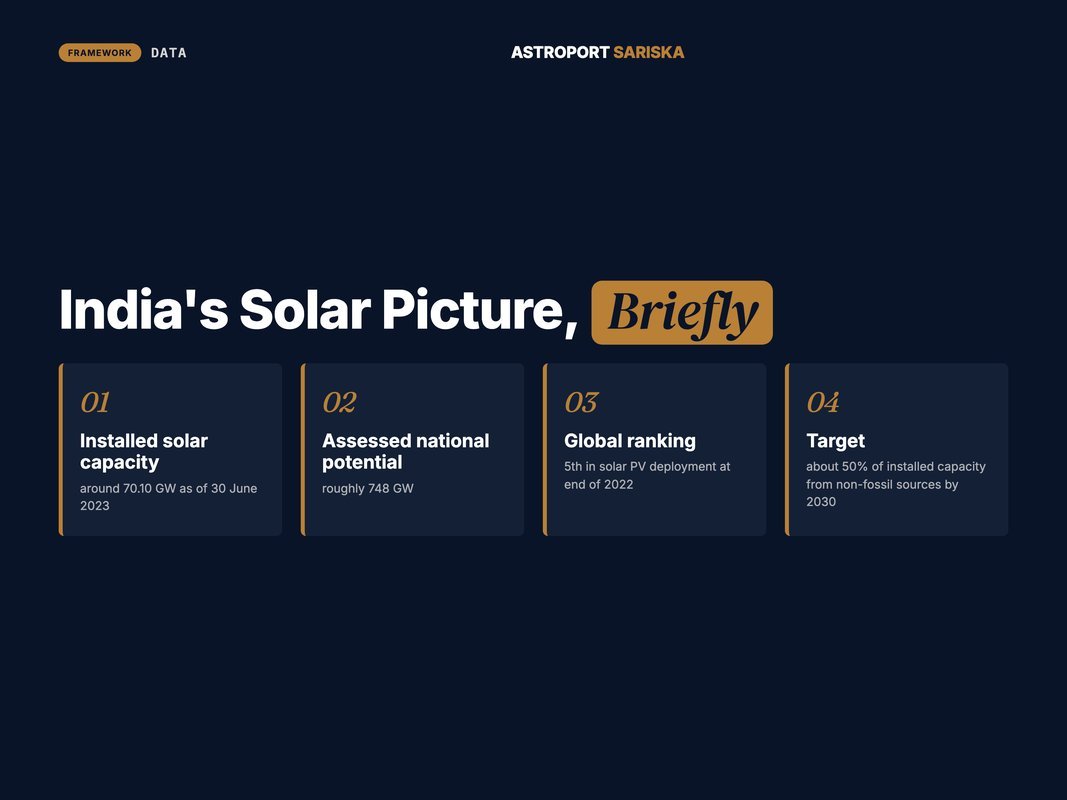
India had reached around 70.10 GW of installed solar capacity by 30 June 2023 (Source: Ministry of New and Renewable Energy, 2026 — Solar Overview).
The assessed national potential is far larger, at roughly 748 GW (Source: Ministry of New and Renewable Energy, 2026 — Solar Overview).
India also ranked fifth globally for solar deployment at the end of 2022 (Source: Ministry of New and Renewable Energy, 2026 — Solar Overview).
The national target is about 50 percent of installed power capacity from non-fossil sources by 2030 (Source: Ministry of New and Renewable Energy, 2026 — Solar Overview).
Rajasthan sits at the centre of that story. Because the state gets intense, reliable sun for most of the year, it is close to ideal for this.
So an off-grid resort here is not a novelty. Instead, it is the sensible use of the local resource.
The sun is the one thing this land has in surplus. So using it is the obvious move.
Winter helps as well. Because the air is dry and clear, panels work well through the cool months.
Summer is harsher on the system. Still, that is when output peaks.
Q: Does a single resort going solar actually matter?
A: On its own, marginally. Still, it proves the model works at hospitality scale. Because guests then see it functioning normally, it shifts what people expect elsewhere.
Why Astroport Sariska
Most places treat sustainability as a line in the brochure. So the useful question is whether it changes the stay.
Astroport Sariska is India’s first astronomy resort. It sits at Tehla in the Aravalli hills, beside the Sariska Tiger Reserve in Alwar, Rajasthan.
The drive is about four to five hours from Delhi NCR. So it is far enough out for the systems to make sense.
The property runs fully on solar power. It also operates as a no-plastic zone, uses organic amenities, harvests rainwater, irrigates by drip and runs a biogas plant.
Food comes largely from the on-site farm, with its own poultry and dairy. So the farm-to-table line is literal rather than marketing.
The comfort is still there. There are stone and rustic cottages, a swimming pool, the Sparsh Spa, and the Orbit Restaurant with a seasonal menu.
And the payoff shows up overhead. Because the site is dark and the lighting is disciplined, guests see thousands of stars on a clear night. Meanwhile, central Delhi offers a couple of dozen.
Resident astronomers run the sessions with professional telescopes. One timing note, though. Astronomy activities pause each year from 1 June to 15 August during the monsoon. Plan your stay outside that window.
Conclusion
So off-grid living does not feel like sacrifice. It feels like subtraction.
The generator hum goes. Floodlights go. So does the plastic.
What is left is quieter, darker and slower. Because those three things are what people actually travel for, the trade works out well.
The systems behind it are unglamorous. Solar panels, batteries, rainwater tanks, drip lines and a biogas plant.
Yet they add up to something rare. A place where the power is silent and the sky is intact.
Spend two nights and the rhythm makes sense. Plan your off-grid stay and hear a resort without a generator.
FAQ
Q: What does off-grid actually mean at a resort?
A: It means the property generates its own power rather than drawing it from the public grid. At Astroport Sariska that power comes entirely from solar. Water, waste and food systems are usually handled on site too.
Q: Do you have to give up comfort at a solar-powered resort?
A: Far less than people expect. Lighting, fans, hot water, air conditioning and kitchens all run normally. What changes is the rhythm of the day rather than the standard of the stay.
Q: Is an off-grid resort noisier or quieter than a normal hotel?
A: Much quieter, and it is the first thing guests notice. There is no constant generator hum and no traffic. Solar panels have no moving parts, so the power itself makes no sound.
Q: What happens on a cloudy day at an off-grid resort?
A: Battery storage carries the load. Good systems size their storage for several dull days. So guests usually notice nothing at all. The kitchen and hot water are prioritised.
Q: How does going off-grid help stargazing?
A: The two go together naturally. When you generate every unit of power yourself, wasteful outdoor lighting is the first thing to go. Less upward light means darker skies overhead.
Q: What other systems does an off-grid property need?
A: Power is only one part. Rainwater harvesting, drip irrigation, a biogas plant and an on-site farm all cut what has to be trucked in. Together they make the site largely self-sufficient.
Q: Is off-grid living in India realistic at scale?
A: Increasingly so. India had around 70 GW of installed solar capacity by mid-2023, and the assessed national potential is roughly 748 GW. Falling costs have made site-level solar viable for hospitality.