
Rain taps the window. The city is grey and the weekend is yours. So you crave two things at once. Green hills to breathe in, and a sky full of stars at night. A monsoon weekend getaway near Delhi can give you both.
It feels like a contradiction, though. Monsoon means cloud, and cloud hides the stars. So can the rains really deliver green and clear at once? The honest answer is yes, but only if you pick the right place and time.
This guide shows you how. We weigh hill stations against the soaked coast against the green Aravallis. Then we explain why semi-arid Rajasthan flips the odds in your favour. You get a region comparison, a month-by-month timing table, and a simple planning checklist.
By the end, you will know exactly where to go and when. The trick is the post-monsoon window. Get it right, and the hills stay green while the sky comes clear.
Why a Monsoon Trip Feels Like a Contradiction
Let us start with the catch. The monsoon is glorious by day and tricky by night. So the same rain that greens the hills also veils the stars.
The southwest monsoon sweeps across India from about June to September (Source: IMD, 2026 — Monsoon Information). It is the cloudiest stretch of the whole year. So a fully clear night becomes the exception, not the rule.
But that is only half the story. Cloud cover is not the same everywhere. Some regions sit under near-constant rain. Others get only passing showers.
The monsoon also moves in waves, not a wall. Active spells bring days of cloud. Then break spells open the sky for a while. So even the rainy season has its windows.
Those windows are the whole opportunity. A break spell over a drier region means stars. So you stop dreading the monsoon and start reading it. The skill is in the timing.
So the goal shifts. You are not fighting the monsoon. You are finding the spot where it rains a little and clears a lot.
That spot exists, and it is closer than you think. It is the semi-arid edge of the Aravallis. The hills green up, yet the air stays mostly dry.
Think of it as a weather sweet spot. The monsoon still arrives here, just gently. So you get the green flush without the endless grey. That single difference changes the whole trip.
Working With the Monsoon, Not Against It
It is worth understanding why this matters so much. The monsoon is a gift and a hurdle at once. So the smart traveller learns to read it. You work with the weather, not against it.
And the payoff is genuinely special. Few seasons offer green hills and clear stars together. So getting it right feels like a small victory. The reward is a sky most city dwellers never see.
It also changes how you plan. On the coast, you brace for days of rain. In the Aravallis, you simply watch for the clear gaps. So your mindset shifts from waiting out the weather to catching the right night.
And the rewards stack up fast. A green hillside by day. A washed, starry sky by night. So one weekend can hold both moods of the season.
Q: Can you really stargaze during the monsoon?
A: Not reliably at peak monsoon, when cloud is common. But gaps between rain systems can bring crystal-clear nights. And the post-monsoon shoulder, from late September, opens steady skies. So timing and place matter more than the calendar word “monsoon”.
What Makes a Great Monsoon Getaway
So what should you actually look for? A good monsoon trip balances four things. Green scenery, clear-night odds, an easy drive, and things to do if it rains.
Green is the easy part. Almost everywhere near Delhi turns lush in the rains. So the real differentiator is the night sky.
Green Is Easy; Clear Nights Are Not
Most travellers focus only on the green. They picture misty hills and waterfalls. But they forget to ask one question. Will the sky actually clear at night?
That question separates a good trip from a great one. A green day is lovely on its own. Yet a starry night turns it magical. So weigh both before you pick a place.
The Other Three Factors
Clear-night odds come down to rainfall. Less total rain means more gaps in the cloud. So a drier region simply gives you more chances at the stars.
The drive matters too. A monsoon weekend getaway near Delhi should stay within a comfortable half-day’s drive. So you are not burning the whole trip on a wet highway.
A wet road also slows you down. Visibility drops and traffic crawls. So a shorter route is safer and saner. You want the green ahead, not the brake lights.
And a rain plan is the safety net. The best places fill a cloudy night with indoor wonder. So even a washout feels worthwhile.
Why All Four Rarely Align
These four factors rarely line up by accident. Most monsoon spots ace one or two and fail the rest. So the goal is to find the rare place that scores on all four.
Take the drive, for instance. A long, rain-slicked highway eats into your weekend. So a closer base means more time under the sky and less on the road.
Then weigh the rain plan again. It is the factor people forget. But it is the one that saves a cloudy trip. So never book a place without it.

Keep these four in mind as we compare regions. One place may green up beautifully but stay socked in. Another may stay drier and reopen the sky fast.
So the winner is the region that nails all four. Read on, and one option keeps rising to the top.
Q: What makes one monsoon destination better than another?
A: Four things decide it. How green it gets, how often the sky clears, how far it is to drive, and what you can do on a rainy night. Green is easy near Delhi. Clear-night odds are the rare ingredient.
Hills vs Coast vs the Aravallis: A Clear-Sky Showdown
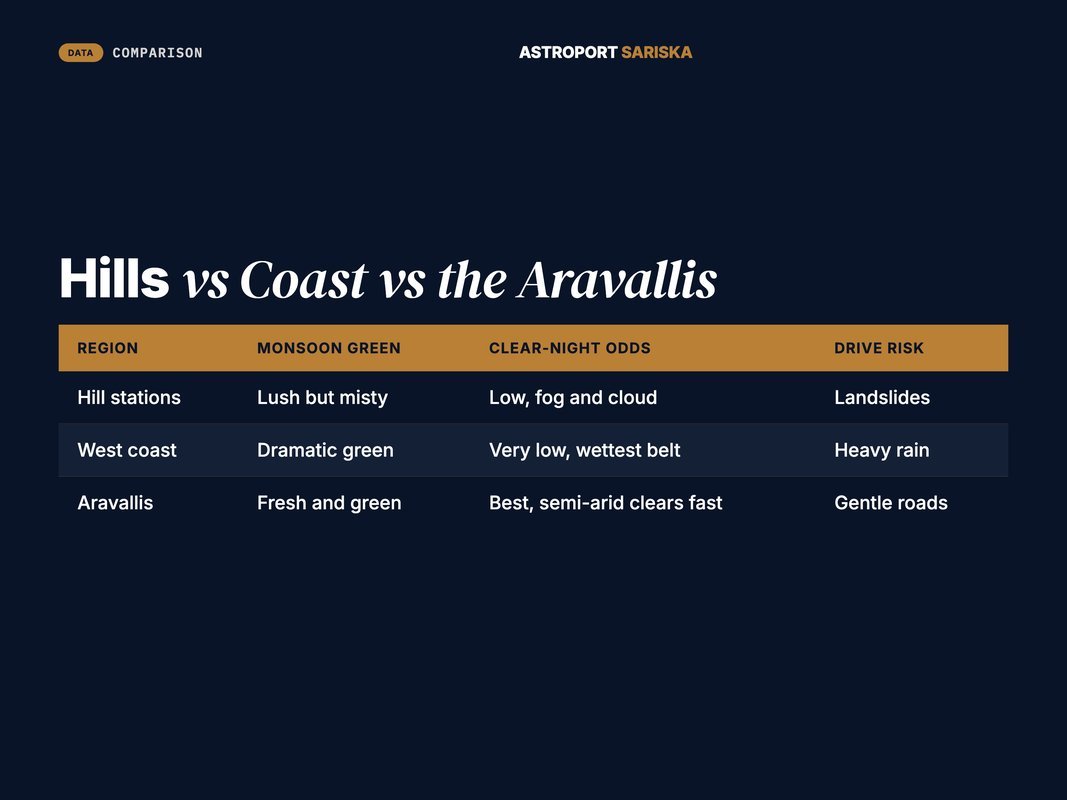
Now for the head-to-head. Three classic monsoon ideas compete here. Himalayan hill stations, the west coast, and the Aravallis.
Hill stations are the default pick. They are cool and green in the rains. But they also sit under heavy cloud and mist for weeks. So clear nights are rare, and roads can wash out.
The mist is the real spoiler up there. It settles in valleys and lingers for days. So even a dry evening can stay hazy. The stars hide behind a soft grey veil.
Landslides add another worry in peak rain. Mountain roads can close without notice. So the drive itself turns risky. For a relaxed star weekend, that is a hard sell.
The west coast is the rain capital. It greens up dramatically. But it sits in the wettest part of the monsoon belt. So the sky stays grey for days on end.
The coast has its own magic, of course. The waterfalls and the green are unmatched. But it is a daytime monsoon, not a night one. So stargazing is rarely the reason to go.
That trade-off is the crux. You can have lush coastal drama. Or you can have clear desert nights. So your priority should pick the place.
The Aravallis play a different game. Eastern Rajasthan is semi-arid, so it gets far less rain (Source: Wikipedia, 2026 — Climate of Rajasthan). So showers pass and the sky reopens fast.
The Rainfall Gap That Decides It
Here is the key contrast. Rainfall around the eastern Aravallis is moderate — a few hundred millimetres across the whole year (Source: Wikipedia, 2026 — Climate of Rajasthan). The west coast can see several times that. So the cloud simply clears more often inland.
That is the whole trick. You want green hills with the least possible rain. The semi-arid Aravallis are exactly that sweet spot.
For a wider list of options, see our guide to weekend getaways under 6 hours from Delhi. The Aravallis stand out for one reason. They mix monsoon green with real clear-sky odds.
It helps to picture each option at night. A hill station is cool but fogged in. The coast is warm but solidly overcast. The Aravallis sit between showers, with stars in the gaps.
So the choice is really about odds. You are betting on clear-night chances. The drier the region, the better your bet. That logic points straight inland.
It is a simple rule to remember. Follow the green, but chase the dry. So you land where the two overlap. The Aravallis are that happy meeting point.
The numbers back the instinct, too. Less rain means more clear hours. So your weekend odds climb sharply. A small map choice makes a big difference.
Q: Why are the Aravallis better than hill stations for monsoon stargazing?
A: Hill stations stay under thick cloud and mist for weeks. The Aravallis are semi-arid, so they get far less rain. Showers pass and the sky clears between them. So you get green hills and many more clear-night chances.
Why Semi-Arid Rajasthan Beats the Soaked Coast
Let us dig into the why. It comes down to one word. Geography.
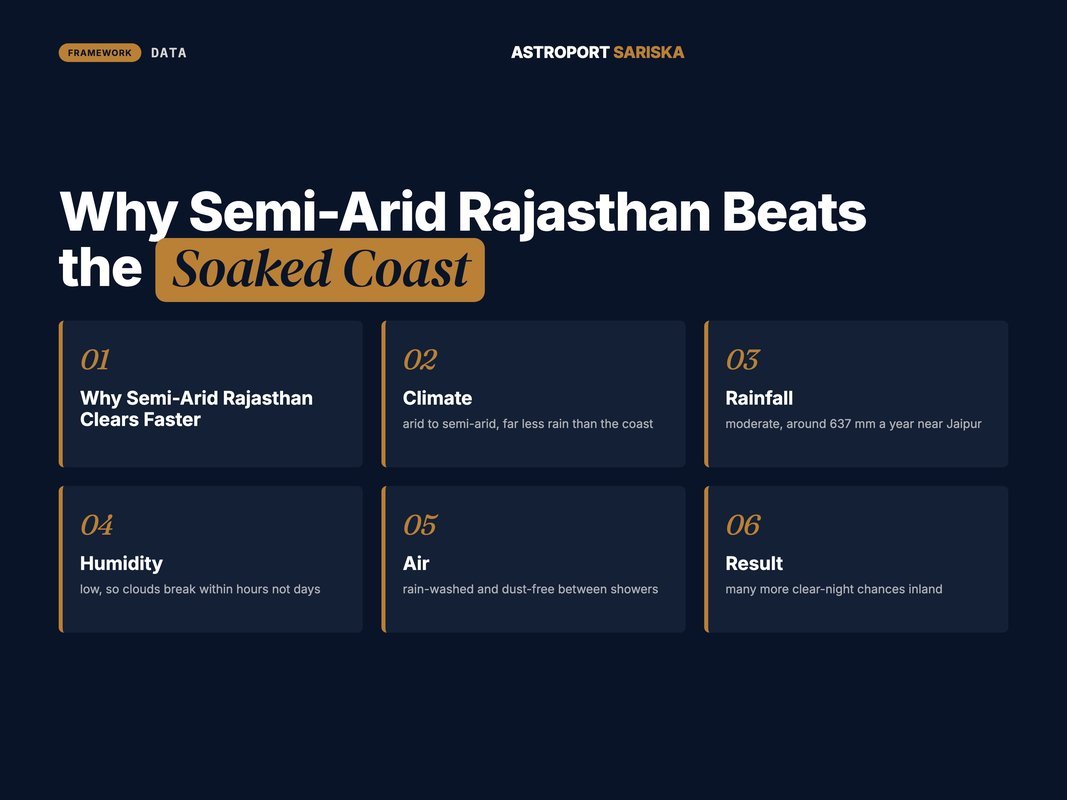
The monsoon dumps most of its rain on the windward coasts and hills. So those zones stay wet and grey. Rajasthan lies in a drier rain shadow further inland.
The state’s climate ranges from arid to semi-arid (Source: Wikipedia, 2026 — Climate of Rajasthan). So even in the rains, the air carries less moisture. So clouds build, break, and clear within hours, not days.
Lower humidity is the quiet hero here. Dry air holds fewer water droplets aloft. So the sky stays clearer and steadier between showers. That steadiness is exactly what telescopes love.
Contrast that with a coastal night. Thick, humid air traps haze and cloud. So even a “clear” coastal sky can look milky. The inland desert simply offers a crisper view.
That fast clearing is the magic. A heavy shower can roll through at sunset. Then the sky scrubs itself clean by midnight. So you get a rain-washed, dust-free view of the stars.
Rain-Washed Air Means Sharper Stars
Washed air is genuinely better for stargazing. Rain pulls dust and haze out of the sky. So the gaps between clouds can be remarkably transparent. Catch one, and the stars feel close.
City air never gives you this. It stays thick with dust and light. So the desert after rain is a revelation. The sky looks scrubbed and deep.
It is the kind of night you remember. Thousands of stars, sharp and steady. So the long drive earns its reward. One clear monsoon night can outshine a dozen city ones.
The Aravallis add the green you came for. The rains wake the dry hills into fresh life. Streams run and the forest turns vivid. So the Sariska Tiger Reserve looks its lushest.
The Aravallis are also ancient and low. They do not trap weather the way tall peaks do. So clouds drift through rather than pile up. That keeps the night sky open more often.
It is a gentle landscape, too. Rolling ridges, not sheer cliffs. So the drives are easy and safe in the rain. You arrive relaxed, not rattled.
So you truly get the best of both. Green hills by day, and a fighting chance at stars by night. That balance is rare, and it is the heart of this guide.
The Comfort Bonus of Monsoon Nights
There is also a comfort angle here. The monsoon cools the desert nicely. So the searing summer heat is gone. Evenings turn mild and easy for sitting out.
That comfort matters for stargazing. You can wait out a cloudy spell in ease. So when a gap opens, you are relaxed and ready. The whole experience feels unhurried.
And the green softens the famous Aravalli starkness. The bare rock takes on a velvet coat. So even the daytime drive becomes a pleasure. The contrast with the city could not be sharper.
Q: Why is the coast worse than Rajasthan for monsoon clear skies?
A: The coast sits in the wettest part of the monsoon belt, so cloud is near-constant. Rajasthan is semi-arid and lies in a drier zone. So showers pass and the sky reopens quickly. You get green hills with far better star odds.
The Real Magic Window: Timing the Post-Monsoon Sky
Now for the honest truth. Peak monsoon nights are still mostly cloudy. So if clear skies are your top goal, you time it.
The magic window is the post-monsoon shoulder. The southwest monsoon withdraws from northwest India through September into early October (Source: Wikipedia, 2026 — Monsoon of South Asia). So late September to October is the sweet spot.
Why the Shoulder Window Is Special
Here is why that window is special. The hills are still green from the rains. But the cloud has begun to lift for good. So you catch lushness and clarity in the same trip.
Few seasons hand you both at once. Summer is clear but brown and harsh. Deep winter is clear but the green has faded. So this brief overlap is genuinely rare.
That is why seasoned travellers guard it. They know the green will not last. They know the skies are turning. So they book early and go before the window closes.
The air also turns crisp. As the monsoon retreats, humidity drops and the sky steadies. So nights grow long, dark, and transparent. This is the start of the best time to visit Sariska for stars.
This shoulder feels like a secret season. The rush of the rains has eased. Yet winter’s chill has not arrived. So the weather sits in a gentle, golden middle.
It is a fleeting window, which is part of the charm. The hills stay green for only so long. Then the dry months slowly fade them. So catching this stretch feels like good timing rewarded.
The wildlife agrees with you, too. The forest is fed and full after the rains. So Sariska looks vivid and alive. The safari and the stargazing peak together here.

Time It to a New Moon
Pair the window with the moon for the best result. Aim for a new-moon weekend in this stretch. So the sky goes truly dark, with no moonlight to wash out the stars. The Milky Way arches highest on these early-autumn evenings.
The moon makes a bigger difference than people expect. A full moon can drown out faint stars. So even a perfectly clear night underwhelms. A dark sky needs a dark moon.
Longer Nights, More Dark Hours
So plan around both at once. Find the clear-up, then find the new moon. When they overlap, you strike gold. That single weekend can outshine a whole season.
The early-autumn timing has one more gift. The nights are growing longer again. So you get more dark hours under the sky. There is simply more time to look up.
So the plan writes itself. Go in the post-monsoon shoulder, near a new moon. You get green hills, dark skies, and the calm after the rains.
This window has another quiet perk. The crowds have not yet arrived. So the resort and the trails feel calm. The dark sky feels like yours alone.
The rates tend to be gentler too. Peak season fills the winter weekends. So the shoulder weeks offer better value and more space. It is the insider’s time to go.
Just keep one thing in mind. The clear-up is a trend, not a guarantee. So a stray late shower can still roll through. Stay flexible, and the window rewards you.
Q: When is the best time for a clear-sky monsoon getaway near Delhi?
A: The post-monsoon shoulder, from late September into October. The monsoon withdraws then, so the sky clears and steadies. Yet the hills stay green from the recent rains. Pair it with a new moon for the darkest sky.
How to Plan It: A Simple Monsoon Trip Framework
So how do you put this into action? Use a simple, repeatable plan. It works for any monsoon trip from Delhi.
First, pick a semi-arid hill region, not the coast. So you front-load your clear-night odds. The Aravallis are the obvious call.
Next, target the post-monsoon shoulder. Late September to October gives green plus clarity. So you stop fighting the rain and start riding the clear-up.
Then book two nights, not one. A single cloudy night can spoil a one-night trip. So a second night gives you another shot at the stars.
Small Touches That Sharpen the Plan
Two nights also slow the trip down. You are not racing the clock. So you can wait out a shower in peace. Then step out when the sky finally clears.
It changes the whole mood, in fact. One night feels like a gamble. Two nights feel like a proper escape. So the small extra is well worth it.

Also, time it to a new moon. So the sky is at its darkest. And keep your plans flexible, since weather still has the last word.
Finally, choose a place with a strong rain plan. So a cloudy night is still a great night. That single choice protects the whole trip.
For more off-the-beaten ideas, browse our offbeat weekend trips from Delhi. The framework stays the same. Drier region, shoulder season, new moon, two nights.
A few small touches sharpen the plan further. Check the moon phase before you book. So you avoid a bright, washed-out sky. A dark new-moon night doubles the star count you see.
Pack Light, Plan Flexible
Watch the forecast in the final days too. The monsoon is restless and shifts fast. So a flexible booking helps you chase the clearer weekend. Even a day’s shift can swing your odds.
And pack light but smart. A rain shell, warm layers, and good shoes cover it. So you are ready for a green trek and a cool night alike. Comfort keeps you out under the stars longer.
Q: How should I plan a monsoon trip from Delhi for clear skies?
A: Choose a semi-arid hill region over the coast. Target the post-monsoon shoulder near a new moon. Book two nights for a second chance at clear skies. Then pick a place with a strong rainy-night plan.
What to Do on a Rained-Out Night
Let us be realistic. Some nights will simply stay cloudy. So a good monsoon getaway plans for that.
The best places turn a washout into a treat. Indoor sky talks bring the cosmos to you. So you learn the constellations even when you cannot see them.
A good talk is half the fun, honestly. You learn the stories behind the stars. So the next clear night means far more. You will know just where to look.
Stargazing is partly about anticipation. The waiting builds the reward. So a cloudy evening sets the stage. When the sky opens, you are ready and eager.
A telescope-making workshop is another draw. You build and understand the optics by hand. So a rainy evening becomes hands-on and memorable.
Warmth, Food and Late-Clearing Skies
Then there is the warmth of the place itself. A campfire, a spa, and a farm-to-table dinner fill the hours. So the night feels full, rain or shine.
And the green is its own reward. The monsoon safari shows the forest at its most alive. So the day more than earns its keep.
The farm comes into its own as well. The kitchen leans on what the rains bring. So fresh, seasonal food fills the table. A warm meal after a wet drive is its own joy.
Family trips suit a rainy night too. There is always something to do indoors. So children stay happy and engaged. The learning never stops just because the clouds rolled in.
So a cloudy night is not a wasted one. It simply shifts the focus indoors. The cosmos comes to you in talks and workshops. Then, if the sky breaks late, you step out to the real thing.
The Late-Night Clearing Bonus
There is a quiet bonus too. Monsoon skies often clear late, well past midnight. So if you stay flexible, a washed-out evening can still end in stars. Being right there is half the battle.
For night-sky basics before you go, read our stargazing near Delhi guide. So even a cloudy trip leaves you ready. The next clear night will mean so much more.
There is real joy in the waiting, too. A monsoon evening has its own theatre. Lightning flickers on a far ridge. So the sky stays alive even behind the cloud.
The sounds change everything as well. Rain on the roof and frogs in the dark. So the night feels lush and full. It is a mood the dry season simply cannot offer.
So reframe the cloudy night entirely. It is not a loss but a different gift. The green, the rain, the warmth. They are reasons to come in the monsoon at all.
Q: What is there to do if it is cloudy at a stargazing resort?
A: A lot. Indoor sky talks, a telescope-making workshop, campfires, the spa, and a farm-to-table kitchen. So a cloudy night still feels rich. And the sky often clears late, so you may catch stars after all.
Quick Facts: Monsoon Weekend Getaway Near Delhi
Quick Facts
– The southwest monsoon runs across India from about June to September, the cloudiest stretch of the year (Source: IMD, 2026 — Monsoon Information).
– The monsoon withdraws from northwest India through September into early October, opening clear skies (Source: Wikipedia, 2026 — Monsoon of South Asia).
– Rajasthan’s climate ranges from arid to semi-arid, so it gets far less rain than the coast (Source: Wikipedia, 2026 — Climate of Rajasthan).
– Rainfall near the eastern Aravallis is moderate — a few hundred millimetres a year, far below the west coast (Source: Wikipedia, 2026 — Climate of Rajasthan).
– Winter, with longer nights and clearer air, is widely called the best season for stargazing (Source: EarthSky, 2024 — Top 10 stargazing tips). The post-monsoon shoulder leads straight into it.
Why Astroport Sariska
Astroport Sariska is India’s first astronomy and eco-tourism destination. It sits in Village Roopbas, Tehla, near Sariska Tiger Reserve Gate No. 2, in Alwar, Rajasthan. The drive is about 4 to 5 hours from Delhi NCR, or roughly 200 km. So it fits a monsoon weekend getaway near Delhi with ease.
The location is the whole point. It sits in the semi-arid Aravallis, the sweet spot of this guide. So the hills green up in the rains, while the dry air still lets the sky clear. On a clear night, the Milky Way’s band stands out overhead — the exact view that city skyglow erases.
Built for Fickle Monsoon Skies
The resort is built for fickle skies. Resident astronomers read the weather and run the sessions. So a clear gap is never wasted. Professional telescopes, a telescope-making workshop, and astrophotography classes keep every night rich.
And there is a full world for rainy hours. Safaris track tigers, leopards, and 200-plus bird species in the green forest. An organic farm feeds the farm-to-table kitchen. The Sparsh Spa, yoga under the stars, and nightly campfires round it out. The whole resort runs on solar power.
And the shoulder season suits the place perfectly. So the forest is at its greenest. Meanwhile, the crowds are still thin. So your stay feels calm and personal.
It is also an easy escape to plan. The drive is short and the roads are gentle. So you can leave the city on a Friday evening. Then wake to green hills and a clean, quiet morning.
So the monsoon just changes the mood, never the magic. Plan your shoulder-season escape and let the washed Aravalli sky do the rest.
Conclusion
So, where should you go this monsoon? Skip the soaked coast and the cloud-bound hill stations. Choose the semi-arid Aravallis instead, for green hills and a real shot at clear nights.
The honest catch is timing. Peak monsoon nights are often cloudy. So aim for the post-monsoon shoulder, from late September into October. The hills stay green, and the sky comes clear.
Pair that window with a new moon and two nights. So you stack the odds for dark, starry skies. And pick a place with a strong rain plan, just in case.
Ready to chase green hills and clear nights? Plan your shoulder-season escape with Astroport Sariska. Choose your dates and let the washed Aravalli sky do the rest.
FAQ
Q: Where should I go for a monsoon weekend getaway near Delhi?
A: Head for the Aravallis around Sariska in Rajasthan. The hills turn green in the rains, and the semi-arid air clears fast between showers. So you get lush scenery plus a real chance at clear, starry nights. It is about a four to five hour drive from Delhi NCR.
Q: Can you actually stargaze in the monsoon?
A: Peak monsoon nights are often cloudy, so star odds drop. But gaps between systems can deliver crystal-clear, rain-washed skies. The surest window is the post-monsoon shoulder, from late September into October. The hills are still green and the air turns dry and transparent.
Q: Why is Rajasthan better than the west coast for clear monsoon nights?
A: The west coast sits in the heart of the wettest monsoon belt, so cloud is near-constant. Eastern Rajasthan is semi-arid and gets far less rain. So showers pass quickly and the sky reopens. You still get green hills, but with many more clear-night chances.
More on Timing and Seasons
Q: When does the monsoon end near Delhi and Rajasthan?
A: The southwest monsoon runs from about June to September across India. It withdraws from northwest India through September into early October. That withdrawal opens the clearest, most reliable night skies of the early season. Late September to October is the sweet spot.
Q: Are the Aravalli hills really green in the monsoon?
A: Yes. The rains wake the dry Aravallis into fresh green within weeks. Streams run and the Sariska forest comes alive. So the safari and the farm look their best. It is a brief, lush season worth catching.
More on Planning and Rainy Nights
Q: What can you do on a rained-out night at a stargazing resort?
A: Plenty. Resident astronomers run indoor sky talks and a telescope-making workshop. There are campfires, the spa, and the farm-to-table kitchen. So a cloudy night still feels full. And if the sky clears late, you are right there to catch it.
Q: How do I plan a monsoon trip from Delhi for the best skies?
A: Aim for the post-monsoon shoulder and a new-moon weekend. Pick a semi-arid hill region, not the coast. Book two nights for a second shot at clear skies. Pack a light rain layer and flexible plans. Then let the washed air do the rest.