
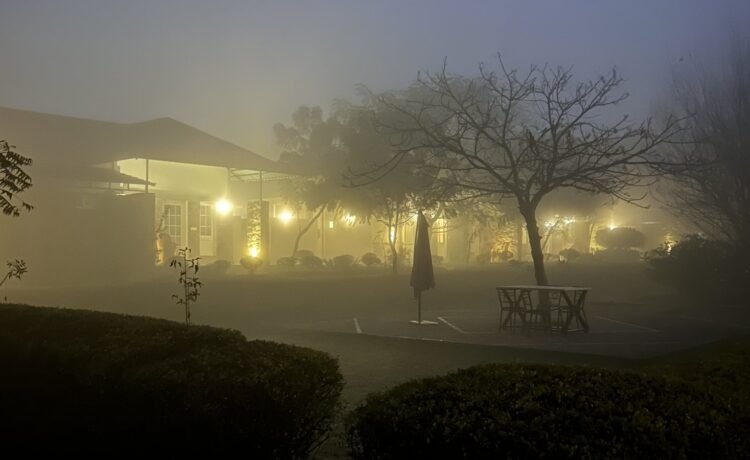
Ask anyone over fifty and you get the same story. They remember sleeping on terraces in summer, counting stars until they drifted off.
Now their grandchildren look up and see maybe six.
So what happened? Nothing happened to the stars, in fact. Instead, something happened to the sky in front of them.
This piece explains why no stars Indian cities light pollution has become such a common search. First, you will learn how skyglow works. Then you will see how fast it is growing.
Also, you will see what it costs beyond astronomy. Finally, you will learn where the stars still are.
The Stars Did Not Go Anywhere
Start with the obvious correction. Every star your grandparents saw is still exactly where it was.
Stars do move, but slowly. So the constellations look effectively identical across a human lifetime.
What changed is the background. Because the sky itself now glows, faint objects have nothing dark to stand against.
Think of a torch in a dark room. Then imagine the same torch at noon.
The torch has not dimmed. Instead, the room got brighter than the torch.
That is precisely what happened to the night sky above Indian cities. So the contrast collapsed, and the faint stars vanished into it.
Only the brightest survive. Sirius, Jupiter, the moon and a handful of others still punch through.
So the sky is not empty. Instead, it is drowned out.
Also, the change crept up slowly. Because each new light added only a little, nobody marked the year the stars went.
Q: So the stars are still there behind the glow?
A: Yes, all of them. Because nothing physically blocks them, they are simply outshone. So the moment you reach a dark site, they all reappear at once.
How Skyglow Actually Works
Light pollution is not one problem. It is three, and they behave differently.
Glare is bright light shining straight into your eyes and spoiling your vision. Light trespass is light spilling where it was never wanted, like a floodlight into a bedroom.
Skyglow is the one that kills stargazing. It is the brightening of the night sky from human light scattered in the atmosphere (Source: US National Park Service, 2026 — Light Pollution).
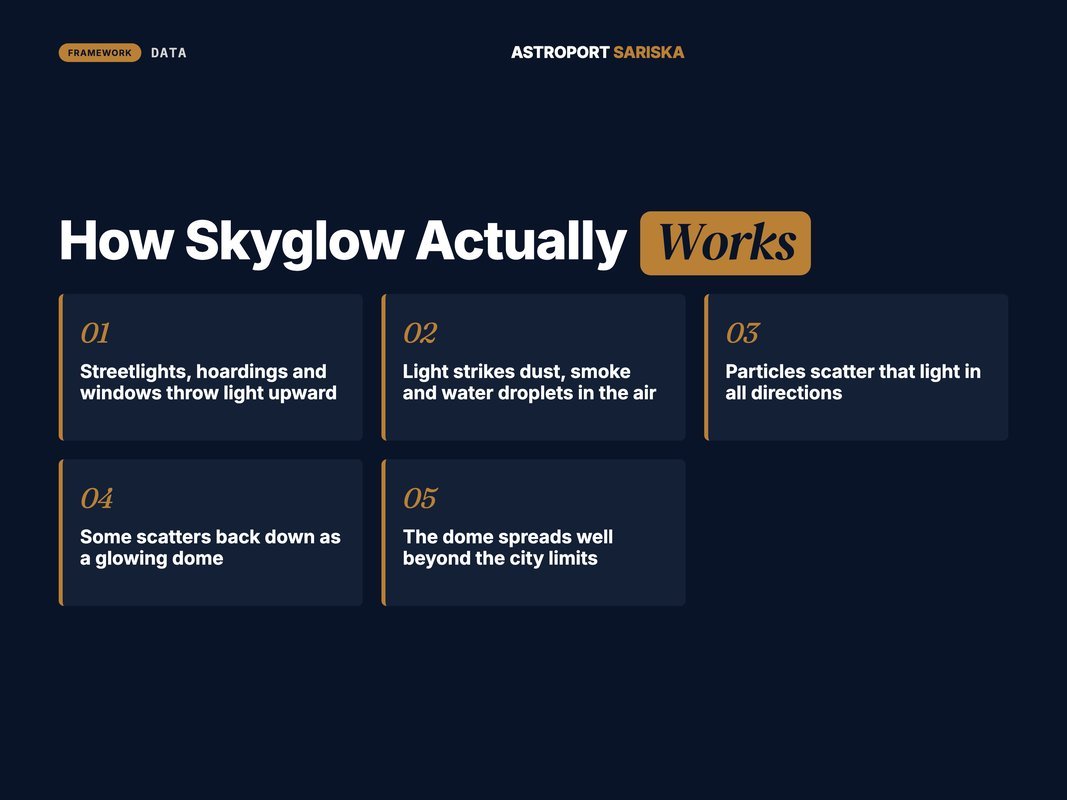
The mechanism is simple. Streetlights, hoardings, parking lots and windows all throw some light upward.
That light then hits dust, smoke and water droplets. Because those particles scatter it in all directions, some comes straight back down.
So you end up standing under a glowing lid. And crucially, that lid does not stop at the city limits.
Then the lid moves with the air. So a dusty week makes it worse. Meanwhile, a windy night thins it out.
City glow has been documented more than 200 miles from its source (Source: US National Park Service, 2026 — Light Pollution).
Cloud makes it far worse rather than better. Because clouds bounce that upward light straight back down, a city sky can brighten by up to 1,000 times on an overcast night (Source: US National Park Service, 2026 — Light Pollution).
Q: Why does Delhi’s sky look orange rather than black?
A: Because you are seeing scattered artificial light, not the sky. So the colour comes from the lamps themselves and from the dust suspended above the city.
The Numbers Are Worse Than You Think
This is where it stops being a nostalgia piece.
More than 80 percent of the world’s population now lives under light-polluted skies (Source: Falchi et al., 2016 — World Atlas of Artificial Night Sky Brightness).
More than one-third of humanity can no longer see the Milky Way at all from home (Source: Falchi et al., 2016 — World Atlas of Artificial Night Sky Brightness).
Also, nearly a quarter of the world’s land surface between 75 degrees north and 60 degrees south now has light-polluted nights (Source: Falchi et al., 2016 — World Atlas of Artificial Night Sky Brightness).
But the growth rate is the genuinely alarming part. The average night sky brightened by about 9.6 percent a year between 2011 and 2022 (Source: US National Park Service, 2026 — Light Pollution).
At that pace the sky doubles in brightness every eight years (Source: US National Park Service, 2026 — Light Pollution).
Meanwhile, the area of Earth under artificial light grew by 2.2 percent a year from 2012 to 2016 (Source: US National Park Service, 2026 — Light Pollution).
So think about what doubling every eight years means for a child. A sky with 200 visible stars at their birth might show a fraction by the time they leave school.
Yet nobody notices in real time. Because the shift is gradual, each year looks like the last.
Still, the graphs are clear. So the trend is steep, and it is not slowing.
Q: Is India worse than the global average?
A: Rapidly urbanising regions tend to brighten faster than settled ones. Because Indian cities have expanded quickly, their glow has grown with them. Still, the global figures above apply everywhere.
What We Lose Along With the Stars
It is tempting to file this under hobbyist complaints. But the effects run wider.
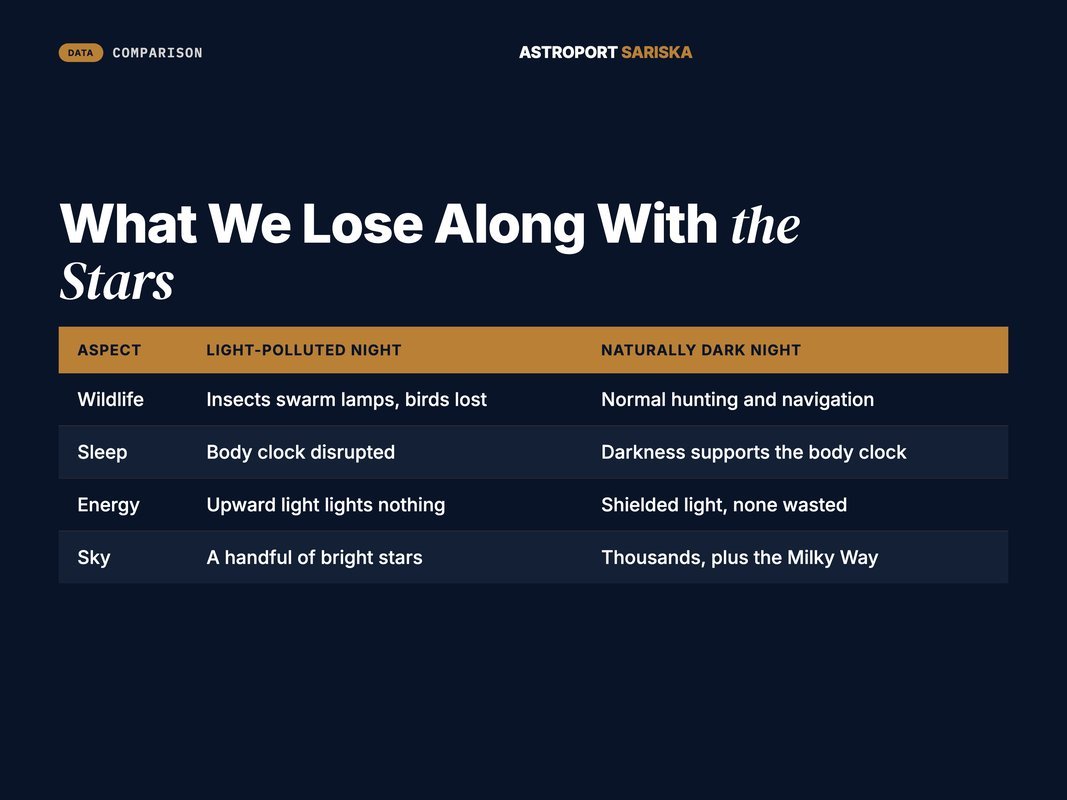
Wildlife pays first. Nocturnal animals navigate, hunt and breed by natural light cues. So artificial light at night scrambles those signals.
Insects gather and die at lamps. Meanwhile, migrating birds get disoriented by lit skylines.
Human sleep suffers. Light at night disrupts circadian rhythms, the internal clock that governs sleep and recovery (Source: US National Park Service, 2026 — Light Pollution).
Energy gets wasted. Any light travelling upward is lighting nothing. So it is money and power spent on illuminating the sky.
Astronomy loses ground. Observatories that once sat in darkness now fight encroaching glow (Source: EarthSky, 2026 — Light pollution is impacting astronomy around the globe).
And something harder to measure goes too. Every culture built stories, calendars and navigation on that sky.
So a generation growing up without it loses a shared reference point. That is not sentimentality. Instead, it is a genuine gap in common experience.
Q: Does light at night really affect sleep that much?
A: It affects the body clock that governs sleep, yes. Because our systems evolved with dark nights, artificial light sends confusing signals. So darker bedrooms and warmer evening lighting both help.
The Unusual Good News
Here is what makes light pollution different from almost every other kind.
It is instantly reversible. So there is no cleanup, no decades of recovery, no residue.
Switch a badly aimed light off and the sky above it improves that second. Shield it properly and you keep the light you need while losing the waste.
Four changes do most of the work.
-
Point light down. First, use shielded fixtures so nothing escapes upward. Because this alone removes most skyglow, it matters more than anything else.
-
Use only what you need. Then dial brightness back to the task. Over-lighting is extremely common.
-
Go warmer in colour. Also, warm-toned lamps scatter less in the atmosphere than cold blue-white ones.
-
Add timers and sensors. Finally, light that switches itself off after midnight costs nothing to run.

None of this means dark streets. Instead, it means light that lands where people actually walk.
Cities elsewhere have done it and kept their lighting standards. So it is a design problem, not a sacrifice.
Plus, it saves money. Because you stop paying to light the sky, bills drop.
Then the wins stack up. Safer streets, lower costs, and more stars.
Q: Would better street lighting make cities less safe?
A: Well-shielded lighting usually improves visibility rather than reducing it. Because glare from bare bulbs creates deep shadows, aiming light down often helps. So the goal is better lighting, not less of it.
Where the Stars Still Are
Change takes time. Meanwhile, the sky is still out there if you travel to it.
Here is roughly what different distances from a large Indian city give you.
| Where you stand | What you can see | Milky Way |
|---|---|---|
| City centre | A handful of bright stars and planets | Never |
| Outer suburbs | Slightly more, still a bright dome | No |
| Rural, two hours out | Constellations become recognisable | Rarely |
| Dark hills, four hours out | Thousands of stars, black horizons | Yes, clearly |
The jump at the end is not gradual. So people are genuinely startled the first time they reach a properly dark site.
Terrain helps as much as distance. Because low hills block glow from towns beyond them, a valley or ridge site outperforms open plains.
That is why the Aravallis work so well for the NCR. You get distance, a ridge line and very little development in between.
Getting Your Own Sky Back
You do not have to wait for policy. So a few habits recover a surprising amount at home.
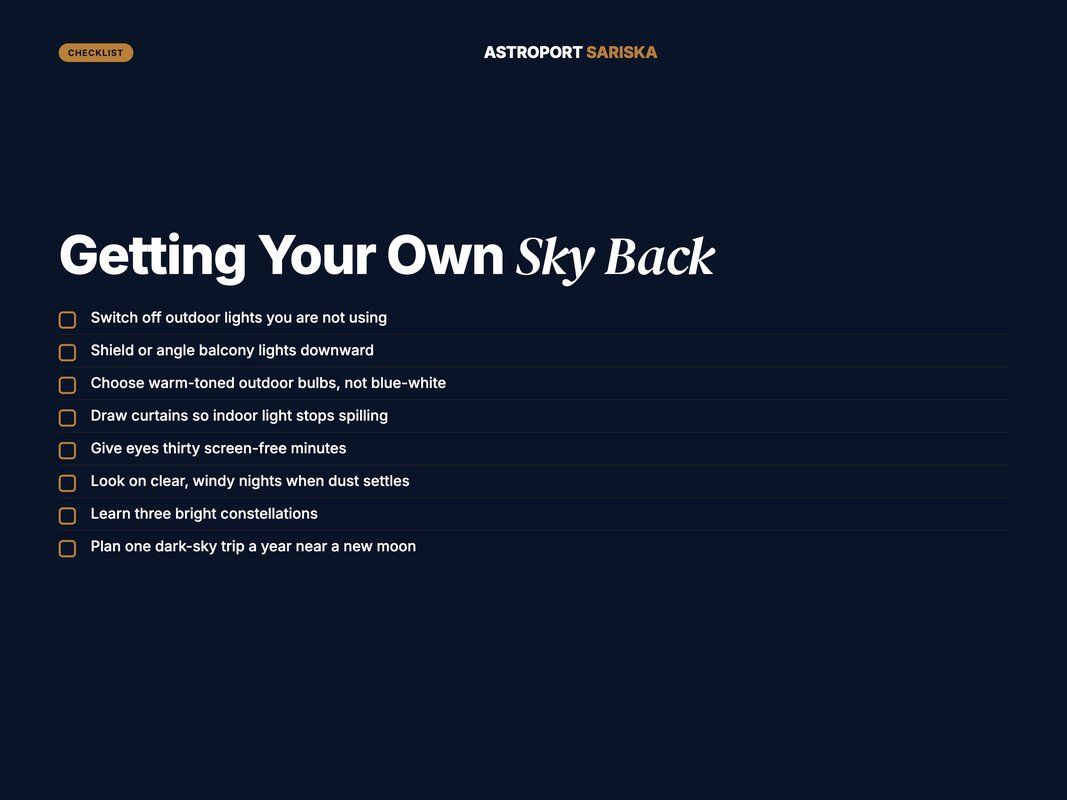
- Switch off any outdoor light you are not actively using
- Shield or angle a balcony light so it points downward
- Choose warm-toned bulbs over cold blue-white ones outdoors
- Draw curtains so indoor light stops spilling out
- Give your eyes thirty screen-free minutes before judging any sky
- Look on the clearest, windiest nights, when dust settles
- Learn three bright constellations, so you notice changes
- Plan one dark-sky trip a year, ideally near a new moon
None of that returns the Milky Way to your terrace. Still, it makes your own patch measurably better.
Q: How long until my eyes see the difference?
A: Give them twenty to thirty minutes with no screens (Source: NASA, 2026 — How to Find Good Places to Stargaze). So most people underestimate this and give up far too early.
Why Astroport Sariska
Reading about a dark sky is not the same as standing under one. So the fastest cure for the city sky is a night away from it.
Astroport Sariska is India’s first astronomy resort. It sits at Tehla in the Aravalli hills, beside the Sariska Tiger Reserve in Alwar, Rajasthan.
The drive is about four to five hours from Delhi NCR. So it clears the region’s glow properly, which is the entire point.
The resort describes its location as one of the darkest skies in India. In practice, guests see thousands of stars on a clear night. Meanwhile, central Delhi offers a couple of dozen.
That contrast is the lesson. Because you experience both skies within a day, the scale of what cities have lost becomes obvious.
You also get expert company. Resident astronomers run the sessions with professional telescopes. Also, there are constellation tours, astrophotography sessions and safe solar observation by day.
The property practises what the subject preaches. It runs entirely on solar power, operates as a no-plastic zone, and has planted thousands of trees.
One timing note. Astronomy activities pause each year from 1 June to 15 August during the monsoon. So plan outside that window. Plan your stay on a moonless week.
Conclusion
So nothing is wrong with the stars. Something is wrong with the sky we put in front of them.
Skyglow now covers most of the populated world. More than a third of us cannot see the Milky Way from home.
And it is accelerating, doubling roughly every eight years. So the sky your children inherit will be dimmer again.
But this pollution is unusual. Because it disappears the instant the light is shielded or switched off, the fix is immediate.
Until cities act, the sky is a drive away. So go and see it once, properly. Plan a dark-sky night and find out what you have been missing.
FAQ
Q: Why can’t I see stars in Indian cities anymore?
A: Because artificial light scattered in the air has made the sky itself brighter than most stars. The stars have not changed or moved. Your sky background has simply been lifted until only the brightest objects can compete with it.
Q: What is skyglow?
A: Skyglow is the brightening of the night sky caused by human light scattering off dust and moisture in the atmosphere. It is why cities sit under an orange or grey dome at night. It spreads far beyond the city that produces it.
Q: How fast is light pollution getting worse?
A: The average night sky has been brightening by about 9.6 percent a year. At that rate the sky doubles in brightness roughly every eight years. A child born today would see far fewer stars by the time they finish school.
Q: How many people cannot see the Milky Way?
A: More than one-third of humanity cannot see the Milky Way from where they live. More than 80 percent of the world’s population lives under light-polluted skies. Those figures come from the World Atlas of Artificial Night Sky Brightness.
Q: Does light pollution harm anything besides astronomy?
A: Yes. Artificial light at night disrupts circadian rhythms in people and disturbs the behaviour of nocturnal wildlife, from insects to birds. It also wastes a large amount of energy by sending light upward where nobody needs it.
Q: Can light pollution be reversed?
A: Yes, and unusually quickly. Unlike most pollution, light stops the moment you switch it off or shield it. Better fixtures that point downward, warmer colour temperatures and timers all deliver immediate results.
Q: Where can I still see a proper starry sky near Delhi?
A: You need to leave the NCR skyglow dome behind, which usually means several hours of driving. The Aravalli hills southwest of Delhi, around Sariska in Alwar, are among the closest genuinely dark skies. Thousands of stars are visible there on a clear night.