
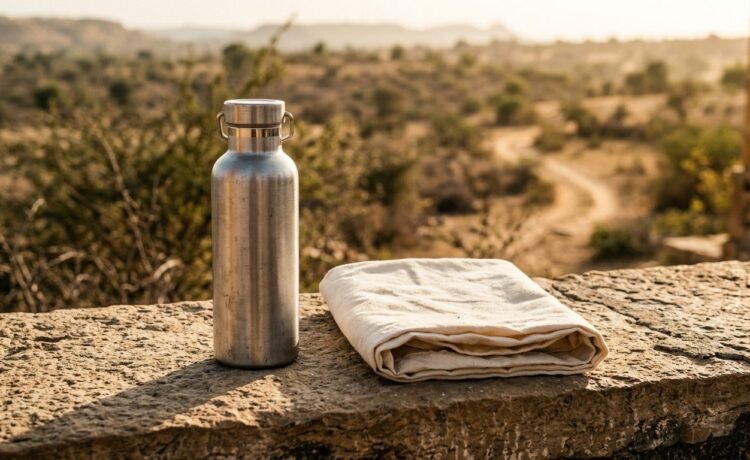
Empty the car after a weekend trip. Count what comes out.
Usually it is bottles. Then wrappers, a few carry bags, and some cups.
None of it felt like a decision at the time. That is the whole problem, and it is also the opening.
This guide covers plastic free travel India habits that survive contact with a real trip. There are nine of them. Also, none require you to be difficult at a counter.
Why Travel Plastic Adds Up Faster
At home, you have systems. There is a filter, a dustbin that gets segregated, and a shelf of containers.
On the road, all of that disappears. So you buy small, buy often, and throw away constantly.
Distance makes it worse. Much of rural India has no waste pick-up at all. So a wrapper dropped near a forest stays there.
India does have rules for this. Plastic waste and named single-use items fall under national rules (Source: Central Pollution Control Board, 2026 — Plastic Waste Management). Policy sits with the environment ministry (Source: Ministry of Environment, Forest and Climate Change, 2026 — MoEFCC).
Still, enforcement varies. So the traveller’s habits end up mattering.
Q: Am I really the problem here, compared to industry?
A: No, and that framing traps people. Still, travel waste lands in places with no system to absorb it. So a small personal change has an outsized local effect.

The Nine Habits
These are ordered by impact. So if you only adopt three, take the first three.
1. Carry One Refillable Bottle Each
This is the big one. Plastic bottles are the biggest item in most travel waste.
Take a steel bottle per person. Then ask at check-in where you can refill it.
Most resorts and many hotels have filtered water. Also, staff are usually happy to fill it if you ask.
Also, steel works better than plastic here. It keeps water cool, and it survives being dropped.
So take one spare bottle for the car too. Then nobody buys one at a fuel stop.
2. Pack Snacks From Home
Road-trip snacks are where wrappers pile up. So pre-pack what you can in a tin or a cloth bag.
Nuts, fruit, homemade namkeen and biscuits travel well. Then you skip most highway stops.
Still, use a tin rather than a bag. A tin keeps food whole, and you can reuse it all trip.
In fact, fruit is the easy win. It needs no wrapper at all, and the peel is not waste in the same way.
3. Keep a Cloth Bag in the Car
You will buy something unplanned. That is fine.
Keep a folded cloth bag in the car. Then the carry-bag question never comes up.

4. Bring Your Own Toiletries
Small hotel bottles get used once and binned, often half full. So bring your own soap and shampoo.
Solid bars work even better, because they cannot leak and need no bottle at all.
Then tell the staff you do not need them replaced. That is the step that cuts restocking.
5. Refuse the Straw and the Cutlery Before It Arrives
Timing is everything here. Say it when you order, not when it lands.
“No straw, no cutlery” at the point of ordering works. The same words afterwards just create waste you did not use.
6. Carry Your Waste Out
Keep one small bag in the car for what you use. Then bin it where waste is sorted.
This matters most in and around protected areas. A bin at a forest edge is often emptied nowhere.
Meanwhile, animals get into open bins too. So a dropped wrapper can end up inside a deer or a monkey.
So keep the bag closed and out of sight. Then empty it in a town, where waste is actually collected.

7. Choose Stays That Have Already Done the Work
Some stays have taken plastic out of the room before you arrive. Glass bottles. Big pump packs. No wrapped slippers.
So your effort drops to nothing. Ask before you book. It is a fair question, and the answer tells you a lot.
8. Skip the Daily Linen Change
Not plastic, but the same idea. A daily wash uses water and power for no real gain on a two-night stay.
Then hang the towel up and say so at check-in.
9. Leave the Place Emptier Than You Found It
Pick up one or two pieces of litter on a walk. That is the whole habit.
Also, take a bag for it. Then it is easy, and you are not carrying wet rubbish in your hand.
Then do it once a day. Over a weekend that is a handful of items, from a place that has no other system.
Also, it changes how you walk. Because you are looking down for litter, you notice tracks, scat and birds you would have missed.
So the habit gives something back. That is usually why people keep it up.
It sounds token. Still, in places with no collection, it is the only mechanism that exists.
What to Pack: The Short List
You can set this up once and forget it. So keep a small kit in the car boot.
- A steel bottle for each person
- One tin for snacks
- Two cloth bags, folded flat
- A bar of soap in a tin
- One spare bag for waste
- A small torch with a red mode
So that is the whole kit. Still, it fits in a shoe box.
Then leave it in the car. The point is that you never have to remember it again.
The One Thing to Buy First
First, buy the bottles. Nothing else comes close on impact.
A family of four gets through a lot of plastic on a weekend. One steel bottle each wipes out most of it.
What a Two-Day Trip Looks Like
Here is how it plays out in practice.
- Before you leave. Fill the bottles at home. Pack the snack tin.
- On the drive. Use the tin, not the shops. Keep the waste bag in the door.
- At check-in. Ask where you can refill. Say no to a daily linen change.
- In the room. Use your own soap. Leave the small bottles shut.
- When you eat out. Say no straw when you order, not after.
- On a walk. Pick up one or two bits of litter.
- When you leave. Take your waste bag with you.
Seven steps, and most take seconds. None of them need you to argue with anyone.
When It Gets Hard
Some of this does not work every time. So it helps to know where it breaks.
Street food is the main one. Much of it comes in plastic, and refusing it means not eating.
Instead, take the food. Then keep the waste and bin it well. That is a better trade than going hungry or being rude.
Markets are similar. Loose produce often comes wrapped anyway, so bring your own bag and ask for it unwrapped.
Sometimes that works. Other times it does not, and that is fine too.
Also, airports are their own problem. Security makes you empty a bottle, so fill it again on the far side rather than buying one.
Then water is the other one. Where you cannot refill safely, buy the big bottle rather than six small ones.
Also, do not turn this into a rule you enforce on other people. It works best when nobody notices you doing it.
Then there is the group problem. One person in a car of five cannot control what everybody buys.
So start with what you carry. Because a spare bottle offered to someone else does more than a lecture does.
Finally, expect to slip. Nobody gets a clean trip, and treating it as pass or fail is how people quit.
In fact, a half-done version still removes most of the waste. Therefore the habit is worth keeping even when it is patchy.
Q: What if the hotel only has plastic bottles in the room?
A: Ask at reception for a refill point. Most places have one, even when the room does not show it.
Quick Facts
- Plastic waste and identified single-use items are regulated nationally under India’s plastic waste rules (Source: Central Pollution Control Board, 2026 — Plastic Waste Management).
- Environmental policy and pollution control sit with India’s environment ministry (Source: Ministry of Environment, Forest and Climate Change, 2026 — MoEFCC).
- India’s tourism strategy prioritises responsible, experience-led travel (Source: Ministry of Tourism, Government of India, 2026 — Ministry of Tourism).
- Artificial light at night disrupts wildlife behaviour, so low-impact travel includes light as well as litter (Source: US National Park Service, 2026 — Night Skies).
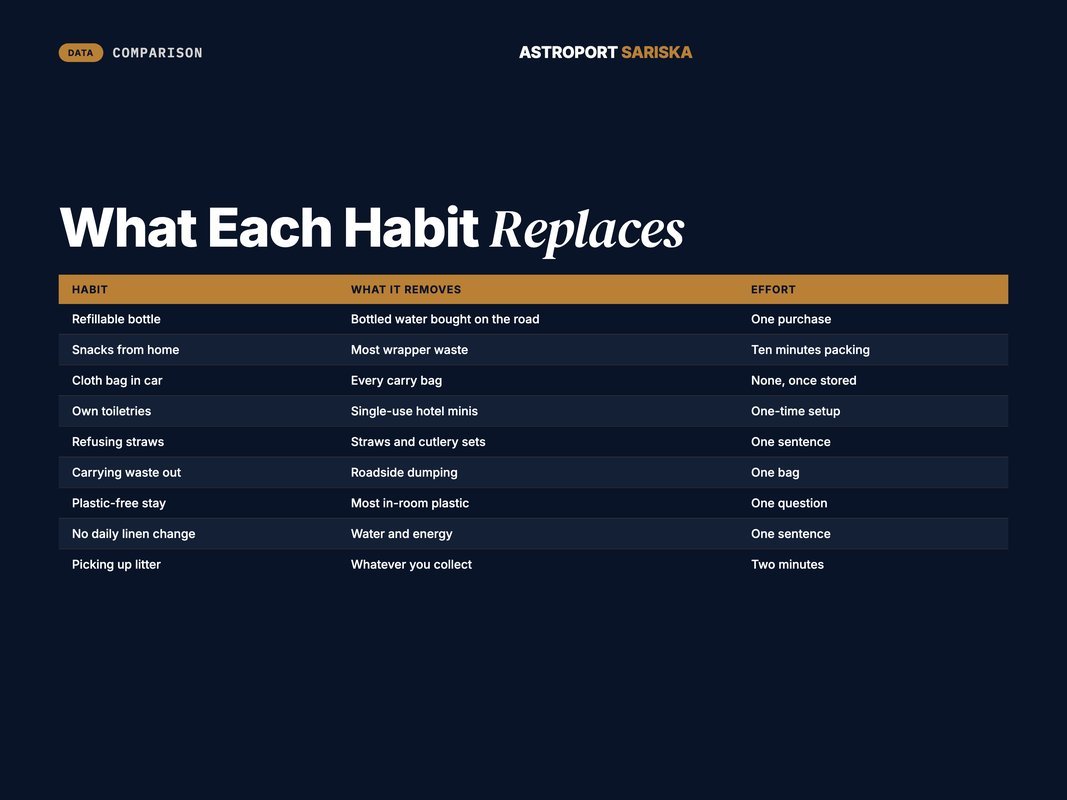
What Each Habit Replaces
It helps to see the swap directly.
| Habit | What it removes | Effort |
|---|---|---|
| Refillable bottle | Bottled water bought on the road | One purchase |
| Snacks from home | Most wrapper waste | Ten minutes packing |
| Cloth bag in car | Every carry bag | None, once stored |
| Own toiletries | Single-use hotel minis | One-time setup |
| Refusing straws | Straws and cutlery sets | One sentence |
| Carrying waste out | Roadside dumping | One bag |
| Plastic-free stay | Most in-room plastic | One question |
| No daily linen change | Water and energy | One sentence |
| Picking up litter | Whatever you collect | Two minutes |
Look at the effort column. Most of these are single decisions, not ongoing discipline.
That is deliberate. Habits that need willpower on day two do not survive a trip.
The Light You Bring Matters Too
Low-impact travel is usually framed as litter. Still, there is a second kind of footprint in rural India.
Light. Artificial light at night changes how wildlife feeds, migrates and breeds (Source: US National Park Service, 2026 — Night Skies).
So in a dark-sky area, a few habits help. Keep torches pointed down. Use red light where possible, because it preserves night vision and disturbs less.
Then turn off what you are not using. A cottage with every light on is visible for a long way across open scrub.
Also, it ruins the sky for everyone else. If you drove four hours to see stars, that is a self-inflicted problem.

How Astroport Sariska Handles It
Astroport Sariska removed a lot of this before guests arrive. The property runs entirely on solar power, in Village Roopwaas near Sariska Tiger Reserve, Alwar.
Food comes from the organic farm on site. So meals involve very little packaging, and produce does not travel wrapped.
Waste is handled on the property rather than trucked out, with organic waste going to a biogas plant. Rainwater is harvested instead of bought in.
Outdoor lighting is kept low and pointed downwards. That is partly conservation and partly practical, because the resort exists to show people a dark sky.
The result is that the guest habits above get easier. There is filtered water for refills and little in-room plastic to refuse.
Want the fuller picture of how that feels? Our piece on off-grid solar resort living covers it.
The Short Version
Start with the bottle. Then add snacks from home and a cloth bag in the car.
Those three cover most of what you would otherwise throw away. The remaining six are refinements, and they cost almost nothing once set up.
Also, choose stays that have already removed the plastic. Because the easiest habit is the one somebody else has already built for you.
Planning a low-impact weekend near Delhi NCR? Plan your stay at Astroport Sariska and travel a little lighter.
FAQ
The Basics
Q: Is plastic-free travel actually realistic in India?
A: Fully plastic-free is hard. Much lower is easy. Most travel plastic comes from a small set of repeat items, like water bottles and snack wrappers. Replace those and you remove the bulk of it.
Q: What is the single biggest plastic item to cut on a trip?
A: The disposable water bottle. On a two-day road trip a family can easily get through a dozen. One refillable bottle each removes almost all of that in a single decision.
Water and Waste
Q: Is bottled water necessary for safe drinking water while travelling?
A: Not always. Many resorts and hotels provide filtered drinking water for refills. Ask at check-in. Where you are unsure, a small filter bottle or purification tablets solve it without disposable plastic.
Q: What should I do with waste I create on the road?
A: Carry it out. Keep a small bag in your vehicle for wrappers and bottles, then dispose of it where segregation exists. Rural areas often have no collection, so roadside bins are not a solution.
Stays and Rules
Q: Does refusing hotel toiletries actually make a difference?
A: Yes, in aggregate. Small bottles are used once and discarded, often half full. Carrying your own means a property restocks fewer of them, which is the part that adds up across a year.
Q: Are single-use plastics regulated in India?
A: Yes. India regulates plastic waste and identified single-use plastic items under national rules administered by the Central Pollution Control Board. Enforcement varies by state, so travellers still encounter them.