

You drive four hours. You check in, eat, and wait for dark.
Then a cloud bank rolls in at nine, and that is your trip.
It happens more often than anyone admits. So the question of how many nights stargazing trip planning needs is really a question about risk.
This guide answers it properly. First, you will get the short version. Then you will see what one night actually delivers.
Also, you will see what the second night adds. Finally, you will learn when one night genuinely is enough.
The Honest Answer
Two nights, if you can manage it.
That is not an upsell. It is about how the sky behaves and how people learn.
One night gives you one chance at clear weather. So a single cloudy evening ends the whole trip.
Two nights give you two chances. Because weather shifts overnight, a washed-out Friday often becomes a clear Saturday.
There is a second reason, and it surprises people. Night one is mostly spent learning how to look.
You arrive tired. Your eyes take half an hour to adjust. Meanwhile, you are still working out what the telescope is showing you.
By night two, all of that is done. So the second night is usually the better one.
Q: Is the second night really that different?
A: Yes, noticeably. Because you already know the sky’s layout and your eyes adapt faster, you start ahead. So most people stay out much longer on night two.
What One Night Actually Gets You
Here is the realistic shape of a single-night trip.
-
You leave home in the morning. First, the drive takes most of the day. Because Astroport Sariska is about four to five hours from Delhi NCR, an early start matters.
-
You arrive mid-afternoon. Then you check in, unpack and eat something.
-
You lose an hour to twilight. Meanwhile, the sky takes well over an hour after sunset to go fully dark.
-
Your eyes need thirty minutes. So even once it is dark, you cannot see faint objects yet (Source: NASA, 2026 — How to Find Good Places to Stargaze).
-
You get a good two-hour session. Then the sky is properly dark and everything works.
-
You drive home the next morning. Finally, the return trip eats the second day.
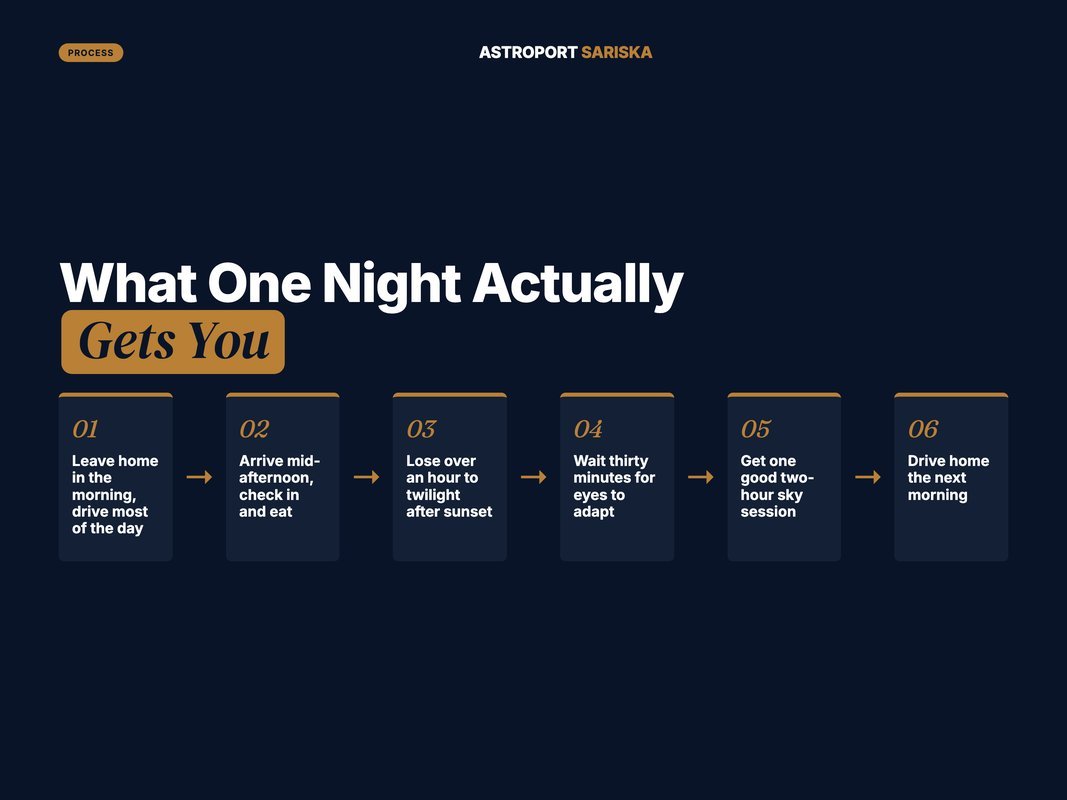
So a one-night trip is really one two-hour window. That is the whole thing.
If it is clear, it is genuinely wonderful. But there is no margin at all.
Think of it as a single roll. There is no second throw.
Also, the drive tires you out. So you reach the good hour already flagging.
None of that ruins the trip. Still, it explains why so many people leave feeling short-changed.
Q: Can I not just arrive late and go straight out?
A: You can, and many people do. Still, a late arrival costs you the first hour. Because you are unpacking under bright lights, your night vision starts from scratch.
What the Second Night Adds
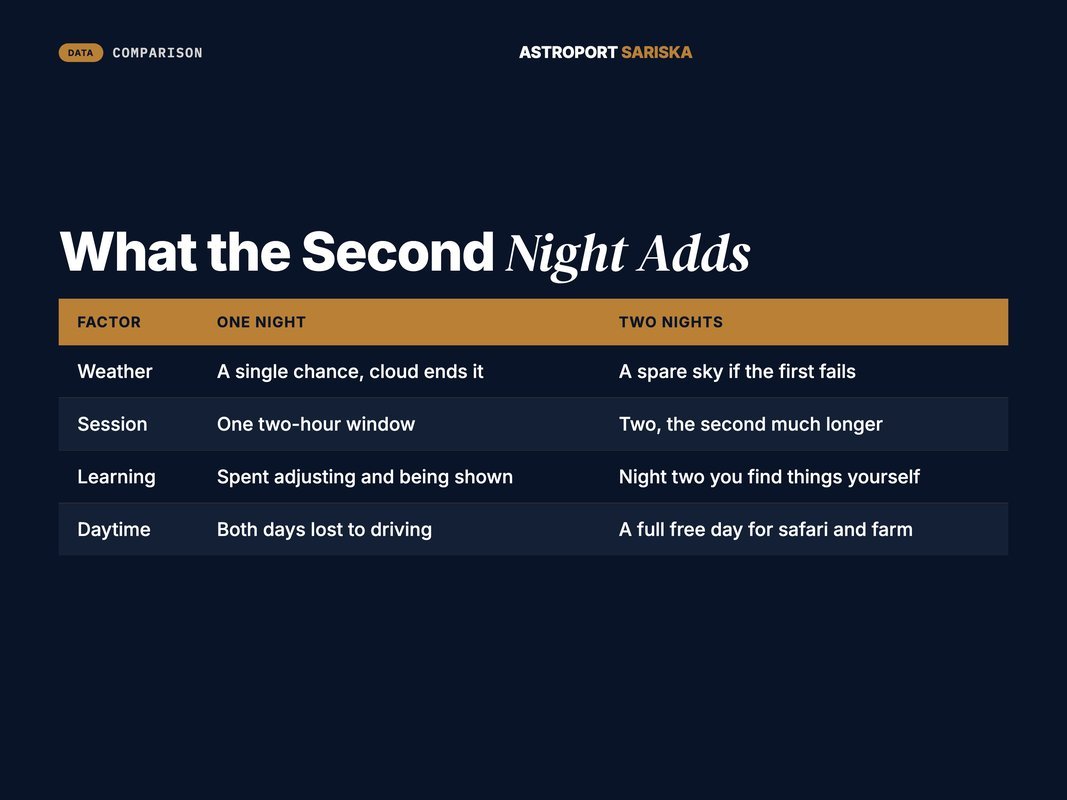
The second night is not simply more of the same. It changes the trip in four ways.
One: a second roll of the weather dice. Cloud is the main reason trips fail. So a spare night is the only real defence.
Two: a faster start. Because your eyes and your bearings are already trained, you skip most of the warm-up.
Three: proper daytime. With only one night you spend both days driving. Meanwhile, a two-night stay gives you a full free day.
That day is not filler here. For example, there are jeep safaris into Sariska, farm walks, birdwatching and a spa.
Four: you actually rest. So you come home rested rather than wrung out.
There is a quieter benefit too. On night two, people stop asking what they are looking at and start finding things.
So that shift, from being shown to seeing, is really what the trip is for.
Night one you follow a pointer. Night two you spot things first.
Then you start asking better questions. Because you know the layout, the answers land.
Children show this fastest. On the second night they run the star map themselves.
Q: Would three nights be better still?
A: For most people, no. Because two nights already covers the weather risk and the learning curve, the third adds less. Still, keen astrophotographers often want it.
When One Night Is Genuinely Enough
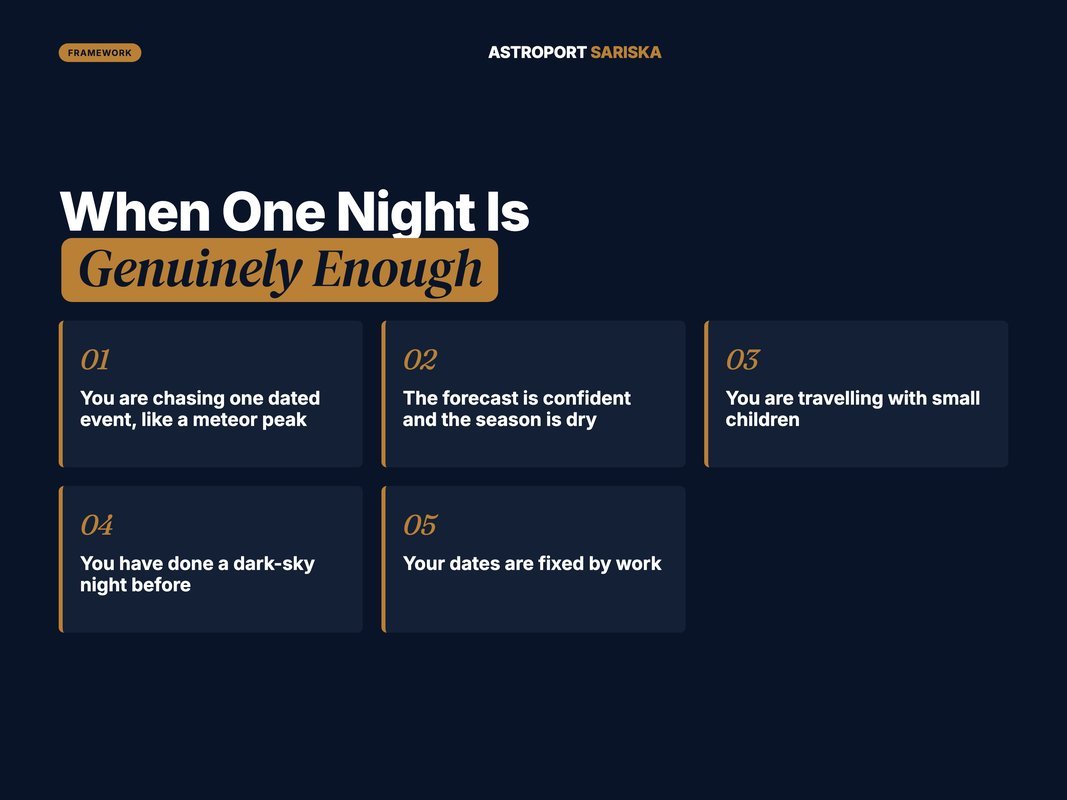
Two nights is the default, not a rule. So here are the cases where one works fine.
You are chasing one dated event. A meteor peak or an eclipse happens on a fixed night. So there is nothing to gain from the night before.
The forecast is confident and the season is dry. In the settled winter months, a clear night is a much safer bet.
You are travelling with small children. Because two late nights is a lot to ask, one is often kinder.
You have done it before. So repeat visitors skip the learning curve and get straight to a good session.
Your dates are fixed by work. A single night under a dark sky still beats none.

In each of those, one night is a sensible choice. So book it without guilt.
Just stack the odds where you can. Pick a dry month and a new moon.
Then arrive early in the day. That single choice buys back the hour you would lose.
Q: What if the one night I book is cloudy?
A: Ask what the resort runs as a backup. Because astronomers usually switch to talks, telescope demos or workshops, the evening is not wasted. Also, thin cloud still allows the moon and bright planets.
Building the Two-Night Itinerary
A two-night stay has a natural rhythm. Here is a shape that works.
| Day | Daytime | Evening |
|---|---|---|
| Day one | Drive from Delhi, arrive mid-afternoon, settle | Early dinner, then the first sky session |
| Day two | Morning safari, farm walk, pool or spa | Longer second session, the best one |
| Day three | Slow breakfast, drive home before dark | — |
Notice the arrival timing. Because you settle in daylight, night one starts properly rather than in a scramble.
Notice also the morning safari on day two. So the wildlife happens when you are already there, without a second drive.
Safaris start early. Because the gates open at dawn, you want to be rested.
That argues against a very late night one. So keep the first session sensible.
Then push late on night two. There is nothing to wake up for.
Then day three is deliberately empty. Because a rushed departure ruins a good trip, an unhurried morning matters.
Q: Should the safari be on day two or day three?
A: Day two, almost always. Because safaris run early, a day-three safari means a very late drive home. So keep the last morning free.
Picking the Right Two Nights
Which nights you choose matters as much as how many. Two calendar checks do most of the work.
Check the moon first. A bright moon washes out faint objects on both nights equally. So aim within about five days of the new moon.
Check the season second. October to March gives clear post-monsoon skies and early darkness in Rajasthan.
There is a hard limit worth knowing. Astronomy activities at Astroport Sariska pause each year from 1 June to 15 August during the monsoon.
If the Milky Way core is your goal, add a third check. The bright core is only up at night from roughly February to October (Source: EarthSky, 2026 — Milky Way season).
So October threads all three needles neatly. Clear air, an early core, and a full activity calendar.
November and December work too. You lose the core, but you gain the sharpest air of the year.
Then January and February stay excellent. So the window is wider than most people assume.
Q: What if my dates cannot move?
A: Book them anyway and adjust the goal. Because a bright moon is itself a superb telescope target, the night still works. So you trade faint galaxies for a spectacular moon.
Your Trip-Length Checklist
Run through this before you book.
- Weather risk considered, since one night means one chance
- Two nights chosen unless a specific reason says otherwise
- Moon phase checked, ideally within five days of new moon
- Season inside the October to March window
- Astronomy availability confirmed, given the June to mid-August pause
- Arrival timed for mid-afternoon, not after dark
- Safari booked for the second morning, not the last
- Departure morning left unhurried
- Warm layers packed, because desert nights turn cold
- Backup plan understood in case of cloud
Also, resist packing the days too tightly. Because the point is rest as much as astronomy, an empty afternoon is not wasted.
One more thing to agree in advance. Decide who is driving home.
Because the last night runs late, a tired driver is a real risk. So share it, or leave after lunch.
Q: What do people regret most?
A: Booking one night. So the common story is a cloudy evening and a four-hour drive home with nothing seen. Because a second night removes that risk, it is the cheapest insurance in the trip.
Why Astroport Sariska
A second night only earns its place if the days are worth staying for. So that is the real test of a venue.
Astroport Sariska is India’s first astronomy resort. It sits at Tehla in the Aravalli hills, beside the Sariska Tiger Reserve in Alwar, Rajasthan.
The drive is about four to five hours from Delhi NCR. So an early start puts you there with the afternoon to spare.
Nights are the draw. Because the site sits far from any city dome, guests see thousands of stars on a clear night. Meanwhile, central Delhi offers a couple of dozen.
Resident astronomers run the sessions with professional telescopes. Also on offer are constellation tours, astrophotography sessions, telescope-making workshops and safe solar observation.
The middle day fills itself. For example, there are jeep safaris into Sariska, nature walks, birdwatching and farm tours.
Food comes largely from the on-site farm, including its own poultry and dairy. There is a pool, the Sparsh Spa, and indoor games for a slow afternoon.
The property also runs fully on solar power and operates as a no-plastic zone. So the second night is a genuine stay rather than padding. Plan your two-night trip near a new moon.
Conclusion
So the short answer is two nights, unless you have a reason not to.
One night is one chance. Because cloud decides more trips than anything else, that is a thin margin after a four-hour drive.
Two nights fix it twice over. You get a spare sky, and you get a second session that starts far ahead of the first.
One night still makes sense sometimes. Fixed events, confident forecasts, small children, or a repeat visit all justify it.
Whichever you choose, the calendar matters more than the count. Pick a new-moon week between October and March, and arrive before dark. Plan your astro trip with a night in hand.
FAQ
Q: How many nights should a stargazing trip be?
A: Two nights is the better default. One night gives you a single shot at clear weather, and cloud on that night ends the trip. A second night doubles your chances and lets you actually rest.
Q: Is one night ever enough for an astro trip?
A: Yes, in dry, settled months when the forecast is confident. It also works with young children, who rarely last two late nights. It also works if you are chasing one specific event, like a meteor peak.
Q: What do you actually miss by only staying one night?
A: Mostly the second half of the learning curve. On night one you spend the first hour adjusting and working out how to look. Night two is when people find objects themselves and stay out much longer.
Q: Should I arrive the day before the event I want to see?
A: Ideally yes. Arriving in daylight means you settle before dark and keep your night vision intact. A late arrival costs you the first hour. That hour is often the difference between a good night and an average one.
Q: Does the moon phase change how long I should stay?
A: It changes which nights are worth staying for. Near a full moon, faint objects are washed out whatever you do. Around a new moon, a second night is far more valuable because both nights can deliver.
Q: When is the best season for a two-night astro trip in Rajasthan?
A: October to March gives clear post-monsoon skies, early darkness and comfortable evenings. Astronomy activities at Astroport Sariska pause from 1 June to 15 August each year, so avoid that window.
Q: Is a two-night trip worth it if only one night is clear?
A: That is exactly the case for booking two. You get one good sky instead of none, and the daytime is filled with safaris, farm walks and the spa. The second night is insurance rather than a repeat.