
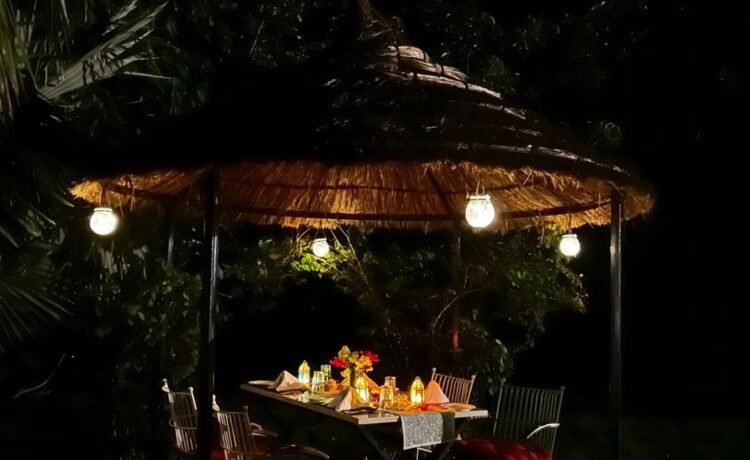
You have booked the Gurugram hotel three times now. Same ballroom, same projector, same lukewarm buffet.
Then everyone drifts to their phones by 4 p.m.
So here is a different proposal for a corporate offsite near Delhi unique enough to be remembered. Take the team somewhere with no city glow, and hand them a telescope.
This guide covers how that actually works. First, you will see why the usual offsites stall.
Then you will get the agenda, the venue numbers and the activities. Also, you will learn how to pick your dates. Finally, you will know what to brief the team.
Why the Usual Offsite Stops Working
The problem is rarely the agenda. Instead, it is the setting.
A hotel ballroom is the same room your team already works in. So the brain treats it as work, and acts that way.
Hierarchies travel with you. Because the room looks like a meeting, people sit and speak in the order they always do.
Novelty is what breaks that pattern. When nobody is an expert, the usual pecking order loses its grip.
Think about who speaks first in your meetings. Then think about why.
It is rarely the best idea. Instead, it is the rank in the room.
So change the room. Take away the desk, the screen and the clock.
Then watch who starts to talk. Often it is not who you would guess.
That is the real mechanism behind a good offsite. So the aim is a shared, slightly strange day out, not a better slide deck.
Stargazing does this very well. Because almost nobody on the team has done it properly, everyone starts level.
It also has a rare quality for group activities. So it is really quiet, and quiet is where conversations actually happen.
Q: Isn’t this just an activity, like go-karting?
A: Not quite. Because go-karting is competitive and loud, it reinforces the loudest voices. Meanwhile, a dark sky slows everyone down. So the conversations afterwards tend to be the useful part.
What a Stars-Led Offsite Actually Looks Like
Here is a workable two-day shape. Most teams adapt it, but the skeleton holds.
-
Depart after breakfast. First, leave Delhi in the morning so the drive is done in daylight. Because it is roughly four to five hours, an afternoon arrival is comfortable.
-
Check in and run the working session. Then hold your meeting in the afternoon, while the light is good.
-
Break for the farm or the pool. Meanwhile, an hour outdoors resets everyone before the evening.
-
Dinner outdoors, early. So eat before full darkness, rather than after it.
-
Astronomy session after twilight. Next, the telescopes come out once the sky is really dark.
-
Campfire and open conversation. Finally, the free hour after the session is usually where the value lands.
-
Morning safari, then home. So a jeep safari into Sariska sends people back with a second story.
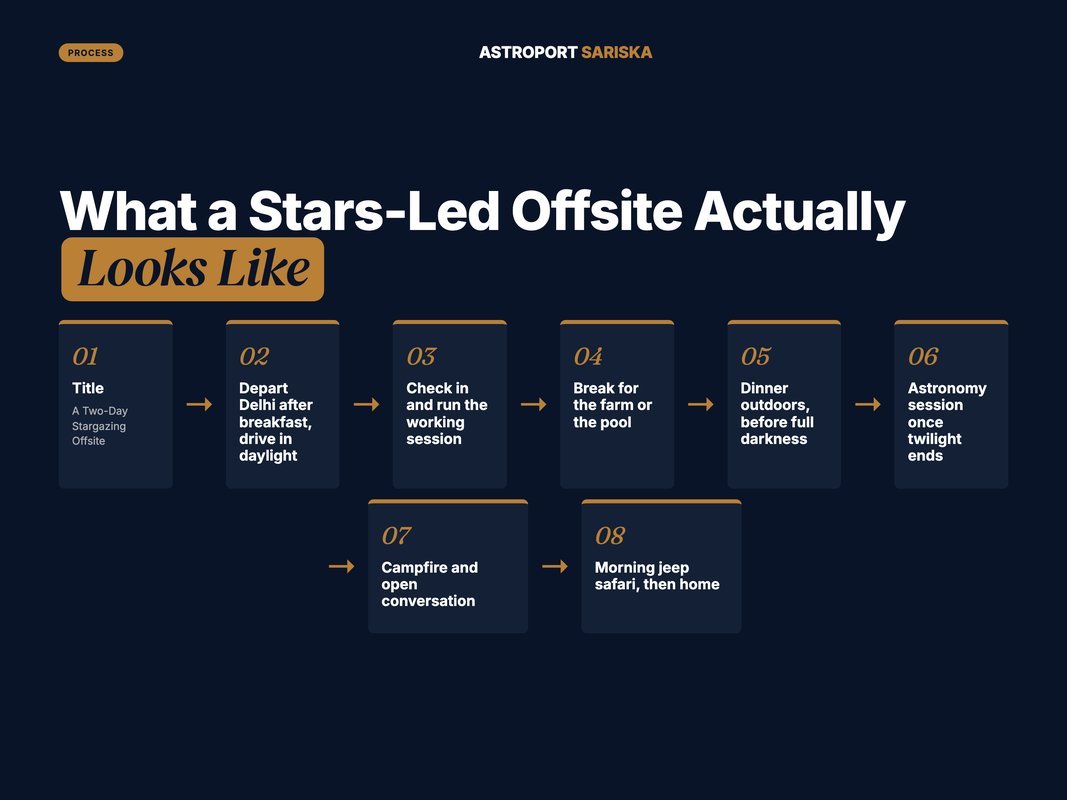
Notice what is missing. There is no evening ballroom session, because the sky is the evening session.
That saves you a slot. So the day stays light and the night stays free.
Also, no one dreads it. Because it is not a talk, no one has to prep.
Q: Can we fit real work into this?
A: Comfortably, if you keep it to the afternoon. So most teams run one focused working block in daylight. Then the evening does the team-building without a workshop host.
The Venue Numbers a Manager Needs
Vibes do not survive a budget sign-off. So here are the concrete details.
| What you need to know | The detail |
|---|---|
| Drive time from Delhi NCR | About four to five hours by road |
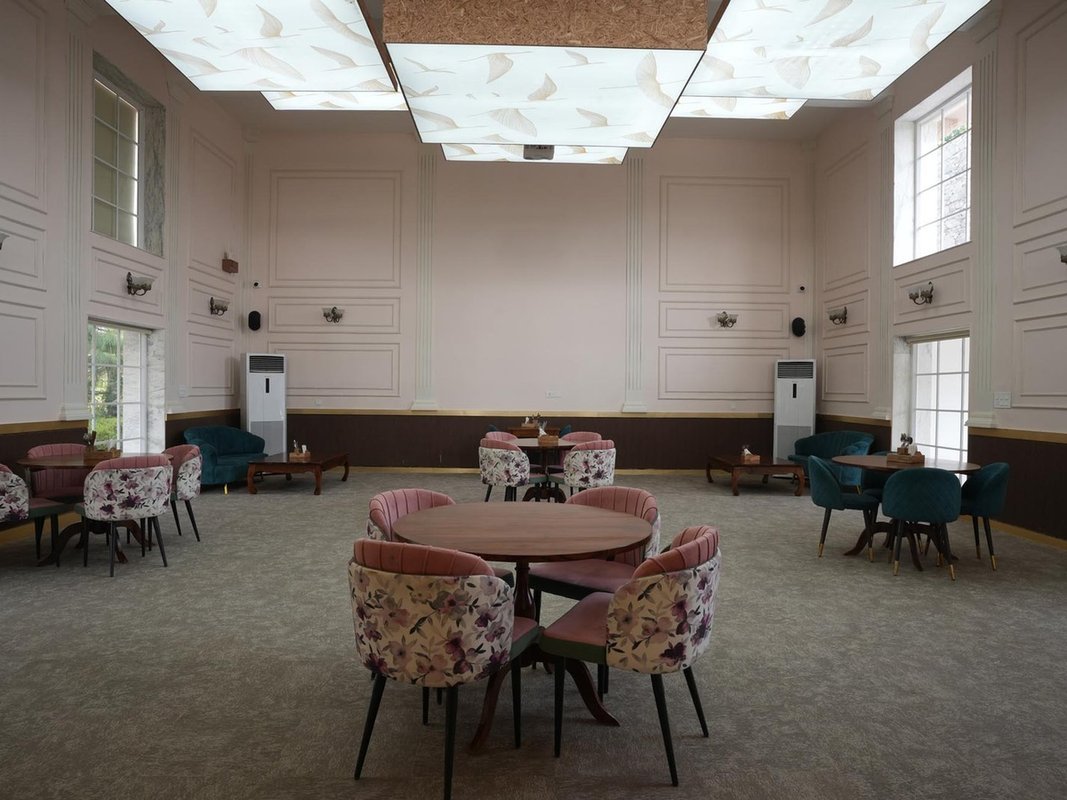
| Conference hall size | Lounge and conference hall of 1,200 square feet |
| Boardroom capacity | Up to 30 people |
| Classroom capacity | Up to 60 people, without tables |
| Room types | Luxury, wildlife, signature and family cottages |
| Largest cottage | Family cottage of 750 square feet, sleeping six to eight |
| Dining | Orbit Restaurant, private dining, jungle dining and hi-tea |
| On-site recreation | Pool, spa, billiards, table games, cricket and badminton |
(Source: Astroport Sariska, 2026 — Corporates and Group Events)
Those limits set the natural ceiling. Because the boardroom seats 30, teams of that size get a single-room session (Source: Astroport Sariska, 2026 — Corporates and Group Events).
Larger groups still work. So they often split into two tracks and swap.
Plan the split before you go. Then no one waits in a queue.
Two tracks also help at the telescope. Because each turn is short, a small group moves fast.
Room types matter for mixed grades too. Because the family cottage sleeps six to eight, it suits sub-teams sharing (Source: Astroport Sariska, 2026 — Rooms).
Q: What group size is the sweet spot?
A: Somewhere between fifteen and thirty. Because everyone still fits one telescope queue and one conversation, the group stays together. So larger teams work but need more structure.
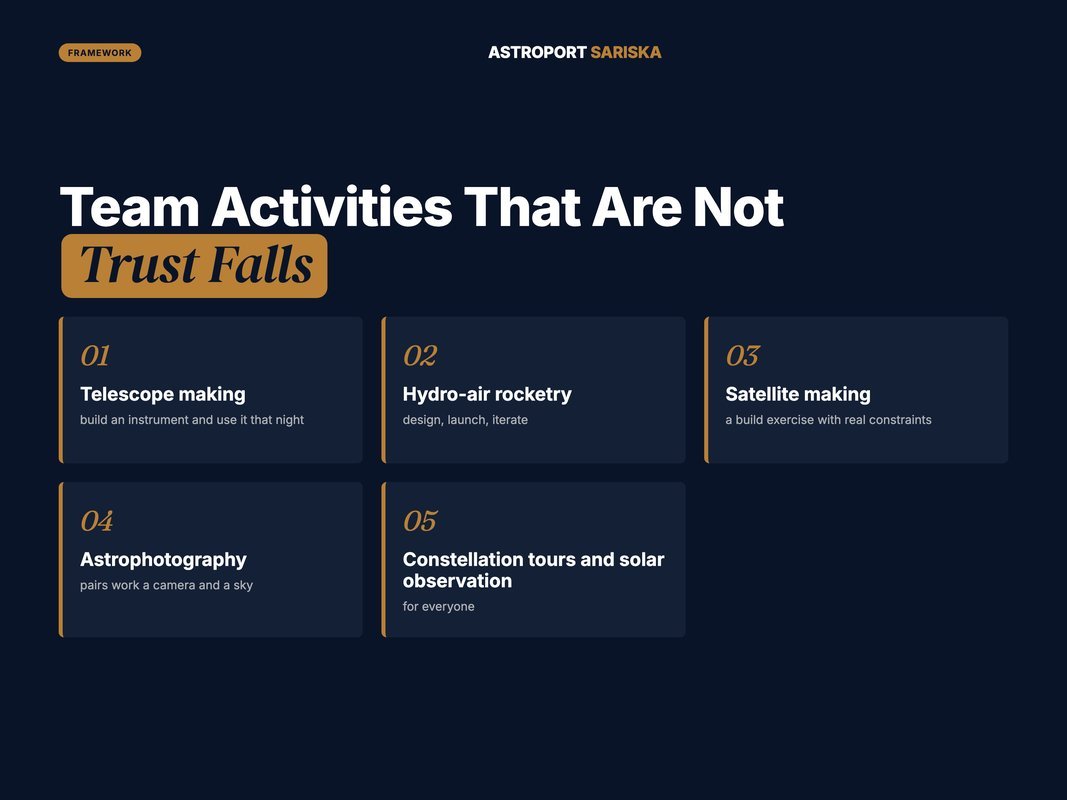
Team Activities That Are Not Trust Falls
This is where the offsite stops sounding like a holiday. The astronomy programme is really hands-on.
Telescope making. Teams build a working instrument and then use it that night. So there is an immediate, visible payoff.
Hydro-air rocketry. Groups design, launch and iterate. Because it fails visibly and cheaply, it is a good lesson in quick fixes.
Satellite making. A build exercise with real constraints. So it rewards planning over enthusiasm.
Astrophotography. Pairs work a camera and a sky together. Meanwhile, the results give people something to take home.
Constellation tours and solar observation. These run for everyone, including the reluctant.
(Source: Astroport Sariska, 2026 — Astroport Sariska)
Daytime adds the wilder options. For example, jeep safaris into Sariska, nature walks, birdwatching and farm tours.
So you get range without a workshop host reading from a workbook.
Each one has a clear end point. You build a thing, or you launch a thing.
That matters more than it sounds. Because the team sees the result, the day feels earned.
None of it needs prior skill. So the quiet ones do just as well.
Q: Which activity works best for a mixed team?
A: Telescope making, usually. Because the build is shared and the reward is the same night, it converts sceptics fastest. So it is a safe opener.
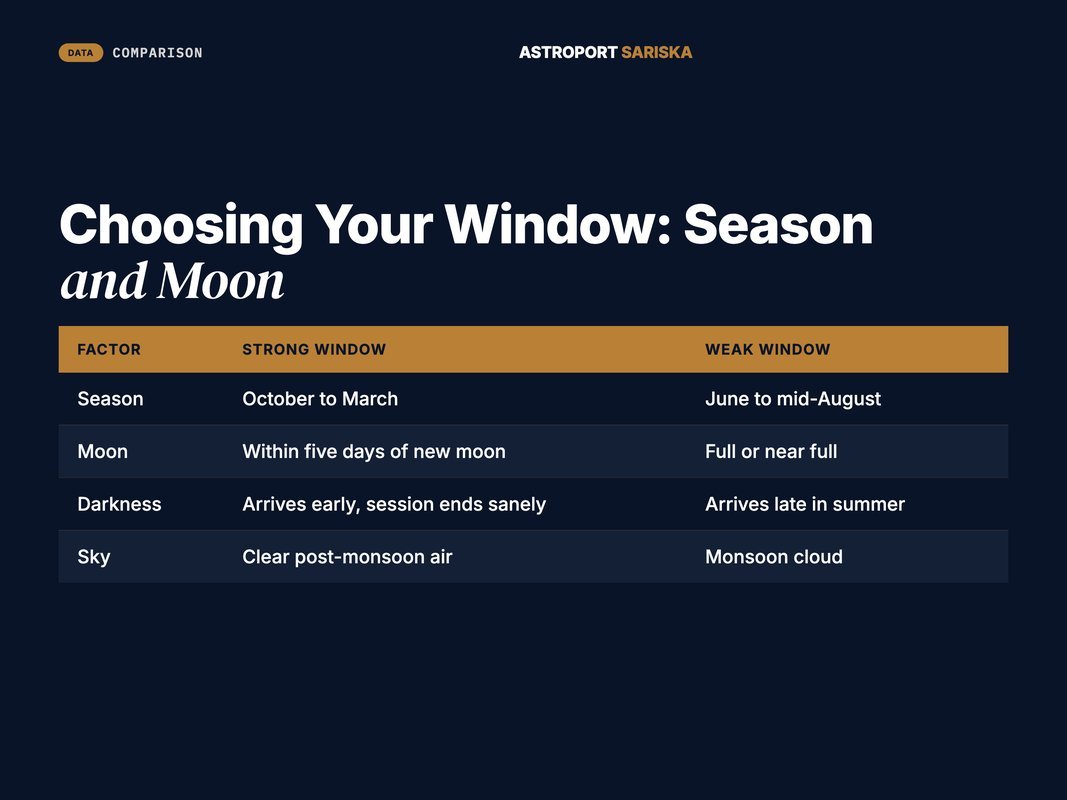
Choosing Your Window: Season and Moon
Two calendar choices decide how good the night is. Both are easy to get wrong.
Season first. October to March is the strong window in Rajasthan. Skies are clear after the monsoon, and darkness falls early.
That last point matters for offsites. Because the sky goes dark early in winter, your astronomy session finishes at a sane hour.
There is a hard constraint too. Astronomy activities at Astroport Sariska pause each year from 1 June to 15 August (Source: Astroport Sariska, 2026 — Our Facilities).
Moon second. A bright moon washes out faint objects entirely. So aim within about five days of the new moon.
Nobody in finance will think of that. So it is worth raising early, because it costs nothing to plan around.
Ask for two date options. Then check both against the moon.
It takes five minutes. Still, it can double what the team sees.
Q: What if our dates are fixed by the business calendar?
A: The night still works. Because a bright moon is itself a spectacular telescope target, the session adapts. So you lose the faint galaxies, not the experience.
The Planning Checklist
Run through this before you confirm anything.
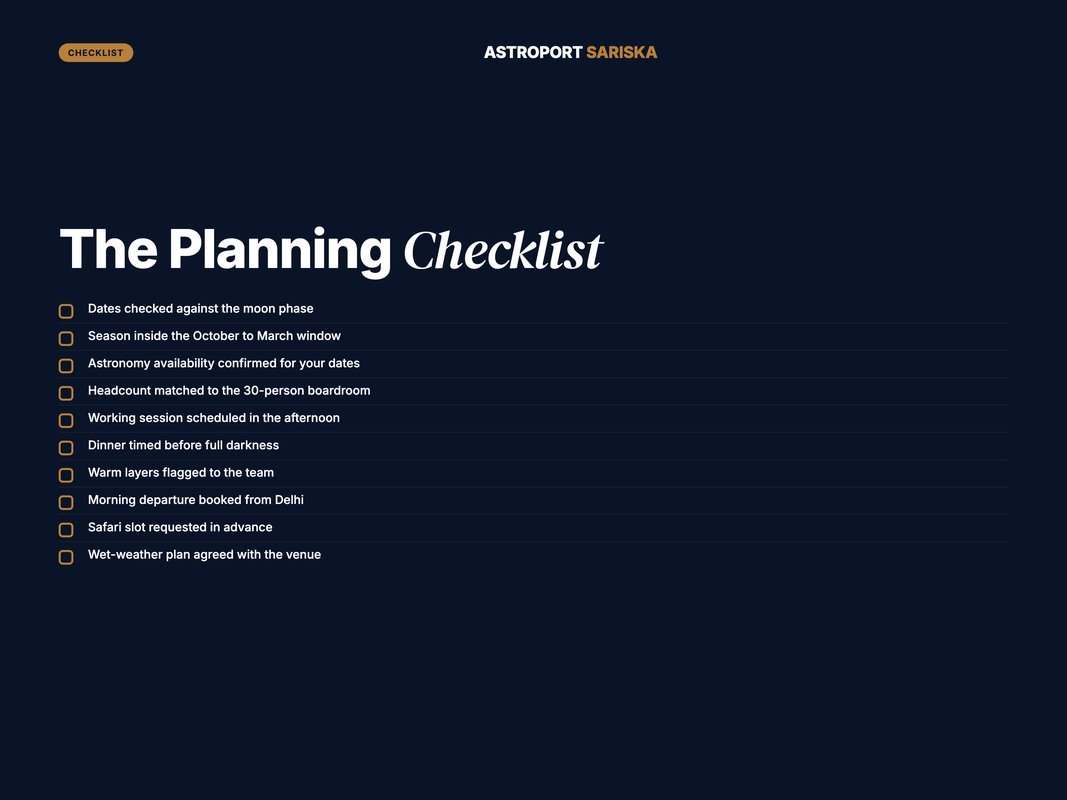
- Dates checked against the moon phase, ideally near new moon
- Season inside the October to March window
- Astronomy availability confirmed, given the June to mid-August pause
- Headcount matched to the 30-person boardroom capacity
- Working session scheduled in the afternoon, not the evening
- Dinner timed before full darkness, not after
- Warm layers flagged to the team, since desert nights get cold
- Travel booked for a morning departure from Delhi
- Safari slot requested in advance for the second morning
- A wet-weather plan agreed with the venue
Also, resist over-scheduling. Because the best part is the free hour after the telescopes, leave room for it.
Q: What do organisers most often forget?
A: Warm clothing. So people pack for Rajasthan daytime and freeze at 10 p.m. A single line in the pre-trip email fixes it.
What to Brief Your Team Before You Go
Expectations decide how the night lands. So set them early, in one short note.
Tell them it will be cold after dark. Then tell them to bring layers, not one jacket.
Warn them about phones. Because a bright screen ruins everyone’s night vision, the session works better with screens away.
Set the pace honestly. So explain that eyes need twenty to thirty minutes to adapt, and that the good part comes later (Source: NASA, 2026 — How to Find Good Places to Stargaze).
Also, say plainly that no astronomy knowledge is needed. Because that is the most common worry, naming it removes it.
Finally, do not oversell the sky. So describe it as really dark and leave the rest to the night itself.
Under-promise here. Then the night does the work for you.
Keep the note short. Four lines will do.
Q: Should we make the astronomy session optional?
A: Make attendance optional and the timing clear. Because nobody wants a mandatory hobby, framing it as an invitation works better. So in practice, almost everyone comes.
Why Astroport Sariska
The venue has to do two jobs at once. So it needs to run a proper working session by day and a genuine dark sky by night.
Astroport Sariska is India’s first astronomy resort. It sits at Tehla in the Aravalli hills, beside the Sariska Tiger Reserve in Alwar, Rajasthan.
The 1,200 square foot lounge and conference hall handles the working half. Meanwhile, resident astronomers and professional telescopes handle the evening.
Darkness is the real edge. Because the site sits far from any city dome, guests see thousands of stars on a clear night. Meanwhile, central Delhi offers a couple of dozen.
Days fill themselves. For example, there are jeep safaris into Sariska, nature walks, birdwatching, farm tours and a spa.
So no one is bored by noon. There is always a next thing.
Plus the food is grown on site. That alone gets people talking.
Ask for the farm tour. It takes an hour and lands well with most groups.
There is an ESG line here too, if your reporting needs one. The property runs fully on solar power. It is a no-plastic zone, harvests rainwater, and has planted thousands of trees.
Food comes largely from the on-site farm, including its own poultry and dairy. So the farm-to-table claim is literal rather than for show.
For a team that has run out of venues, it reads as really different. Plan your offsite around a new-moon week.
Conclusion
Offsites fail when the setting looks like work. So the fix is a place your team cannot pattern-match.
A dark sky does that cheaply and without a workshop host. Because nobody arrives as the expert, the usual hierarchy loosens on its own.
The practical side holds up too. There is a 1,200 square foot conference hall for the working session, cottages for the group, and safaris for the morning.
Two calendar decisions carry the most weight. Pick a month between October and March, then aim close to a new moon.
Do that, and the evening runs itself. Plan your stargazing offsite and give your team something they will actually talk about.
FAQ
Q: How far is a stargazing offsite venue from Delhi?
A: Astroport Sariska sits in the Aravalli hills near Alwar, roughly four to five hours from Delhi NCR by road. That makes it a comfortable two-day, one-night offsite. Teams usually leave after breakfast and are settled well before dark.
Q: What size team does a stargazing offsite suit?
A: Small to mid-sized groups work best. The conference hall at Astroport Sariska is 1,200 square feet. It seats up to 30 in boardroom format. Without tables, it takes up to 60 classroom style. Larger groups usually split across sessions.
Q: What team activities are available besides stargazing?
A: Telescope making, hydro-air rocketry, satellite making and astrophotography all run as group activities. Days can also include jeep safaris into Sariska, farm tours and nature walks. Indoor and outdoor games are available on site.
Q: What is the best time of year for a corporate offsite near Delhi?
A: October to March is the strongest window. Skies are clear after the monsoon, evenings are comfortable and darkness arrives early. Astronomy activities pause from 1 June to 15 August each year.
Q: Does a stargazing offsite work for people with no interest in astronomy?
A: Usually better than expected. The appeal is shared novelty rather than technical knowledge, and nobody needs preparation. Teams who assumed they were indifferent tend to be the ones still outside at midnight.
Q: What happens to the programme if it is cloudy?
A: The astronomy content shifts rather than disappears. Telescope-making workshops, rocketry and talks all run indoors or under cover. Resident astronomers also watch for gaps in cloud through the evening.
Q: Can the venue handle working sessions as well as activities?
A: Yes. There is a dedicated 1,200 square foot lounge and conference hall for meetings and presentations. Most teams run their working sessions during the day and keep the evening for the sky.